
It has become a common recommendation in the greater Amel community to install “zerk fittings” on the furling gearboxes on an Amel, then use these to pump the boxes full of grease. It is certainly easy, and convenient. However, I believe this to be a bad idea for several reasons. I have what I believe to be good engineering logic to support this opinion, and it is not just my opinion, there are a list of technical references at the end that you might want to review. It is what I do, and will continue to do on our Amel.
Read on, and if you still want to pump grease into these gearboxes, at least you can do so with your eyes open to the issues.
From the Factory
All of these worm gear boxes come from the factory filled with heavy gear oil, not grease. In the case of the smaller Leroy-Somer boxes on the mast, it appears to be an SAE120 (ISO320) oil, in the case of the genoa furler I’d guess a SAE 140 (ISO460) viscosity. I have opened an Amel genoa furler and a Leroy-Somer gearbox both fresh from the factory, so I KNOW they come filled with lubricating oil. Especially in the case of the genoa furler—which was designed by Amel—are you sure you are smarter than the Captain?
Grease Is…
The original ISO460 oil used in the genoa furler is so thick, and flows so slowly, a casual observer might easily consider it a “grease,” especially if it is cold, but it is quite different. So let’s start with what grease is.
Normal grease is petroleum oil (or sometimes a synthetic one) with a thickening agent added to it. The different kinds of grease come by selecting different kinds of oils and thickeners. (Silicone “grease” can be something very different, but that should not be used here.) Grease is nothing other than a way to deliver lubricating oil to where it is needed.
A key message here is that grease is NOT forever. The oil component has a finite, albeit slow, rate of evaporation. Over time, the oil evaporates, leaving the thickening agents behind. Contaminating dirt and wear products accumulate and also make the grease more abrasive. The grease gets thicker, less mobile, and less lubricating over time.
If you have ever disassembled a sheet winch that was well past its service date, you know you find a crusty, messy solid left behind where grease used to be. This is the thickening agent left behind after the oil has evaporated, further contaminated with salt and dirt. Removing old grease is a key part of the maintenance of any grease lubricated piece of equipment.
Another issue is if you start with a factory original gearbox, you are taking a risk with just pumping it full of grease. Not all oils are compatible with all greases. If you insist on using grease you should remove all the original oil at the start. Then there is another problem. Not all greases are compatible either. Most commonly, a grease with a clay-based thickener and one thickened with Li-soap do not play together well at all when mixed. Do you KNOW that kind of lubricant is in the box? Are you sure?
Out With the Old
Anytime you service a piece of equipment that is lubricated by grease it is vital that you remove the old grease and replace it with fresh. This is especially important if the equipment is subject to contamination with things like… salt water. This is exactly the same logic that has you change the oil in your engine instead of simply topping it up.
Zerk fittings are well and properly used in small spaces. Places like unsealed bearing housings, ball joints, chassis hinges, and the like. In these applications the new grease pumped in can easily flush out old grease and contaminants out from all of the moving parts.
In all of the Amel furling gear boxes anything approaching complete flushing out of old grease and contaminants is impossible. As an example, in the genoa furler there are highly loaded bearings at the ends of the worm gear shaft that will NEVER be lubricated by a zerk fitting on the housing. You would never dream (I hope) of servicing a sheet winch without cleaning the old grease out, why should your furler be different?
As the Worm Turns–Why are these different?
Worm gear drives (as these gear boxes are) require special lubrication. Unlike normal helical gears and bearings, the metal surfaces of the worm and the worm wheel continuously SLIDE past each other under very high load. This sliding motion rapidly wipes grease off the contact surfaces, and leaves them poorly lubricated—at best. It is important that worms and worm gears have a steady supply of appropriate oil, or they will wear rapidly.

The other place on the boat that uses a worm drive like this is the anchor windlass–which is also oil lubricated. There are a few others I can think of, (the diaphragm bilge pump, for example) but they are all very small, and have a worm wheel made of plastic, and are mostly self lubricating.
As is very typical for a worm drive, the worm in all of these gearboxes is steel and the “worm wheel” is brass or bronze. On our boats we can “get away with” less that optimal lubrication—for a while—because the bronze does absorb some oil and it is a LITTLE self lubricating. Our furling gearboxes also accumulate very few hours of operation. So we can “get away with” rates of wear that would be totally unacceptable on continuously operating equipment, but why should we tolerate that?
A properly designed and lubricated worm drive should run for thousands of hours of continuous operation. The expected lifespan of a worm drive gearbox in continous operation is about 3 years, or 20,000 hours. In the kind of application we have on our furlers, this would be essentially forever. Yet, on grease lubricated gearboxes I am seeing very significant wear of these bronze gears in just a few years of normal sailing use.
Some low speed, low load worms, such as are used in steering systems, can be successfully lubricated with grease, but the worm in these furlers is a high speed shaft, running at the same speed as the drive motor.
Keeping Water Out
One of the reasons people give for switching to grease from the original oil is that when the seal fails, oil leaks out on deck and makes a mess. I would submit the correct response to this issue is to fix the seal. If the seal can not keep the oil IN, it is surely is not keeping water OUT.
Speaking of seals, if you are not disassembling these units periodically and looking for water intrusion past seals that have failed, you are going to have the mechanical part catastrophically fail—eventually. The seals all have a finite lifespan. Especially the upper seals on these boxes run “dry” and are subject to abrasion from dirt, and salt. And to make life extra difficult, some of them are exposed to the sun. They are not forever. If you never look inside, how will you know that you do not have salt water in there destroying things?
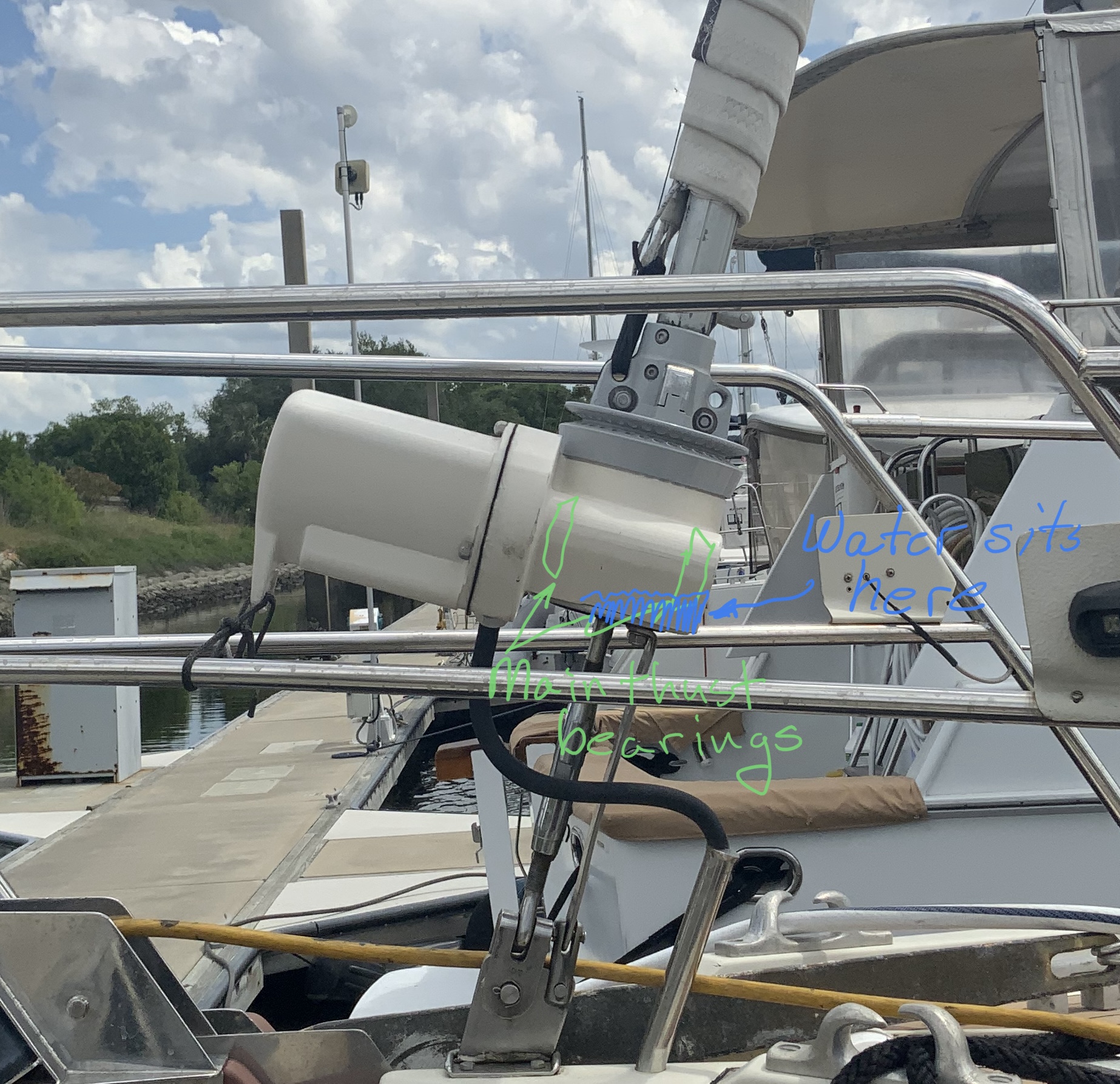
Here is how the genoa furler sits on the boat. I have marked where the main thrust bearings are inside the housing. These thrust bearings take the full load of furling the genoa, so they are critical and highly stressed parts. I have also marked where any water that leaks in past the seals would accumulate. These carbon steel bearings would have a VERY short life immersed in salt water. Replacing the lower one is a job for a machine shop. Its race is pressed into the aluminum housing and swapping it out would be virtually impossible with normal onboard maintenance tools.
In Short
Taking a long story, and making it as short as possible: If you are opening up the gearbox on a regular basis to inspect or replace the seals, (as you should) it is really easy to change the lubricating oil at the same time.
I know that going up on deck and pumping a bit of grease into the gearbox is easy. I know it makes you feel like you have done something good. It might be better than nothing. But I do not believe it is taking the best possible care of these pieces of irreplaceable equipment.
Recommendations
For filling these gearboxes, one oil that is widely available is from SuperLube. They make a synthetic gear oil that is available in an ISO-460 viscosity, equivalent to an SAE140 oil. (Superlube 54401). Also Elba Lubrication GH-1 460, or Mobil 101923 ISO460, or Lubriplate L0981-054. Anyone of these will do the job for you.
Because we accumulate so few hours on these gear boxes compared to industrial equipment, the oil change interval is driven by things other than the failure of the oil. I inspect these gear boxes every two to three years to see if the seals are in good shape. Generally, the seals are so inexpensive compared to the machinery, I just change them. Since the gearbox needs to be disassembled to replace the seals, you might as well put new oil in at that point.
How much oil? The right answer is not full, but rather half way up over the worm screw. This allows the oil to splash around inside the housing from the rapid rotation of the screw, lubricating the other parts that might not be immersed, most notably the top seal.
References:
- Nor Corporation. (May 2001) “Lubrication of Worm Gears” MachineryLubrication.com. Retrieved 18 April 2023
- Fitch, Bennett. (Feb 2016). “The Right Way to Lubricate Worm Gears”. MachineryLubrication.com. Retrieved 19 April 2023
- Whitby, R. David. (May 2013). “Lubrication of Worm Gears” Tribology & Lubrication Technology. Retrieved 19 April 2023
- Black, Aaron. (Sept 2009) “Worm Gears Explained”. MachineryLubrication.com. Retrieved 18 April 2023
- Fitch, Jim (August, 2011). “Grease Dry-out: Causes, Effects and Remedies“. MachineryLubrication.com. Retrieved 18 April 2023
 fetchinketch