We are spending the middle of winter here in Brunswick GA. It’s a place we have spent some time before, and we will probably be here for about another 5 or 6 weeks until we get all my medical clearances to resume our sailing. Hopefully, I can catch up on some project notes and points of ineterest here!
In the meantime, I have been working on some boat projects and getting some maintenance and repairs to the good ship Harmonie. Today’s project was to try to repair the navigation lights at the top of the main mast. They had become a bit unreliable, not something you want for critical collision avoidance equipment! Unfortunately, repair doesn’t seem likely, so we will replace it, and back up the mast when the new fixture comes in.
We haven’t yet finalized our cruising plans yet for the coming months, but wherever we go, it will be fun!
In the meantime, I have a project waiting for me down in Martinique. I’ll be traveling down there to help a fellow Amel owner with a major engine project the last week in January.
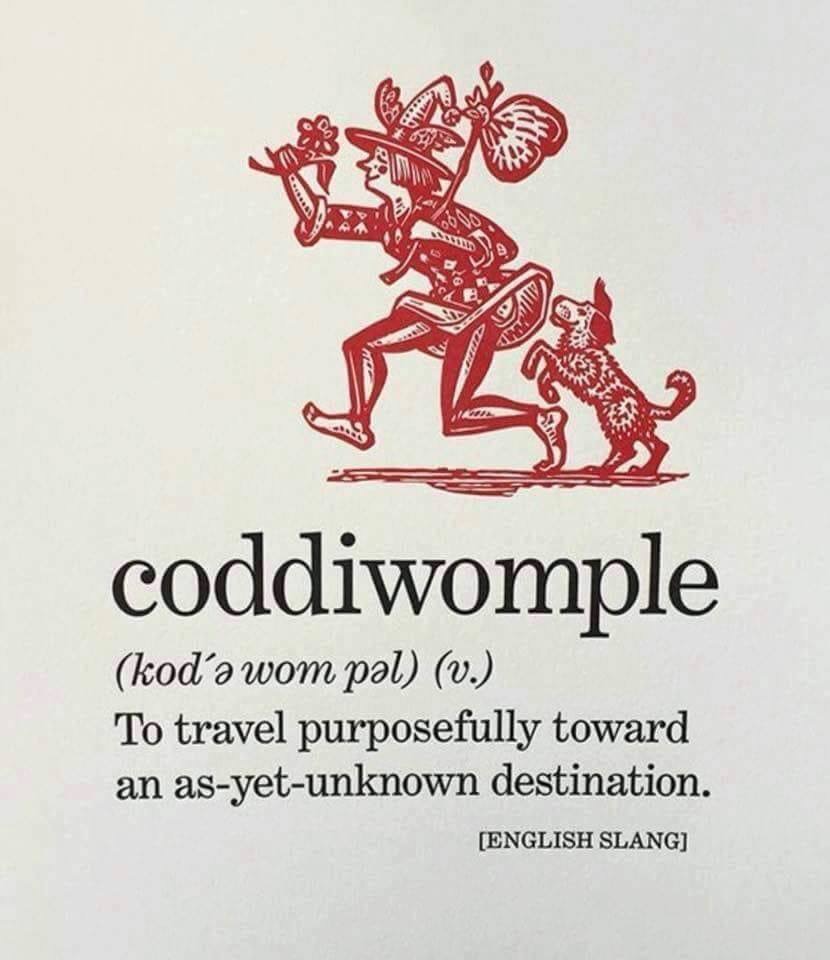
And just for fun, here is your vocabulary word for the day. One of those fun words that aren’t really used much these days, more’s the pity! It would make a great boat name!
We pulled out of Wrightsville Beach inlet yesterday just after sun rise, and had a truly glorious day of sailing. as soon as we cleared the inlet we had sails up in the forecast northwest wind, and started making great time. Most of the day making 8 and 9 knots.
We had a 47 foot catamaran that was just in front of us out of the inlet, and by the time we rounded Cape Fear, they were almost three miles back in our wake. The sailing performance of the Amel never ceases to surprise me, in the best way.
Over night, the wind faded, again as forecast, and we fired up the Volvo to keep moving along.
Not all the boats around us were so lucky. 250 miles off shore a catamaran was taking on water, and called for a Coast Guard air evacuation. That’s past the maximum reach of the USCG Dolphin helicopters, so I am guessing they had a Jayhawk nearby with an 800 mile round trip range. Everybody was taken off and returned to land safely. This morning a sailboat entering Charleston Harbor ended up on the rock jetty at the entrance. We have no information about how that came to happen in totally benign conditions.
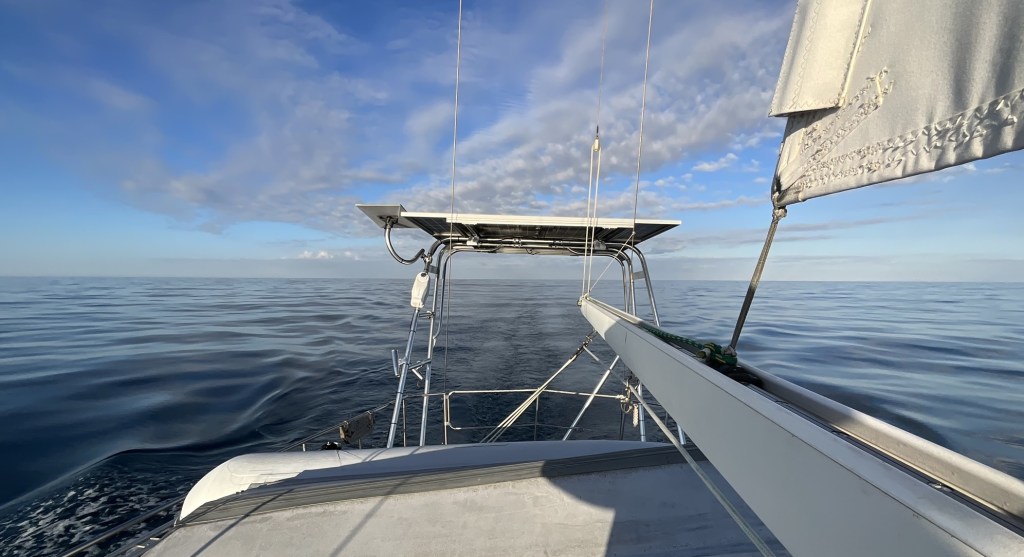
Harmonie motoring in an oil-calm sea. The new solar panels and Starlink antenna mount are visible on the arch. New lights, and a full rewire complete the upgrade.
We are now about 50 miles from the sea buoy off of Brunswick, and should be arriving at the marina shortly after midnight.
The offshore weather forecast for yesterday had southerly winds at 10 knots. Rather than deal with that, we decided to break off and head into Wrightsville Beach. A good decision it turn out to be, because that 10 knot south wind actually turned out to be more like 25 knots. Even better that we had friends already in the anchorage.
Sunrise at Wrightsville Beach
A good dinner was had ashore with good company. Rising with the sun this morning, we’re underway again with a wind from the northwest at 15- 18 knots. We’re making excellent time under sail, and all is good! We should be in Brunswick tomorrow evening.
If the leaves on trees around Annapolis are red and gold instead of green, and we wake in the morning huddled under a down comforter, it’s time to head south.
Harmonie has been at Jabin’s Yacht Yard for two months. A couple big projects were completed, and a slew of minor ones.
A Tangled Web
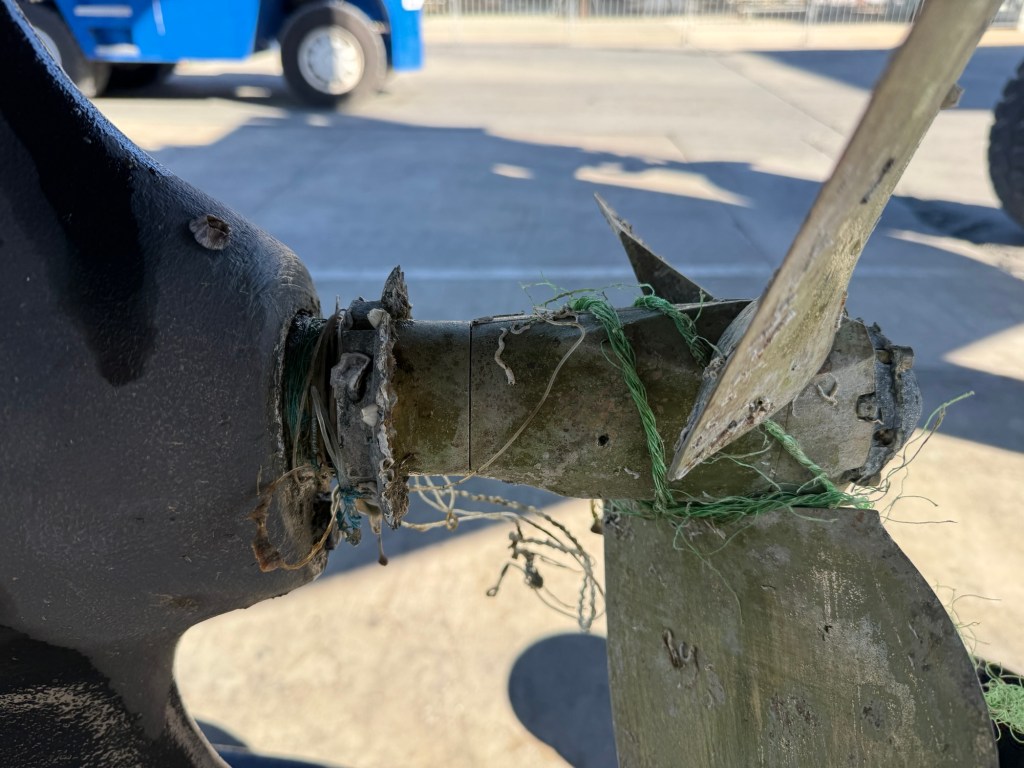
When we arrived in the Chesapeake we had the first hints of a problem with our C-drive. A trace of water was showing up in the oil. This was definitely not normal, and surprising since the seals had all been replaced a few months before. We arranged an overnight haul to do the repair.
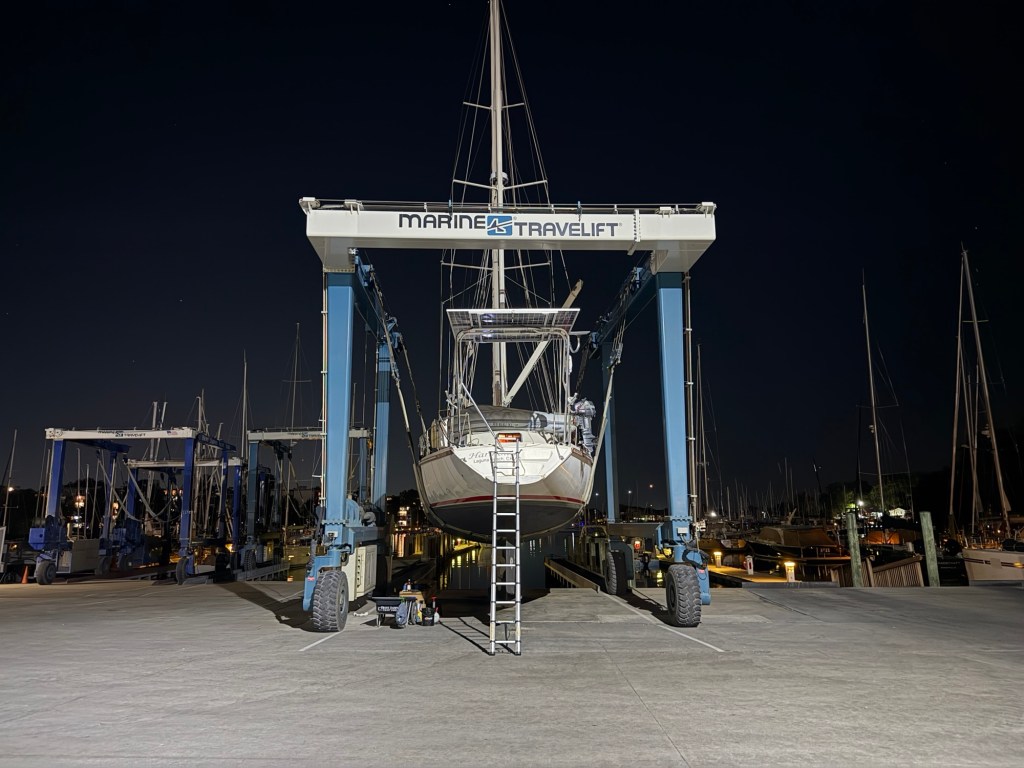
A first for us, sleeping on the boat while it was hanging in the travellift.
As soon as the boat came out of the water, the problem was obvious. We had an assortment of fishing lines and ropes wrapped around the shaft, and they had damaged the seals.
It took about 4 hours to drain the oil, pull the prop, take out the old seals and get a fresh set installed and get everything put back to seaworthy condition.
Keeping Things Cool
Second project was a full rebuild of our Volvo’s cooling system. It had been showing signs of unstable temperatures, and a loss of circulating coolant. Pulling and pressure testing the heat exchanger, replacing seals, flushing out old coolant, and reassembly, and now she’s running like new. The operating temperature is spot on design specification. Not bad for an engine with close to 11,000 hours.
Let the Sun Shine
Last project was a repair and upgrade to our solar power system. Our old panels had a nameplate capacity of 630 Watts, the new system upgrades the mounting system and wiring, and gives us 1180 Watts. Hopefully further reducing our generator run time.
The Migration Starts
We dropped lines this morning, filled the diesel tank, and headed down the bay. Underway for a couple hours now, we have yet to see any sailable wind. The surface of the water is glassy, with no trace of the smallest ripples. The forecast for the trip down to Brunswick, Georgia is good. Hopefully we’ll be getting some wind in a favorable direction in a few hours, and be there in about four days
The next leg of our trip to Annapolis was a delightful venture. Sailing was delightful, with very modest winds the whole way, almost completely from aft of the beam. We had the chance to do some fishing, and catching.
Some of the highlights of the trip were the spectacular weather, seeing more whales up close as we rounded the end of Cape Cod, numerous pods of dolphins scattered all along the route, including at the anchorage where we ended up, and the chance to put some tilefish in the freezer.
Seventeen pounds of Golden Tilefish.
We had one strange fish story while trolling lures past the Hudson Canyon. We had a bite on one of the lines that ran off a couple dozen yards of line, and then dropped off. Over the next ten minutes, the lure was repeatedly attacked and harassed by a large sailfish. Sometimes he’d just hit it with his bill, sometimes he’d grab it and run off while always managing to avoid the hook. Not the worst outcome for us, as sailfish are not considered the best eating.
We ended anchored behind the breakwater in Lewes, Delaware. We spent a quiet night, and will shortly be riding the flood tide up the Delaware toward the C&D Canal. It is likely we will miss the afternoon tide through the canal, so we will likely anchor nearby until morning for our passage into the Chesapeake and down toward Annapolis.
Maybe we should just stop making plans! Even when things seem simple and straightforward, something changes outside of our control.
We had planned to be spending a couple weeks in Maine, but while we were in Gloucester we were contacted by friends and fellow Amel owners who had a change in plans and needed help getting their boat (based in New Hampshire) south to Annapolis. The chance to help friends and add to the cruising kitty at the same time made our choice easy. So we are going to take Harmonie to Annapolis, ASAP, then fly up to New Hampshire, and then drive someone else’s boat right back down to Annapolis. We made the short jump the other day back to Provincetown, and anchored there while we waited for the weather to cooperate. Tomorrow morning we weigh anchor and head south with what looks to be a very good weather window.
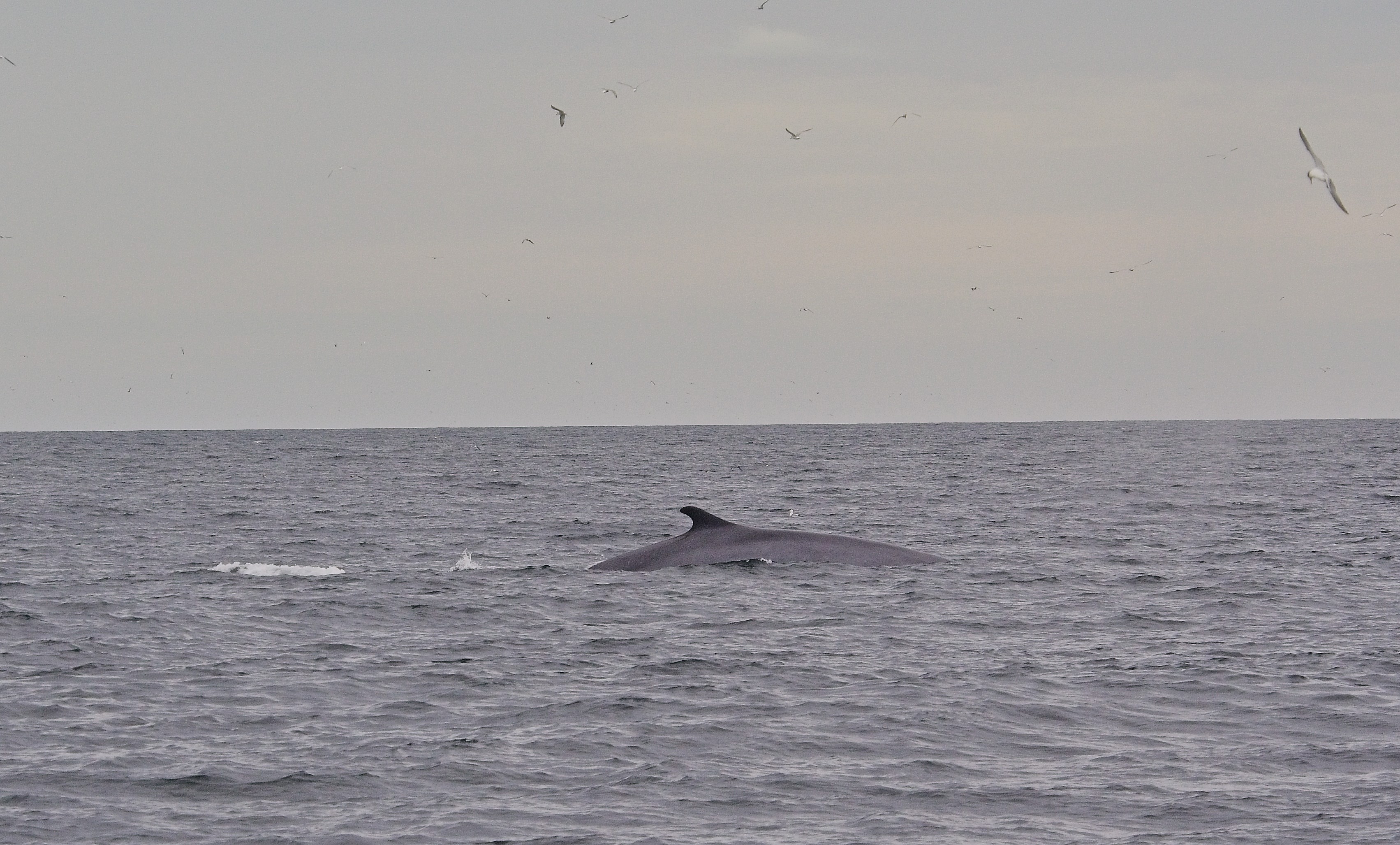
Here is a chance to catch up on some of the things we have done and seen. While out fishing on Stellwagen Bank, just north of Cape Cod, we didn’t have any luck with our primary target, bluefin tuna, but we were treated to a constant parade of whales.
A fin whale (I think) comes up for a breath.
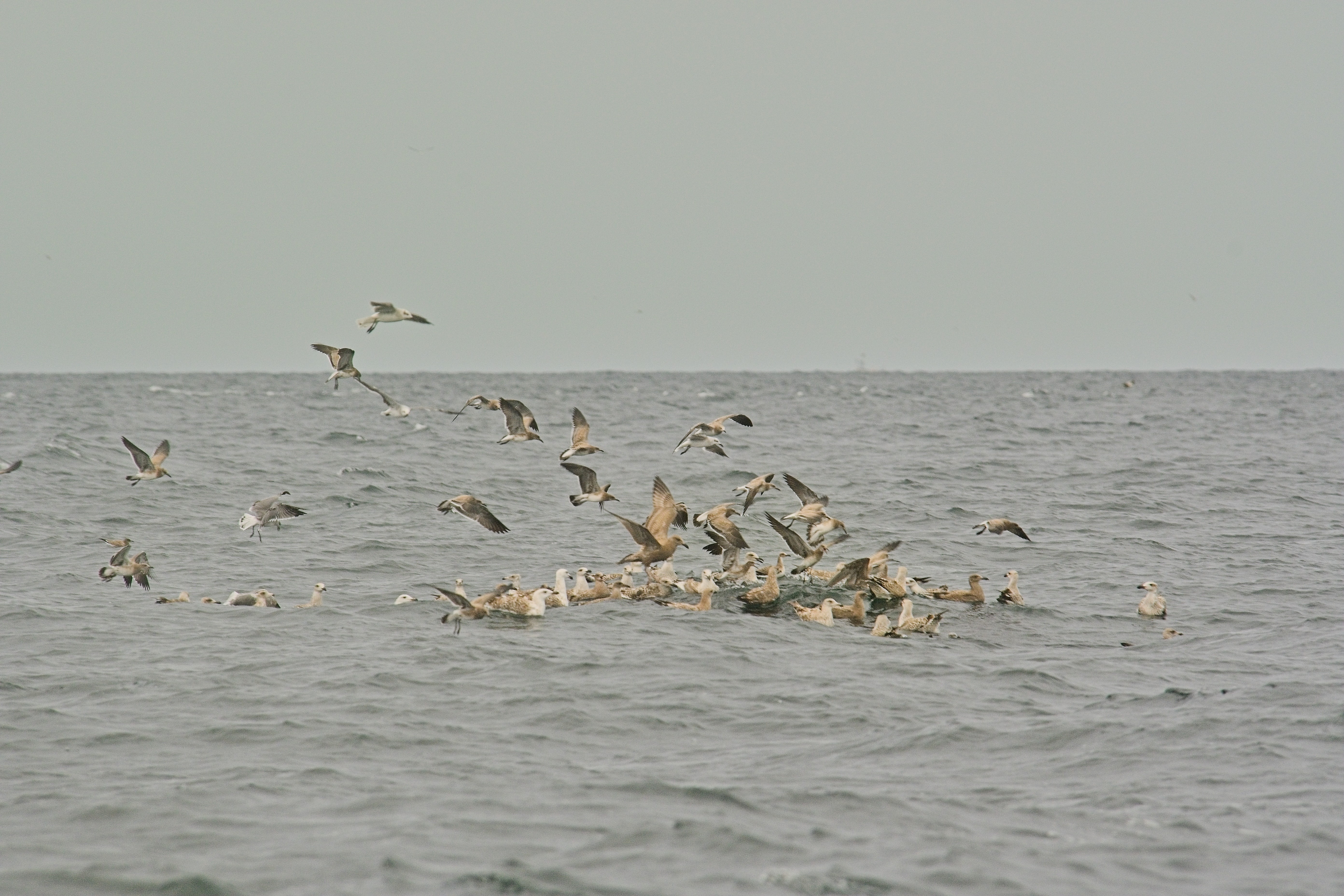
How do you figure out where to look for whales? It’s actually pretty simple: You follow the birds. They have magic powers. A tightly bundled group of birds know that a whale is chasing food up from the deep to the surface where they can help themselves the their share.
One the way south from Gloucester to Provincetown we dragged lures behind the boat to see if we could get a tuna. No luck (again!) for the tuna, but we did hook a porbeagle, also known as a mackerel shark. They are supposed to be one of the best eating of all the sharks, and are highly valued commercially in places where they are allowed to be caught. Local regulations here have a minimum size of 57″, and the one we brought to the side of the boat was less than forty. We released him to grow some more and make more little sharks before we could get a photo.
Sometimes we do not have to go looking for the local wildlife, it comes to us. We were sitting at anchor in Provencetown harbor. Karen was siting on the back of the boat chatting on the phone, suddenly, she says, “I’ll call you right back!”, and yells down to me to get up on deck right away.
There is an Ocean sunfish (scientific name: Mola mola) right behind the boat, swimming lazily at the surface on its side as they sometimes do. It seems to be giving us a careful once over.
This is a large fish by most measures, about 4 feet across, and probably weighing a couple hundred pounds, but it is small as these creatures go. They are the largest bony fish in the ocean and can weigh over a ton. Comically shaped, they have been described as a fish designed by Salvador Dali on acid. Imagine a huge fish head with no body, and no tail and you’ll have a good idea.
A young Mola mola visits Harmonie in Provencetown Harbor
During the summer tourist season, historic, replica, and modern schooners take the visitors out in Gloucester harbor for a taste of salt water.
Chicken Sailors?
As we were prepping to leave Provincetown, we were chatting with the marina’s launch driver. He said that the wave forecast from the offshore hurricane had basically ended their season, everybody had cancelled their visits for the coming weekend. I was incredulous.
The weather forecast was beautiful! Yes, there was going to be a large swell running, but not at all an issue if you stayed out of the surf. Sure enough, when we got out in to the open ocean, the waves were high, but they were so far apart that the boat never even rolled, the boat just went up… and down… I am all for being careful, but anybody cancelled plans to take their private boat from Boston out to P-town missed a great weekend on the water.
Stopping On the Way
Yesterday we left Provincetown and headed north, with a stop on the Stillwagon Bank to see if we could hook a Bluefin tuna. The way you do this is you catch a bunch of mackerel, put one on a hook out behind the boat, and then cut the rest of them up in pieces and slowly dribble those pieces into the water to attract the tuna. Catching mackerel is easy. You can fill a bucket with them in 20 minutes. Catching the tuna… not so much.
A few hours of trying left us with a bloody mess from chopping up chum, but no tuna. As the wind was picking up, we cleaned up and put out sails, setting a course for Gloucester. In the category of hope of expectations, we dragged a large diving plug behind the boat, still thinking a tuna might be on the menu. About half way to Gloucester, we had a tuna grab the lure and run off a LOT of line very quickly. Unfortunately, he never really got hooked, so we were still tuna-less.
We visited Gloucester a few years ago. It has a nice harbor, and is both a pretty tourist destination and a real working fishing town. We hope to explore for a day or two and then jump north again.
The weather has had us running faster than we can update our blog, but not to worry, we are in good places.
On leaving Cuttyhunk, we came up through the Cape Cod Canal, and tucked into Barnstable Harbor for a couple days. We’ll have more on that later, but it for now it is enough to say it is a great place to hide for everything–except a northeast blow. When a northeast wind up to 30 knots was forecast, we ran north to Provincetown, which has excellent protection from the North and Northeast. We grabbed a mooring here for a few days, which also gives us shelter from the local effects of Hurricane Erin.
But we have a day or two until Erin passes by, so tomorrow we are going to go out whale watching and tuna fishing.
One of the downsides of today’s media is the need to attract attention to generate revenue. The way to generate attention is with “clickbait” headlines. This is especially true when talking about a topic as mundane as the weather. the headlines make everything appear a lot worse than it will be. We watch the official forecasts closely, and avoid social media for our weather information. We expect to see winds of up to 30 knots or so on Thursday night and Friday morning. Not weather we want to be sailing in, but not really an issue in a protected harbor we secured.
Hopefully, tomorrow we will have whales and other sea stories to tell!
One of those New England names that are almost surely from one or another of the pre-Columbian tribal languages, but whose exact origin is murky at best. It is a small island, but one that lives large in the history of recreational saltwater fishing for the exceptional striped bass fishery in the local area. It is a small village with a summer population of a few hundred, and a winter population of less than a dozen, which I guess makes it a contender for the ultimate summer town.
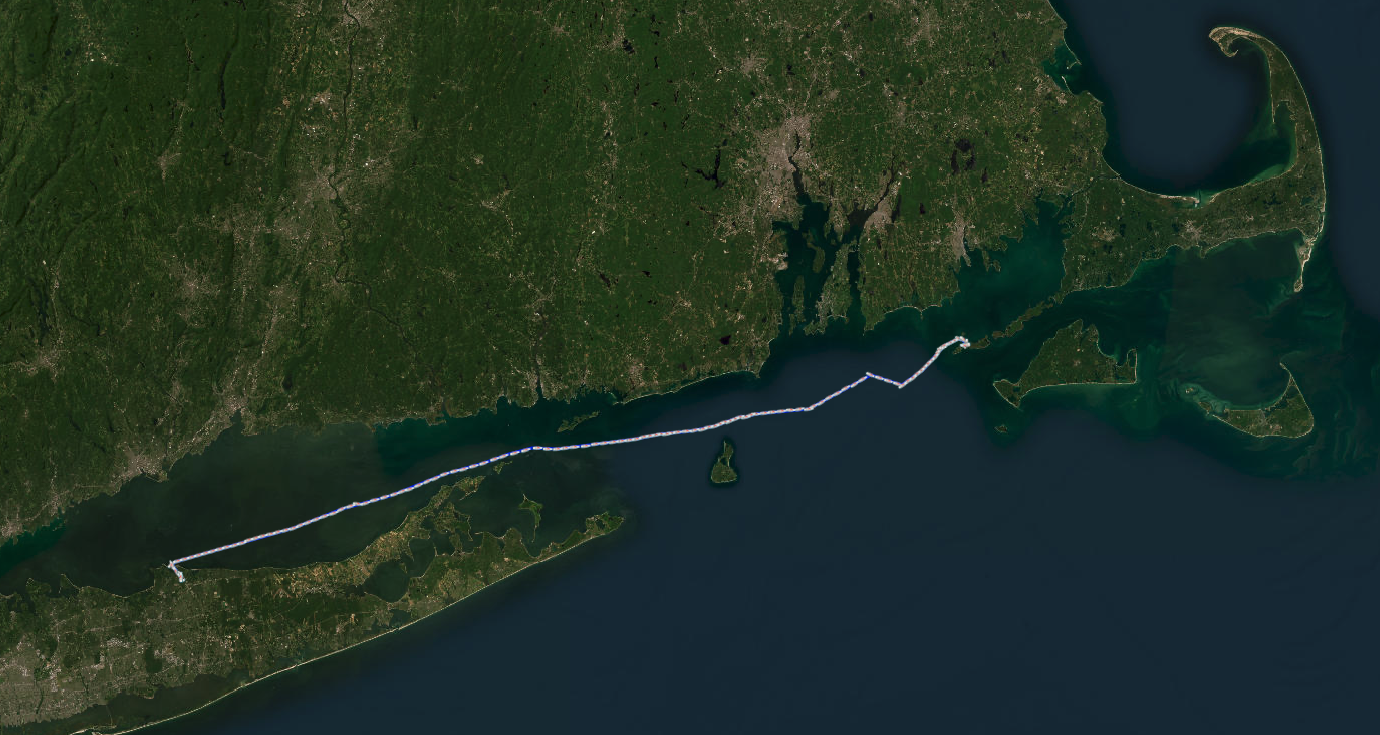
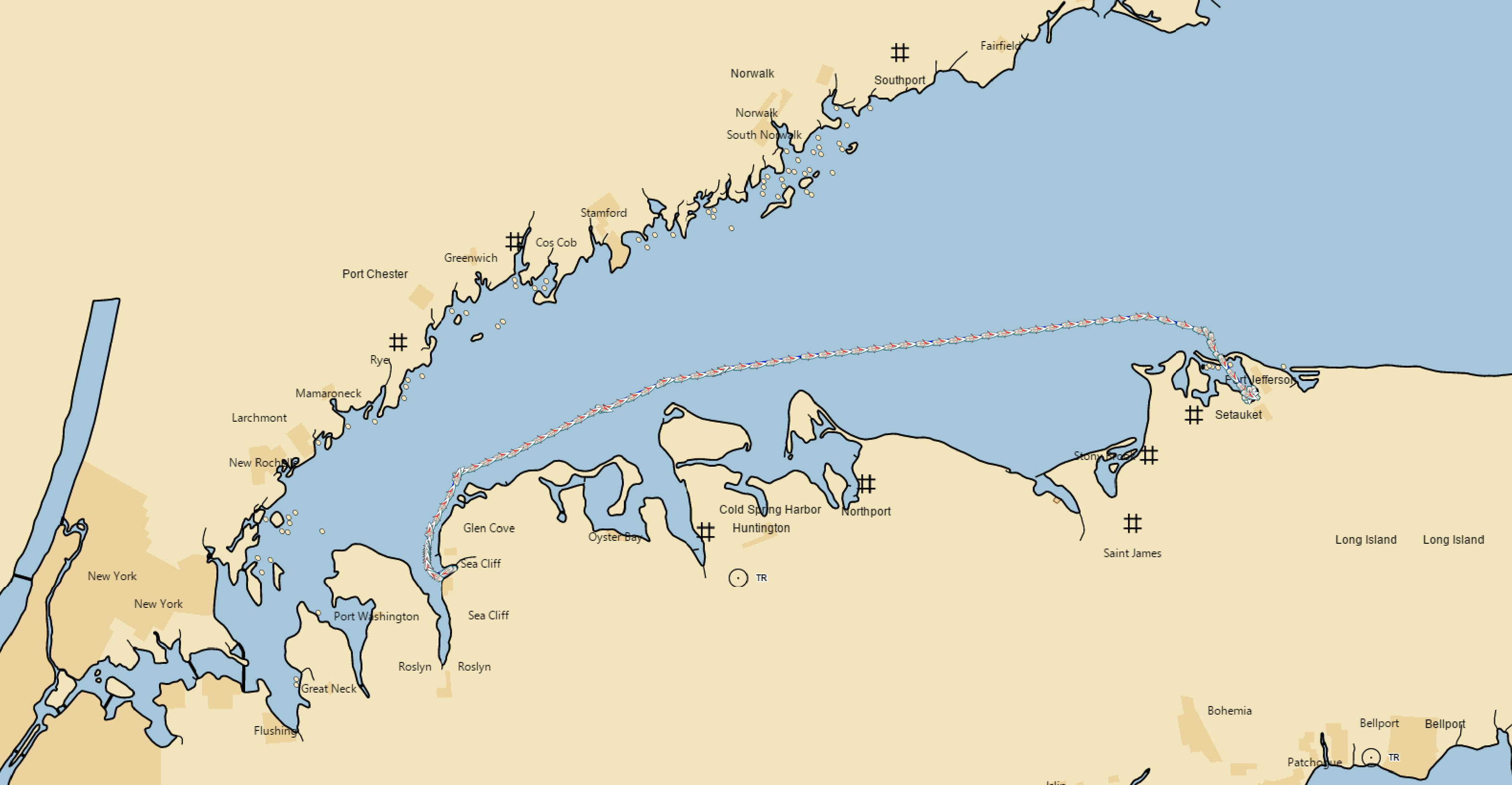
Our passage from Port Jefferson to Cuttyhunk Island.
Arriving at Cuttyhunk
We had an easy overnight sail up from Long Island arriving at Cuttyhunk Harbor just after daybreak in light fog where we were greeted by an unusual sight. At anchor in the outer harbor was the 108 foot topsail schooner Shenandoah. Built in 1964 she serves as a cruise and training ship traveling the local islands. She has the distinction of being the only vessel of her type in the world navigating without any form of mechanical propulsion. She goes by the wind, or doesn’t go. Now she does cheat a bit… Look closely at the photo and you will see a small boat hanging on the stern with a greatly oversized propeller. Something I am sure is used as a tug when she needs to get into or out of tight spots.
The “pure” sailing vessel Shenandoah
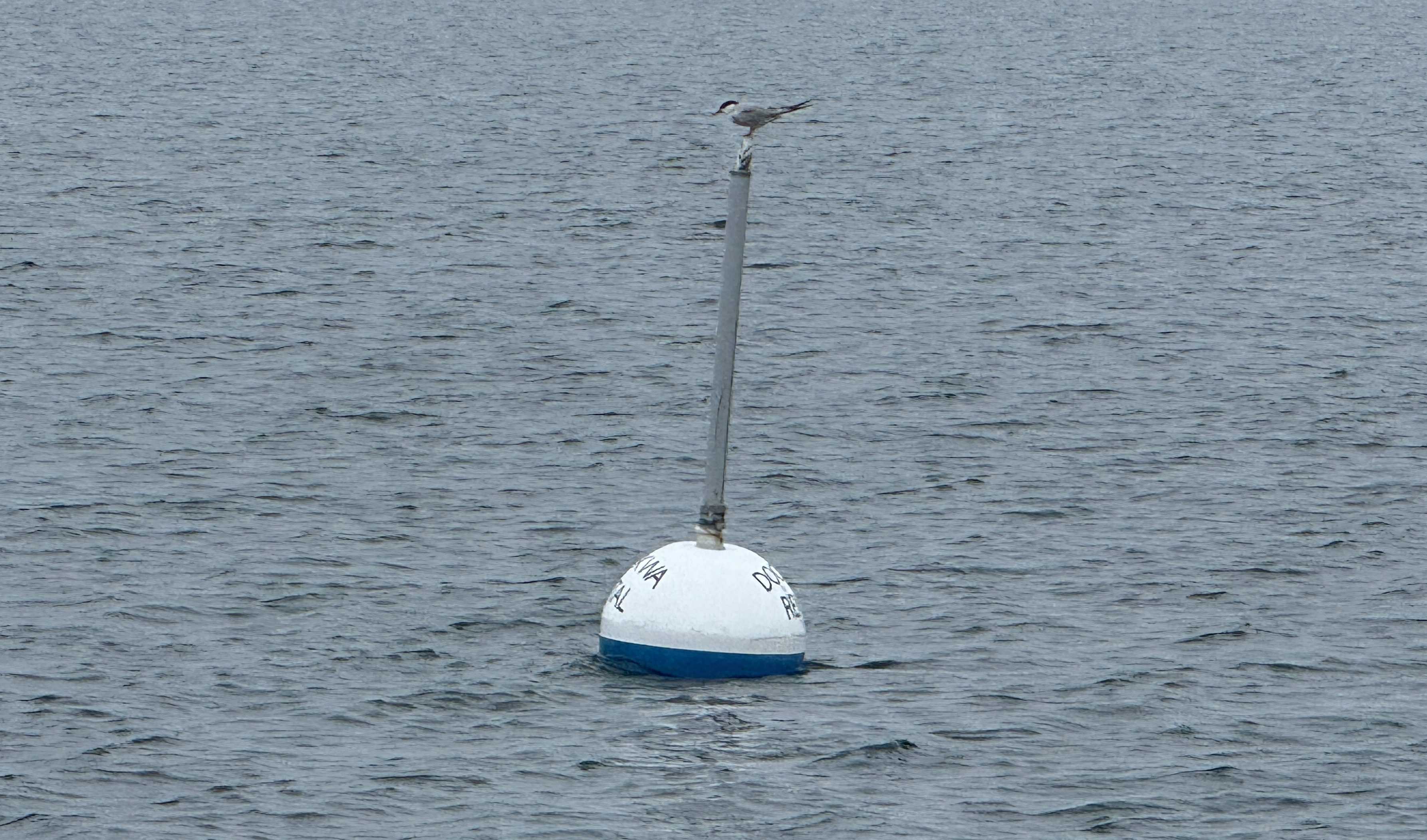
The moorings in the outer harbor here at Cuttyhunk are an unusual design that are the easiest to use we have come across in our travels. The anchor line passes through the center of the float and ends in a loop that is supported on a tube about 4 feet out of the water. Easy to reach from the deck, no contortions or boat hook needed.
A Cuttyhunk Harbor mooring ball.
Mooring Field Follies
After an overnight sail, we settled in for a bit of a morning nap, arising around lunchtime, we were treated to the entertainment of other boat’s arrivals.
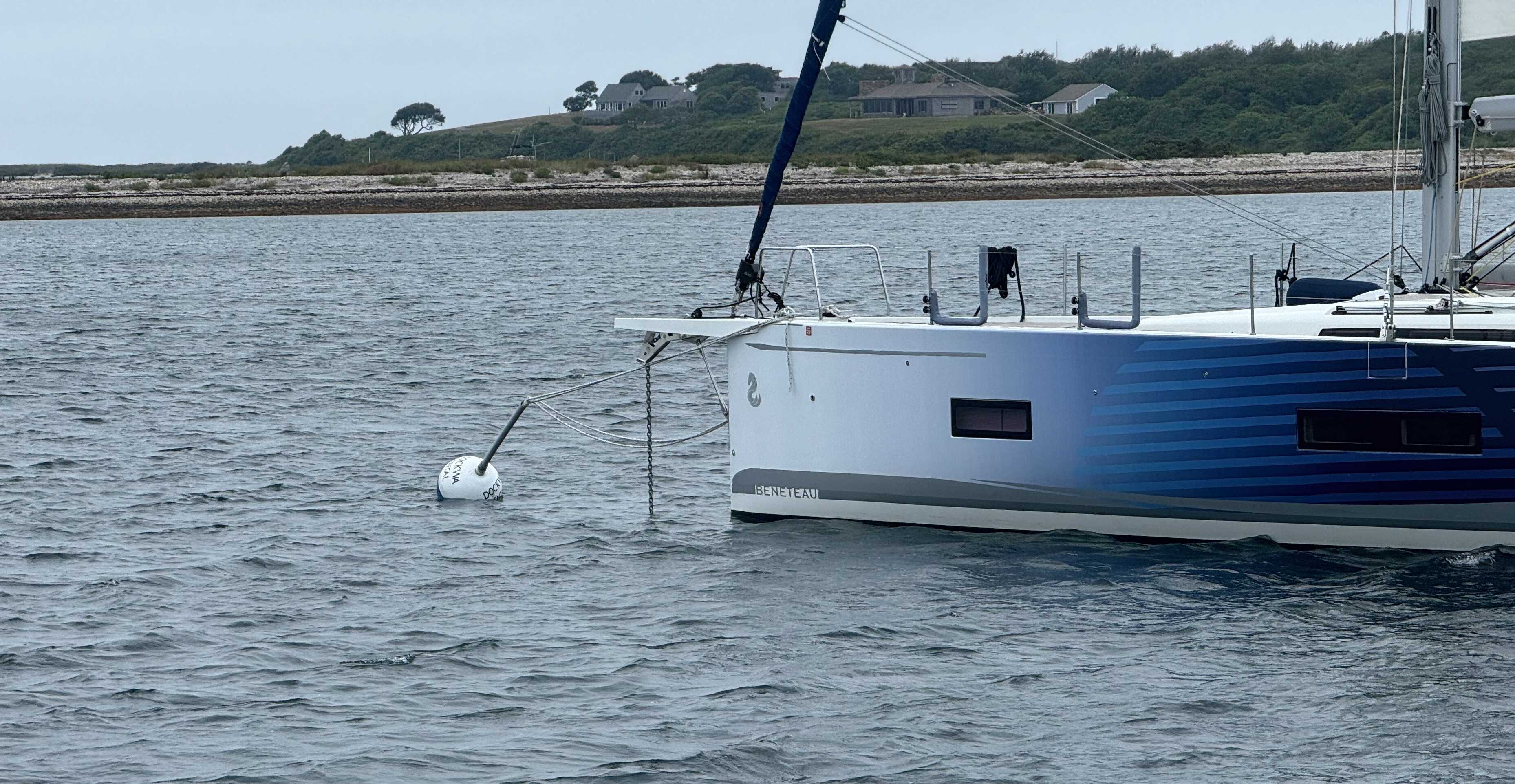
First up was a shiny new Beneteau Oceanis 54, a boat that is supposed to be the newest and best cruising boat that Beneteau can build. They left out something… There seems to be no good way to tie to the mooring without the mooring line chafing on the anchoring gear. The captain even lowered the anchor into the water in an attempt to limit the swinging of the boat back and forth, but even in the light winds here it was not enough. As the boat sailed back and forth, the ground tackle sawed on the mooring lines.
Cruising boats typically spend a lot of time anchored or on moorings. this is not an area where compromises should be made.
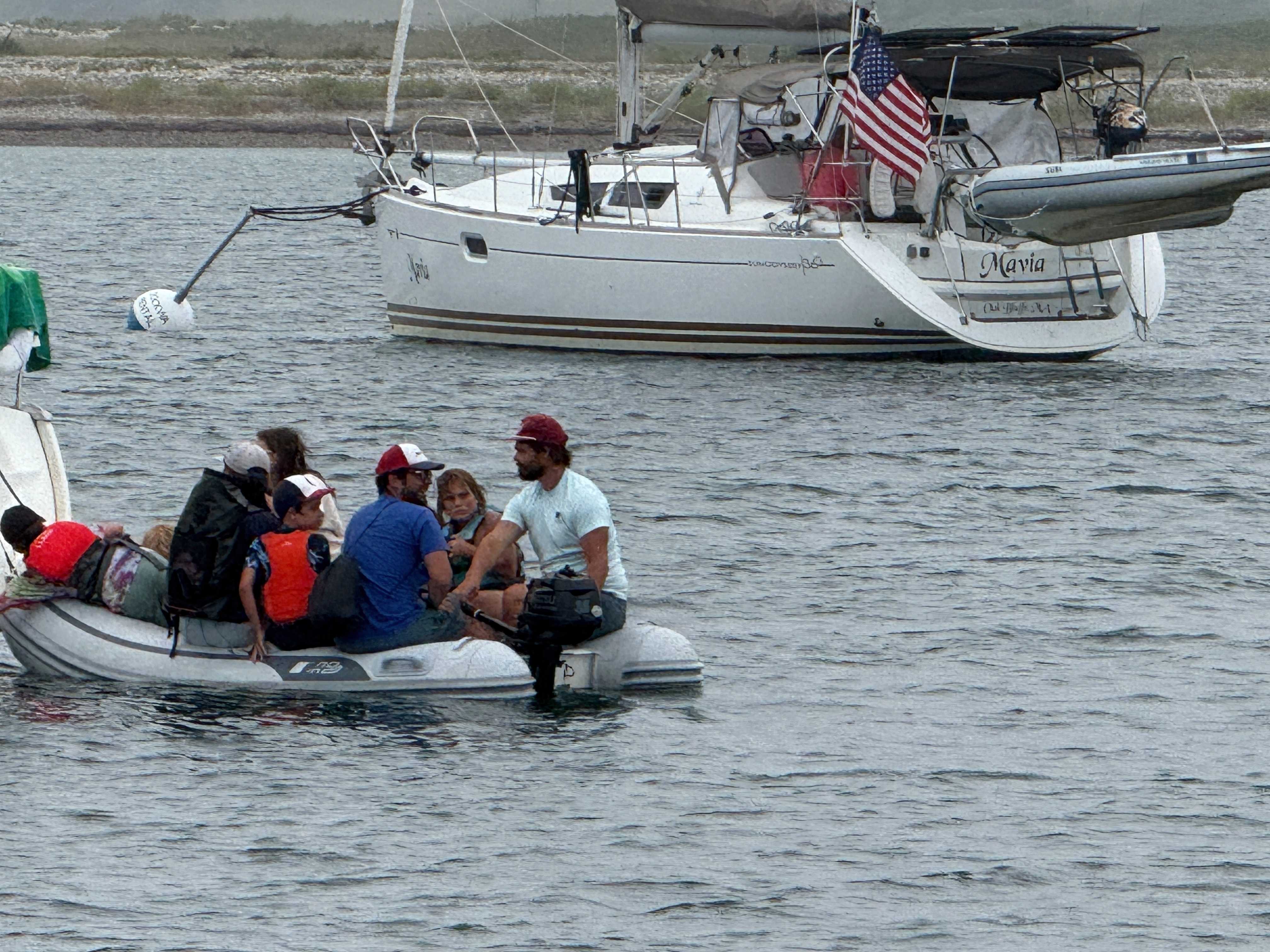
Next up was a crowd of four adults and four children all jam-packed into a dinghy for the trip from shore to the moored boat. It really would not have taken very long to make two trips. This is ridiculously (and dangerously) overloaded. The only good thing I can say, is it looks like the kids and women have lifejackets on. Something that seems to be too wimpy for the manly-men onboard.
I’m sure there is room for ONE more!
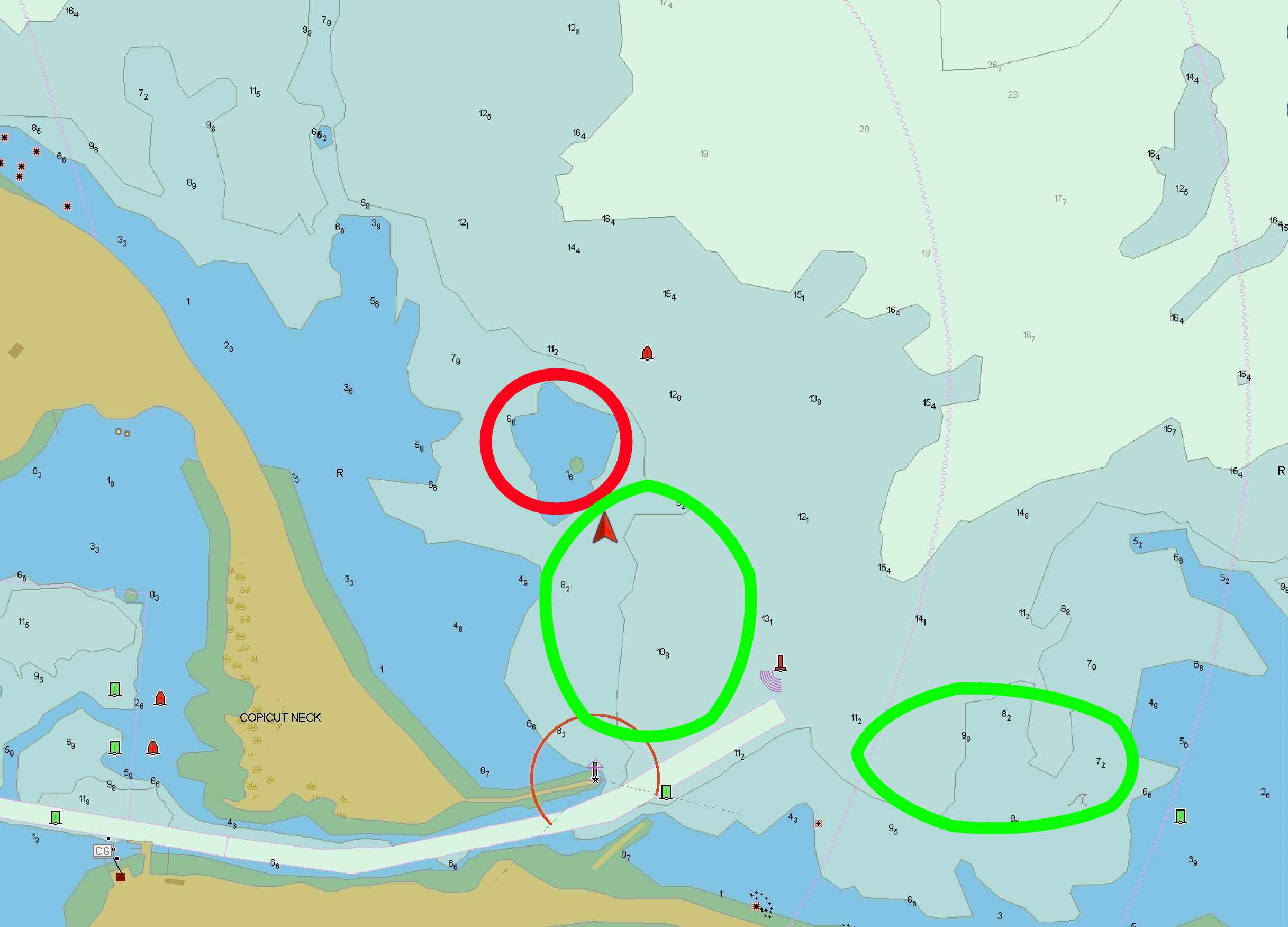
To understand the next act of the afternoon follies you have to see a chart of Cuttyhunk Outer Harbor.
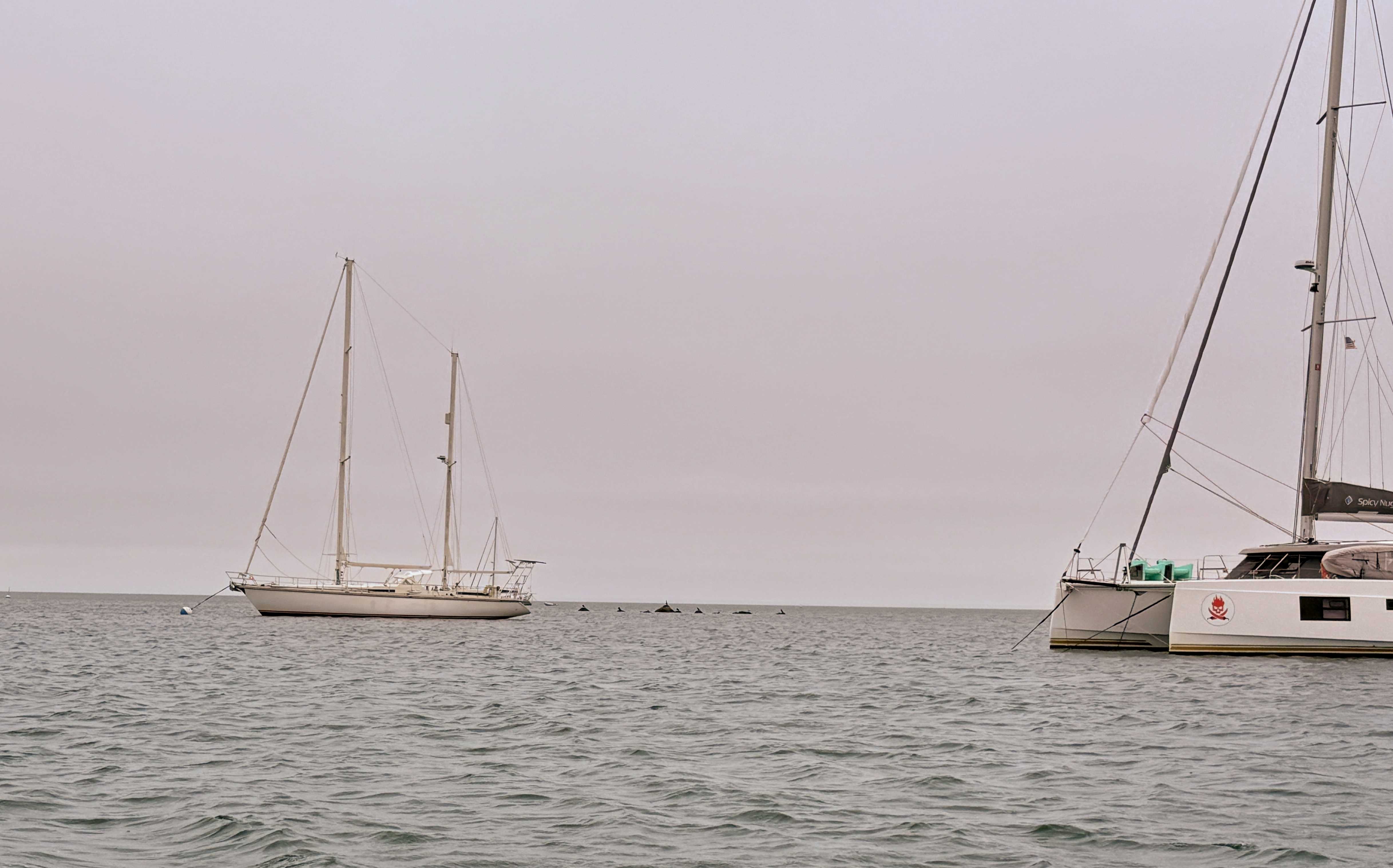
The mooring fields are roughly outlined in green. The red circle marks “Pease Ledge,” a hard rocky ledge that is submerged at high tide but is well exposed at low. Here is a picture of the ledge just poking through the surface at about half tide behind our own Harmonie:
At high tide, the catamaran to the right of the photo tried to approach apparently without looking at the chart (or maybe not understanding what it was showing?) and fetched up hard on the rocks–that were then underwater–to the sound of grinding fiberglass. They did manage to get off without much trouble, but still not a good look…
More to Follow…
I’ll be posting up a video tour of Cuttyhunk Harbor within the next week. Tomorrow morning we are up early to weigh anchor at about 6AM so we can catch the north flowing tidal current in the Cape Cod Canal. Our target for tomorrow is to be anchored by early afternoon in Barnstable Harbor on the north side of Cape Cod.
After a month at the dock In Glen Cove, New York working with another Amel owner to install a new C-drive in his boat, and do some other assorted repairs and upgrades, our time is our own for a while. This morning we headed out of the marina in Glen Cove, and moved about 25 miles east to Port Jefferson. A nice little tourist town and a harbor full of moorings available for $75/night, and that includes launch service from your mooring to downtown. From here, our plan is to jump to Cuttyhunk Island for a day or two, then up the Cape Cod Canal toward the coast of Maine with possible stops along the way.
The C-Drive Installation.
The Amel C-drive is a very reliable piece of machinery, but everything is subject to failures eventually. I have now replaced two of these and in both cases the cause for failure could not be clearly identified.
The gearboxes used in these units came from two different French manufacturers. There are external differences bewteen the two supplier’s units. I do not know i the internals are identical or not. Amel can supply a replacement of the entire drive system for about €32,000.
Amel has a contractor who installs the lower unit in a bespoke fiberglass housing, The problem is that these housings are not drop-in replacements. The housing as supplied today requires modification to fit. It has to be made larger in some areas, and smaller in others. I suspect that each boat model will require somewhat different tweaks to get the fit and alignment as perfect as it needs to be.
The overall process to install one of these is tiem consuming, fussy, and difficult. The modifications need to be done to a fairly high level of precision so the alignment comes out correctly. The engine then needs to be aligned with precision to the new drive system.






 fetchinketch