
We are going to file this under the category “Nobody’s Perfect,” or maybe even “What Were They Thinking?” As a boatbuilding company, Amel is famous for thinking “outside the box” in boat design and construction. Almost all the time they ended up doing something better. Every once in a while, however, they got a bit too far outside the box. This is about one of those times
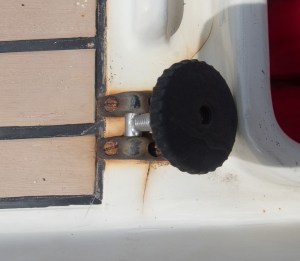
The deck hatches on Harmonie are held down by these clever swing bolts and hand screws. Several of them were bleeding rust onto the deck. I figured that the rust was from poor quality metal in the screws, and had not really prioritized it any higher than a strictly cosmetic project. We finally got tired of the ugly rust stains and set out to clean it up and make it look once again properly “yachty”.
It turned out there was a significantly bigger reason than cheap hardware for these rusty screws and cracked gelcoat…
This was one of Amel’s “different” ideas that, honestly, did not turn out so well. Under the solid fiberglass deck surface, they glassed in a small block of what the marketing people called “ironwood.” A not-so-precise term that is used for many different types of unusually hard, usually tropical, woods. They then screwed into this with standard thread M5x0.8 machine screws. Kind of an odd choice, but it worked–when things were new. After 20 years, however…
Over time, water found its way into the wood, and that is never a good thing. The wood they used might have been rot resistant, but it certainly was not rot proof. Every one of ours were bad. Some were so bad Karen just pulled the screws straight out by hand. We drilled some over sized holes in the top of the deck where the screws went in and extracted what was left of the wood out…

Yes, all of that rotten, punky, soaking wet, fibrous yuckiness was pulled out of those four screw holes with a pair of tweezers leaving roughly a 2 inch square hollow under the deck surface. A very tedious job, repeated for each of the 10 hold-downs around the deck. It took Karen the better part of two long days. The good news is that this wood is isolated from the balsa core of the main deck, so the problem with water intrusion is very localized.
The resulting gap where the wood used to be was then filled with West System G/Flex 650 epoxy heavily filled with high density 404 filler, the way it really should have been in the first place.


I like this stuff for this kind of work because it is much “tougher” and less brittle than “regular” epoxy. I don’t use it for everything, by any means, but when you end up with the final result being mostly cured epoxy, the extra mechanical strength of this material is worth it. As a bonus, the 1:1 mixing ratio means a little can be mixed quickly and easily.

Ahhh… that’s better. The cavity where the wood had rotted filled with cured epoxy resin.
After the epoxy cured, we drilled pilot holes and used #6 self tapping screws to reattach the hold-downs. No leaks possible. Nothing to rot–ever.
If at any point we decide the self tapping screws are not sufficiently strong, we can easily upgrade to through bolts without compromise to the integrity of the deck. There are not a great number of places on this boat where I can with total honestly say, “Better than new,” but this is one for sure.
 fetchinketch
Hi Bill,
we’re currently in the process of fixing the same Amel issue you describe—so thank you for documenting this so well. We have a quick question for you.
On our boat, the four forward screws of the starboard bow locker are very wet, as are the four screws in the port aft locker. Could you clarify exactly where this area is separated from the rest of the deck’s sandwich walking surface?
Our main concern is whether the balsa core of the deck walking surface could also have been affected by moisture. We’re a bit worried that some water may have migrated beyond the localized ironwood blocks.
Additionally, do you know whether this same “ironwood” was also used under the deck fittings such as the cleats, and under the two aft stanchion bases that are close to the aft locker?
Any insight into how Amel isolated this area, or how confident you felt that the balsa core was unaffected, would be greatly appreciated.
Thanks again, and best regards,
Marius
SV RHEA
SM#103
LikeLike
Hi Marius,
I had a similar concern about water intrusion into the balsa core at the time we did that project. I can tell you on our boat, the hardwood that the screws were driven into was laminated separately from the balsa, there was no path connecting them. I believe that the same wood was used as a backing block for the deck cleats. The primary difference there is that the cleats are much better sealed to the deck, and we have not had any problems with water getting under them. A place to watch carefully for water getting into the deck structure is the deck fittings for the holding tanks. The balsa is quite exposed there to leaks.
regards,
Bill
LikeLike