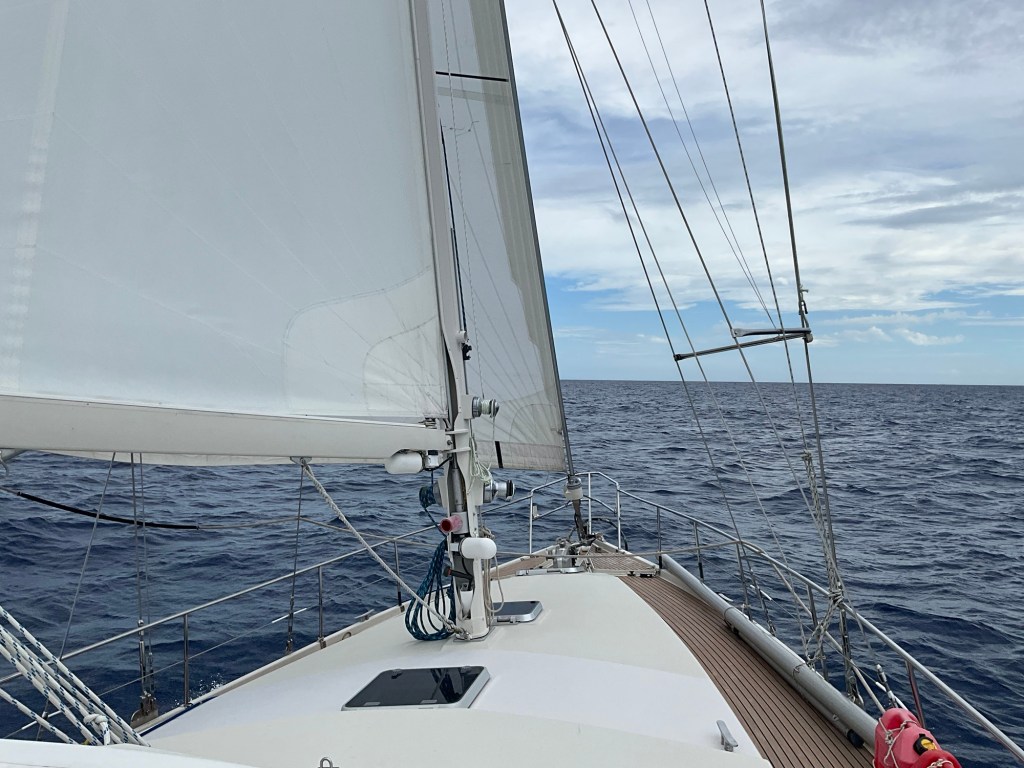
Not the best way to wake up. We were making good time on a comfortable broad reach sailing with just our genoa and our mizzen. The genoa had come detached at the top of the mast, and was quickly settling down into the water.
It wasn’t going to go anywhere, it was still attached at the bottom, but it is a very big, heavy sail that gets REALLY heavy when it full of water. It took about 20 minutes to drag it all up on deck, and get it tied down safely.
Back on the boat, but not doing us much good like this!
It seems the lashing that holds the head of the sail to the swivel had come undone. The good news is I had not tied it on, the crew in Martinique did that as they were reassembling things after the work they did. The bad news is that without the weight of the sail, the swivel is stuck at the top of the mast until I get up there to pull it down. To do that, we are headed into a calm anchorage. We are motorsailing in that direction now, and hope to be there late tonight.
Tomorrow we’ll get the sail back up, and be on our way.
After a little more than a week anchored off the uninhabited Plana Cays in the Bahamas, it is time to move on.
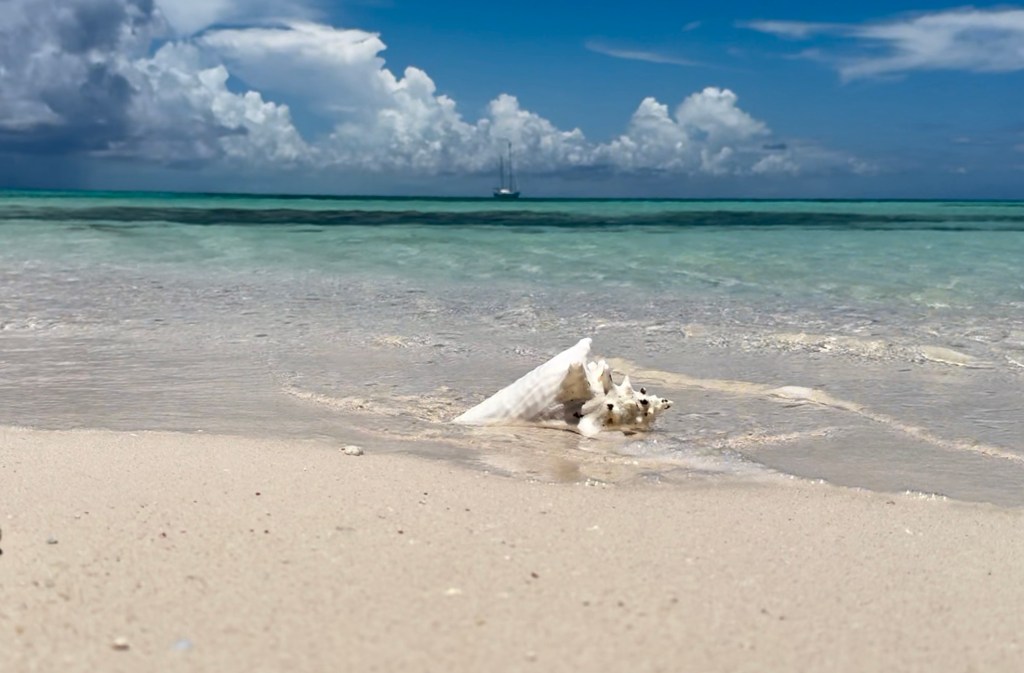
What does one do for a week on an uninhabited island? You hike miles of beaches with no footprints in front of you. You explore all kinds of interesting things the ocean has tossed up, seemingly just for you. You catch fish. You bird watch. You are surprised one morning when you wake up to a sister ship to your boat anchored a few hundred yards away, and discover they are old friends we haven’t seen in several years.
But like all great things, this great playtime comes to an end, and we had back to the coast of the USA. We lifted our anchor this morning, and set a course for Brunswick, Georgia which will be our base for a month or two while we get some boat projects done on Harmonie, and on some client’s boats.
We are now sailing in easy comfortable weather through the Bahamas. It will be about 4 or 5 days before we make landfall in Georgia. Right now we are under a full moon that is sliding in and out of the clouds. Winds from behind us at about 14 knots. Seas calm and comfortable.
If we believe the weather forecasts, the trip should be mostly just like this. Time will tell!
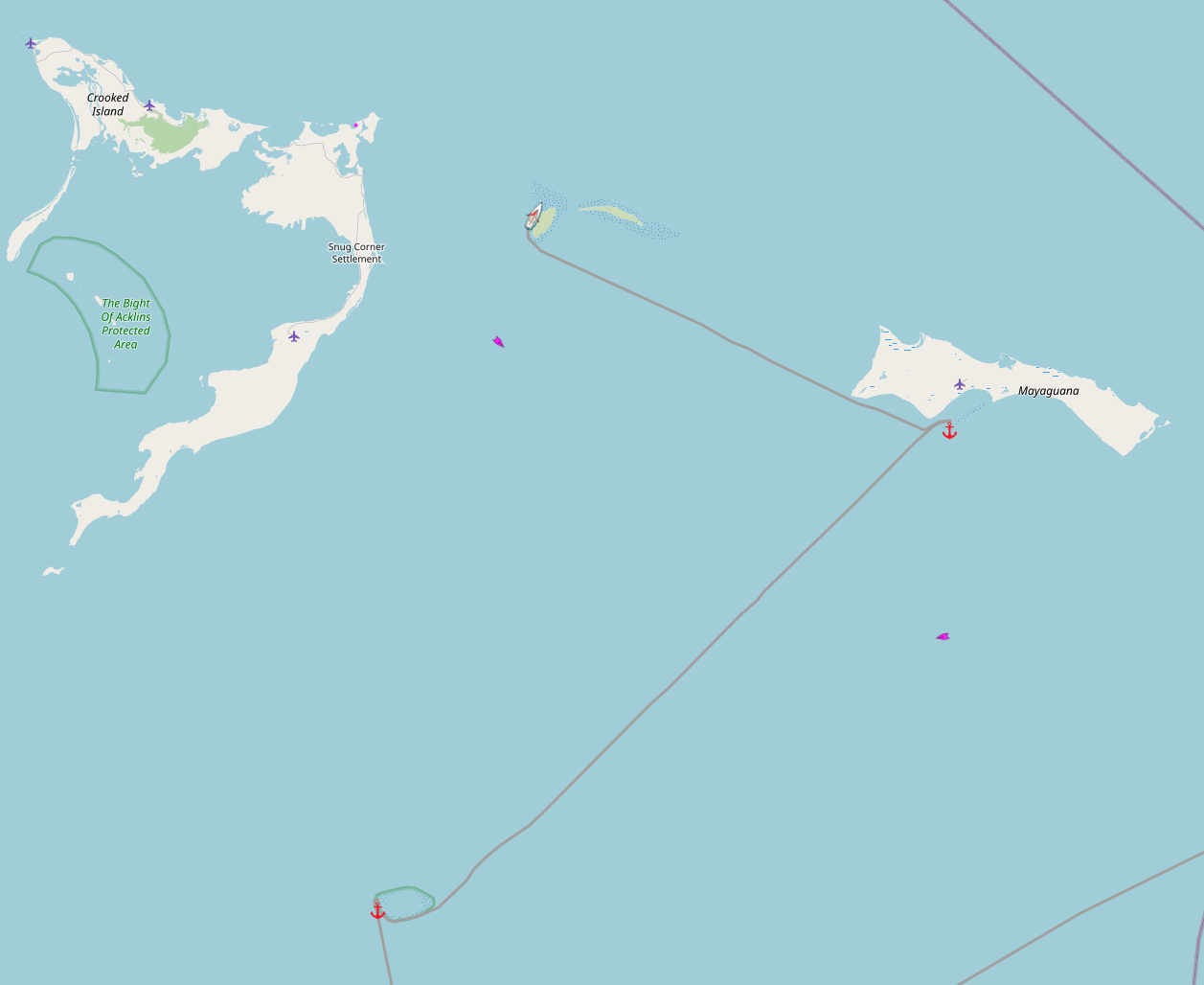
Unfortunately, the weather took a turn on us, and staying anchored at Hogsty Reef was no longer tenable. We packed up and sailed off, first for a night in the well protected harbor at Mayaguana, and then onward to one of our favorite destinations in the Bahamas, the uninhabited Plana Cays where we hope to spend a week or so.
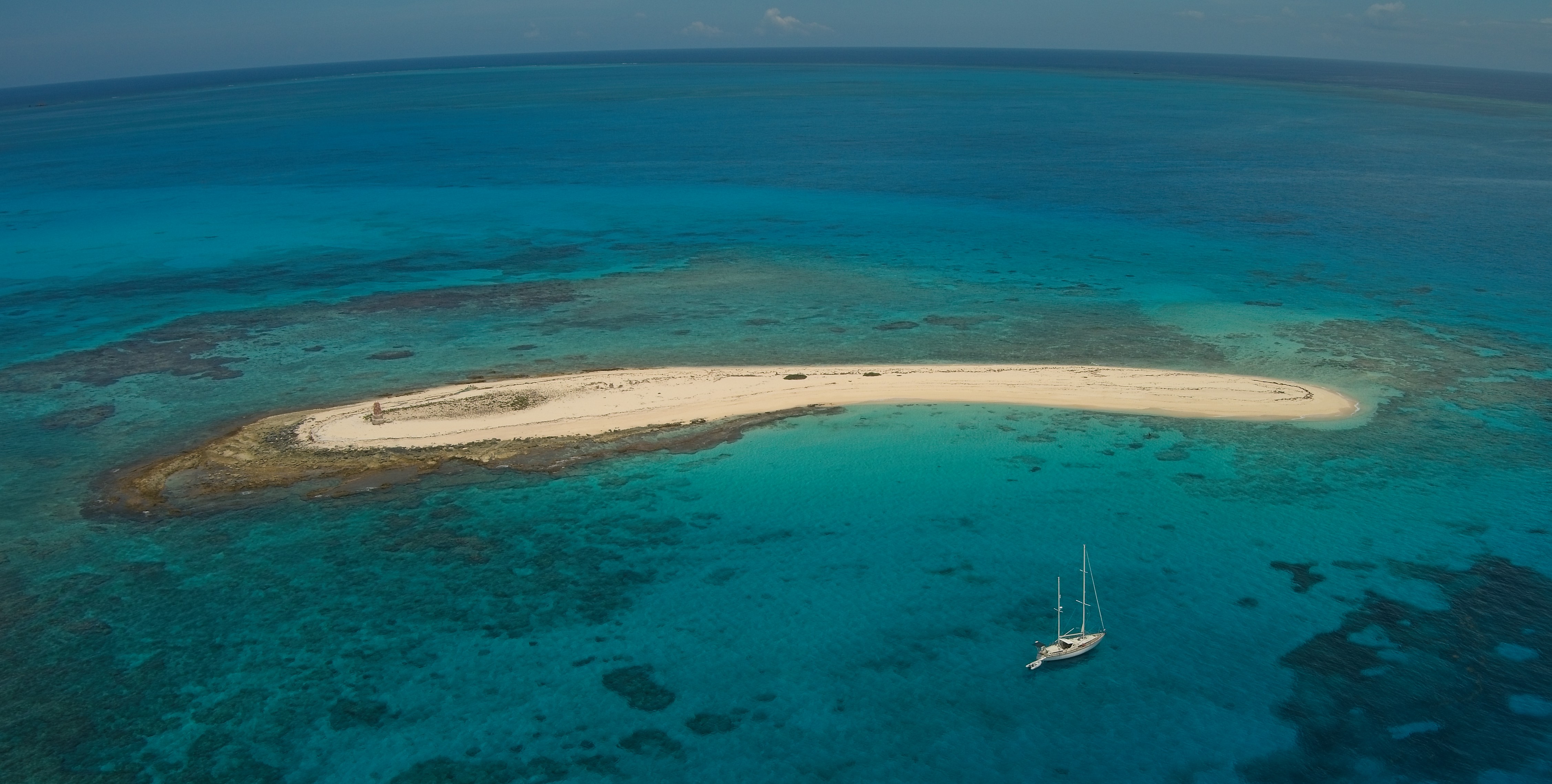
We do however have some more photos of Hogsty Reef. At Northwest Cay, there is an unusual stone tower.
This was obviously a rather complex construction project for such a remote site. Built of cut stone blocks, and originally covered with ochre colored plaster. I have found no information about why it is there. It would hardly be tall enough to be much more visible than the island itself. There used to be a light on the island, but all that remains of it is a bit of its foundation sticking out of the sand.
On the north side of the cay is the remains of a wooden ship of significant size, mostly buried in the sand, one of the three wrecks visible above water. The reef has always been a serious hazard to navigation, even to quite recently. It does not project high enough to give a significant radar return, and it rises so quickly from the depths that sonar would give you only a few minutes of warning.
The small hill is covered with nesting sooty terns, and anything higher up has brown boobies perched on it. With this number of birds, the population of small fish in the shallow waters is quite limited!
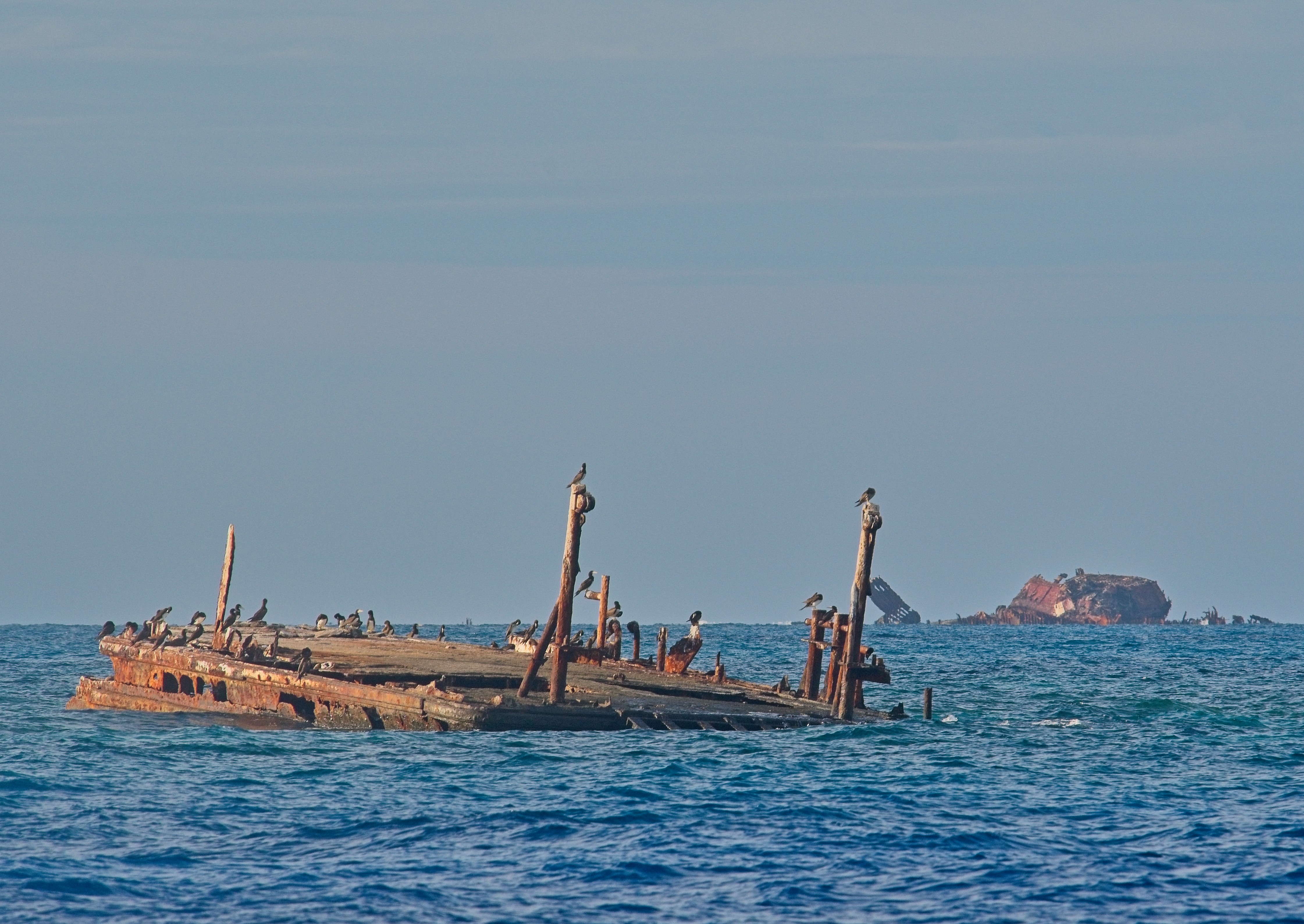
The other two wrecks are steel hulled ships providing more roosting places for the brown boobies. They are on opposite sides of the reef about 3 miles apart. Aside from the two tiny cays, they are the only things above the water surface at high tide.
The one on the far side in this photo is quite a substantial ship. It is the SS Richmond P. Hobson, one of the Liberty class cargo ships built in American shipyards by the hundred during WWII. It met its end on Hogsty in 1963.
The nearer wreck is the Lady Eagle, an offshore supply vessel that was sailing under a Bahamian flag when she ran up on the reef. All I can find online is that she was built in 1967, and was likely one of the fleet of inter-island ships that are locally known as “mail boats.” I am not sure when she ran up on the reef.
Not a lot of places can claim to be truly “unique”, and actually one of a kind. Our current location, Hogsty Reef, is one of those. It is the only official atoll in the Atlantic Ocean. It has been on my list of places to see for some time, but to visit the weather has to be pretty stable and cooperative. Finally on this trip, we got here.
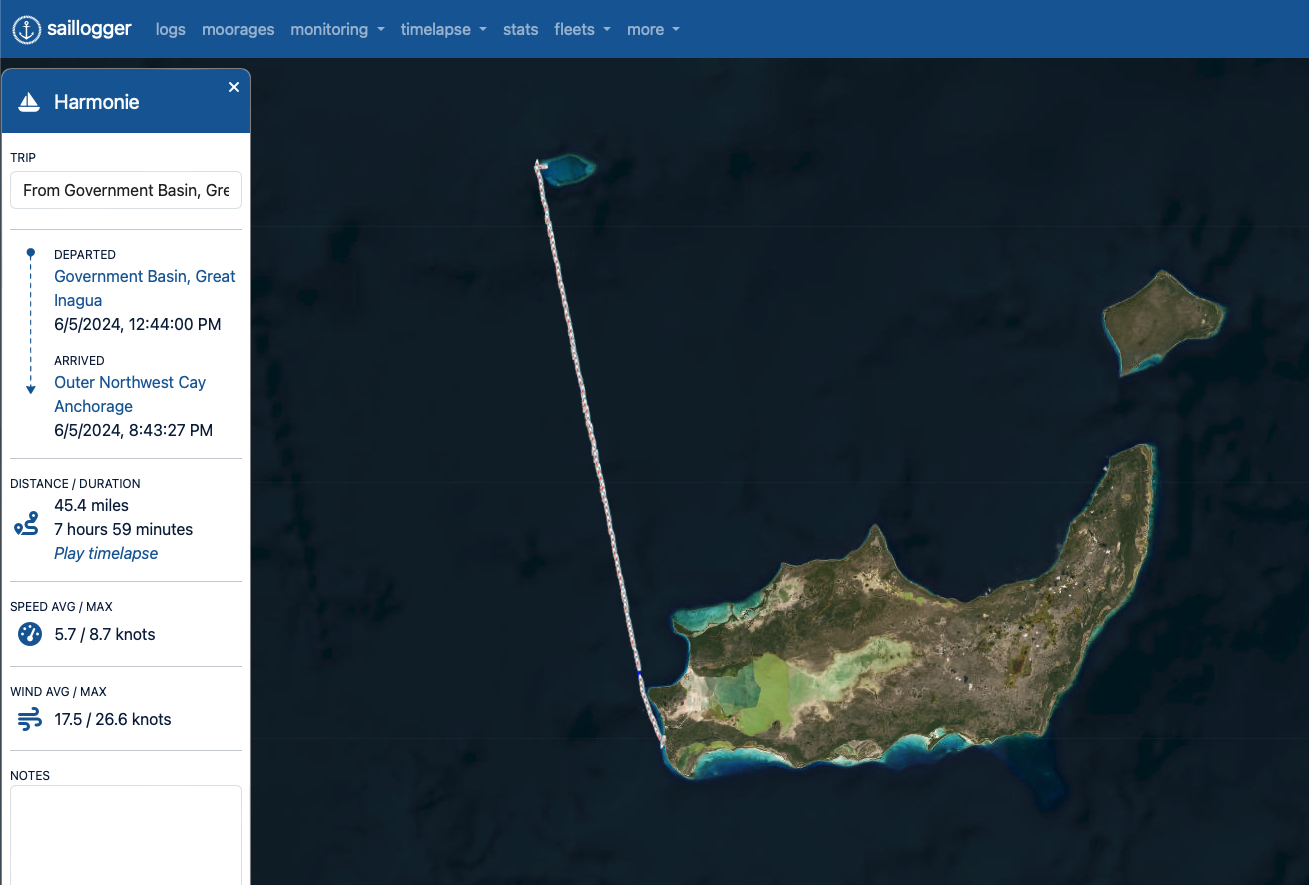
Our trip here from Great Inagua was straightforward, and uneventful. 45 miles in 8 hours, mostly motor sailing through somewhat contrary winds.
An atoll is a central lagoon surrounded by a coral barrier reef. In the Pacific Ocean atolls are more common and are most commonly produced when a volcanic island sinks beneath the waves, and the coral grows faster than the land subsides, leaving a ring of coral around a lagoon. Hogsty Reef has a different origin story. A couple dozen feet higher, and it would have been a typical Bahamian Island, but as the water levels rose after the last ice age, the upper surface ended up below sea level, and the coral grew in a ring of reefs around the submerged land in the middle creating a lagoon about 4 miles across.
A least one blogger has pronounced it as “the most isolated place in the Bahamas!” Nice headline, but not true. It is only 35 miles from two other islands, and there are Bahamian islands with more space around them than that. But is does FEEL remote for sure, and visits are rare.
There are two “permanent” patches of land, Northwest Cay, and Southwest Cay. We are currently anchored off the larger of the two, Northwest Cay.
We will not be going ashore here because the terns are still nesting on the island. Certainly one of the smallest places we have ever anchored at. This is also a marine protected area so we will not be fishing or collecting here.
If the weather holds as forecast, we will be spending another day or two here, and hopefully have a chance to get you some more photos from above and underwater.
We are sailing to the northwest off the northwest corner of Puerto Rico, crossing the Puerto Rico Trench. Over five miles deep, it is the second deepest place on the world’s oceans. At the end of the afternoon it is mostly cloudy, cooler than we have gotten used to (maybe “less hot” would be a better description.
Our sail for today has been easy, and comfortable. A steady wind on the quarter of 1pm to 12 knots, and a boat speed of 5 to 6 knots. The autopilot has been steering full time and no adjustments have been needed to the sails.
Last night was a bit more challenging. After dark, numerous small squalls popped up. Nothing violent (except for some truly thunderous downpours), but the convection associated with them caused the winds to vary dramatically in speed and direction, requiring constant active sailing of the boat to keep moving more or less on course. Especially since they were so close together, predictions of the wind shifts proved impossible to make ahead of time.
The forecasts for tonight have things a bit less active. Time will tell.
We are now about 3 days out from Great Inagua where we will check in with Bahamian customs which will leave us free to move around the Bahamas. We expect to arrive in Brunswick, Georgia a few days before the beginning of July.
We are just about 3 days from leaving the dock in Martinique. Our expected next stop is the island of Great Inagua in the Bahamas where we will check into customs for a stay of a couple weeks. After sailing for 360 miles, we are in the Spanish Virgin Islands off the east coast of Puerto Rico.
We have another 5 days and a bit over 500 miles before we reach our destination.
Sailing has been easy, all downwind. Other than a bit of rain from the first tropical wave of the season, the weather has been perfect.
We did stop at a seamount to add fish to the freezer. A place 80 miles from the nearest land, and 100 feet deep surrounded by water half a mile deep or more is always a place to expect a good catch.
A red hind grouper from Gibbs Seamount.
We expect more good weather and fair winds for the rest of the trip.
We have had a couple of deliveries lined up over the past month or so that have kept us busy, and some what off line. If you think that job might be all fun…
The romance of the open ocean! Sailing boats to exotic places! The glamor! The fun! All while getting paid! What’s not to love? Ha!
Reality
Nobody (well, almost nobody!) hires a delivery captain to move a boat downwind, in good weather, from one desirable port to another. That’s the kind of sailing the owner wants to do! We just got back from a delivery, and while we had a fun time, all is not rainbows and unicorns.
This boat needed to move from St Thomas in the US Virgin Islands to Martinique. This is about 330 nautical miles as the seagull flies, and it is almost always an upwind passage into the tradewinds. There was an extra complication, the boat’s engine was not reliable. While it was working, it had a history of recent problems that had not really been definitively diagnosed and repaired.
Off to a Good Start
We left the marina in good weather, and motored out. Everything was running fine, and spirits were high for a passage easier than we expected. But it was not to be. A few hours into the trip, the engine stopped running, and would not restart.
Oh, well, it is a sailboat, and we have wind!
Strategy
The wind was forecast to continue blowing from the east at about 15 knots, with no real changes expected. On most cruising boats this passage would be taken down close to the island chain, but I decided not to do this.
Some of these islands are quite high, and have dramatic wind shadows where wind speeds are dramatically reduced. Off Dominica the wind shadow can extend 50 or 70 miles to the west. Not usually a problem, just fire up the engine, and push through the calm… Oh… Wait… We don’t have an engine…
We trimmed the boat for a close hauled course on port tack, and just kept it like that, sailing as close to the wind as we could until we reached the latitude of our destination, and only then began to work our way east. Instead of the 330 miles of the direct rhumb line course, this took almost 490 miles, and just about 4 days.
On arrival at the outer harbor in Martinique, we used the dinghy as a tug boat to push us into the marina, and get docking lined up. The marina crew at Marina du Marin was, as usual, helpful and professional. They used their boats to push and poke at us until we were secured at the dock, just 5 slips down from our Harmonie.
From Here…
Within a couple days, we will be preping Harmonie to start our migration northward, almost the exact reverse of the delivery sail we just completed, except this time (Cheers!) it will be a downwind route. Our first planned stop will be in the Bahamas, which will be about a week’s sailing from here.
We have been in Le Marin, Martinique since our last update–at least mostly!
When we first arrived, the dock was full of boats that were full of people we knew. Lots of socializing and many sea stories were traded.
The main harbour in Le Marin, Martinique. Since the arrival of the Sahara Dust it has not been anywhere nearly this clear.
The weather has been consistent to the point of boredom. About 90ºF during the day, and high 70’s at night. Other than one day of rain, it is partly or mostly cloudy. The biggest topic of discussion locally about weather is the large amount of dust in the air blown up off the Sahara Dessert and across the ocean. Parts of our boat are liberally sprinkled with rich orange dust from 3,000 miles away.
Today’s satellite measurements of airborne dust
While here we have scheduled a couple deliveries. Week last we finished moving a boat from Fort Lauderdale to Deltaville, VA, and next week we will be moving another boat from St Thomas in the US Virgin Islands to here in Martinique.
Generally, we don’t post much about deliveries, that is more the prerogative of the client. But here is a quick example of the perils of being a delivery skipper. The boat had two ways of keeping the batteries charged. The alternator on the main engine, which we already knew had “issues.” In addition there was a diesel powered generator, which had been working well in the weeks leading up to the delivery. Unfortunately, the first time we needed it, the engine on the generator started and ran, but only at idle speed, insufficient to generate any usable power.
It turns out the throttle linkage was broken. It’s not often I get to make a temporary repair on a boat with baling wire, but in this case it got us to our destination.
OK, I KNOW it is really ugly. But it did get us to where we needed to be!
When we returned from the delivery that ended in Virginia, all of the people we know back in Le Marin had scattered in various directions on the ocean. It seems strange to be here “alone.”
Harmonie Visits the Boat Spa
Harmonie has been getting a lot of work done by the staff of the local Amel service center. Some of the projects are significant routine service that we did not have the time or tools to do, some of them are upgrades and cosmetic improvements. The Amel staff does exceptionally good work, they know these boats better than anybody, with the possible exception of the factory in La Rochelle, France. They are about the only crew I would ever turn over major mechanical work to, and then leave the boat with them while we went off on a delivery.
I know we have said it before, but if you own an Amel and it is even remotely possible, you need to get the boat here and have Alban and his crew give it a good going over. Their labor rates are reasonable, they have the parts they need, and they do an excellent job. Just as an example, Karen asked them if they have the little rubber feet that support the wood shower grates up off the fiberglass floor in the head. The reply was, “Sure, how many do you need?”
All that, AND the price for space at the marina is also one of the lowest we have paid anywhere in the Caribbean, or the East Coast of the USA. Costs of supplies and food are reasonable, and the best selection of boat supplies in the Caribbean, outside of Sint Maartin. The down side is that there are three chandleries within walking distance from the dock, and somehow they all seem to carry (mostly) different things. Sometimes you just have to visit them all to find exactly what you are looking for.
What’s Next?
As soon as we finish the next delivery we will begin serious preparations for moving north. Karen has a number of places she really wants to stop in the Bahamas that we skipped on the way down to take advantage of favorable weather.
Our first stop back in the US will likely be Brunswick, GA. We have some clients there with a work list that will keep me busy for a few weeks, then we will probably head further north to avoid the heat of the southern summer.
We have made 800 miles in 5 1/2 days. Not a blistering pace, but respectable. After cutting over the Puerto Rican Trench, at nearly 30,000 feet some of the Earth’s deepest water, we are now approaching Anagada, the Northeastern most of the British Virgin Islands. Once we enter the Anagada Passage, we will officially leave the North Atlantic Ocean, and enter the Caribbean Sea.
Our winds continue to be almost bizarrely favorable. The only possible complaint is right at the moment we could use a bit more, but a little motoring in calm seas is vastly better than the hard-core closehauled beat this route would normally require.
It has been an uneventful trip so far in waters relatively empty of shipping. The highlight was Karen’s spotting of a distant splash, which quickly turned into a humpback whale jumping repeatedly out of the water. These waters are the winter calfing and breeding grounds for these huge creatures, so not too surprising to see them.
Martinique is about 330 miles as the seagull flies, we expect to be pulling in there in two days
We left Cape Eleuthera 3 days ago, and have covered 420 miles since. Not a terrible fast trip, but easy and comfortable. The weather continues to give us exactly what we need, and the forecast continues to look good. For anybody used to sailing in the Caribbean, the idea that anyone could sail from the Bahamas to Martinique in one go and very sail upwind will seem almost laughable, but here we are!
This part of the ocean is really very empty. A highlight of the day is if we have two other vessels within 25 miles. Not much exiting to report. Winds right now are on the lighter side, we are on a beam reach with winds from the NNW at 8, it’s sunny and comfortable.
Our expected arrival in La Marin, Martinique is April 1, making this one of our longer passages on Harmonie so far.