
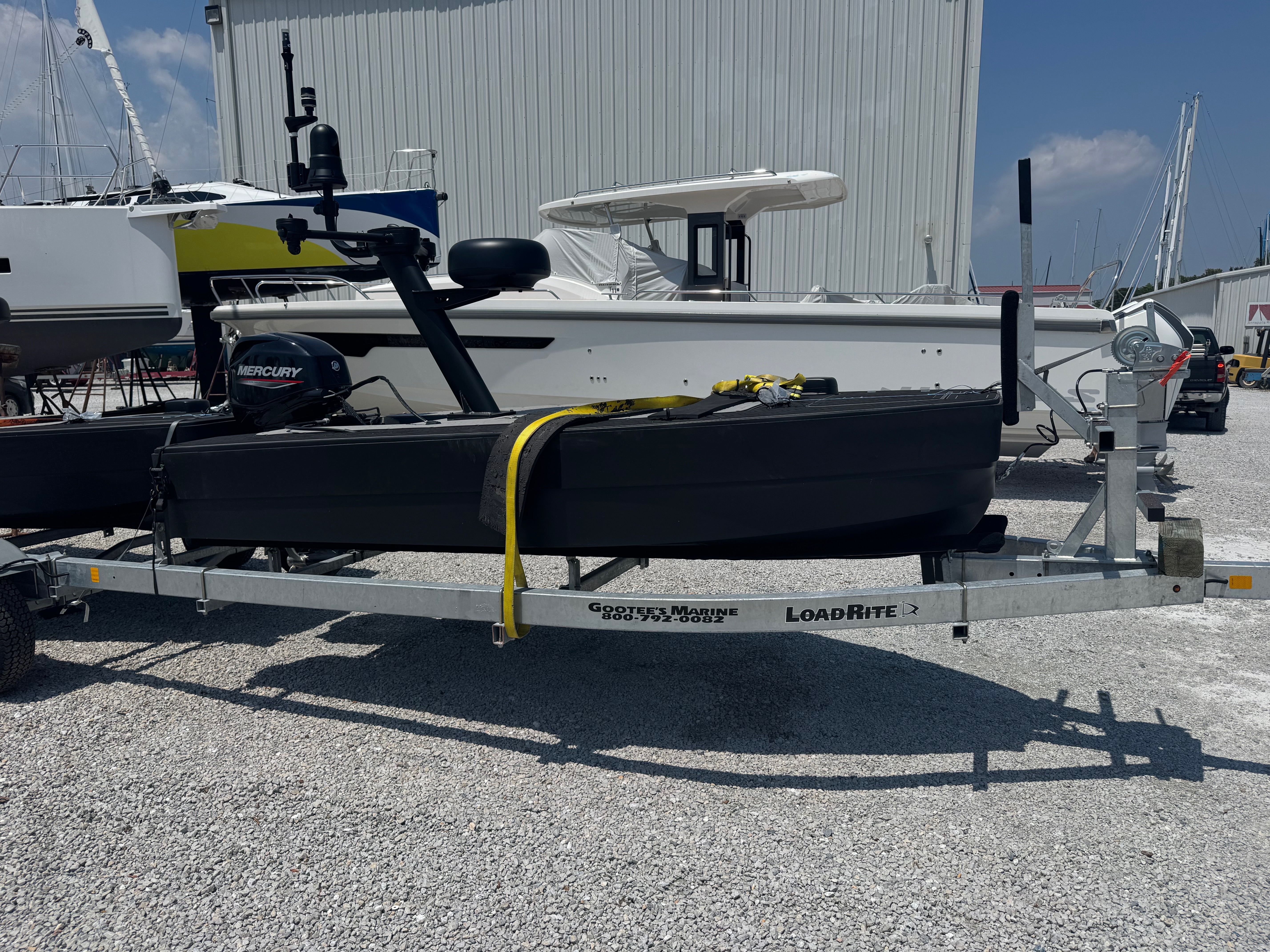
Just wandering the boatyard I found something unusual, and–to me–a bit scary. On a trailer, a pair of 12 foot long marine drones. This is a Ghostworks MUT by Ghostworks Marine out of Michigan.
Obviously marine drones have been in the news a lot recently, mostly thanks to the innovations in navel warfare coming out of Ukraine. Now, I am not afraid of being blown up by one of these, and my worries extend to civilian drones as well as the more sinister versions like these.
These boats are small, only 12 feet long, have an advertised maximum speed of 28 knots, have a composite hull, radar, four cameras, a weather station. a light, a GPS antenna, a single navigation light, and, not identifiable, but obviously present, is the communications gear for being controlled by the home base. As far as I know, these are all remote control and are not autonomous. They are designed for the hulls to stack, and quickly assemble for deployment. It is very unclear to me what the actual mission of these things would be. They are so low to the water, that the radar and cameras would have very limited range, although with a published endurance of 370 nautical miles, I guess they could extend the surveillance capabilities of many navel vessels. I am sure they COULD be equipped with munitions payload to turn them into kamikaze drones, but these specific hulls don’t show evidence of anything like that.
There are many other types of water drones on the ocean these days. Weather drones, military drones, and drones of classified purposes. Many of them are autonomous, out on the ocean perusing their own programming without direct human oversight. The problems I see coming is a conflict between manned vessels (like our sailboat) and these unmanned vessels. The rules of navigation at sea have been refined over the last century to ensure that vessels that follow the rules can avoid collisions. Unmanned drones ignore these rules, and in many cases simply can not comply with them. The operators of many of these vessels seem to rely on the “big ocean theory” to avoid crashes.
A decade ago, the Coast Guard would have taken an extremely dim view of a remote control boat out on the water totally out of sight of its operator, with no registration, no dedicated lookout, and improper navigation lights. Now, that is normal. The risks I am worried about are real, and are not theoretical. The UK’s navy has crashed one of their drone boats into a boat under sail in Portsmouth Harbor, causing extensive damage to the yacht. The last update is that they are “investigating” what happened. In the normal rules for collision avoidence, a small motor boat like the drone involved, is required to keep learning of boats under sail.
Just taking this photo as an example, a Ghostwork MUT is a very small, highspeed, craft. It is obviously designed specifically to be low visibility with a matte black paint job, and because of its size and construction will have an extremely small radar return. In waves of any size at all it will be virtually invisible by any means from the cockpit of our sailboat. I suspect that is exactly the point. It has a single navigation light on its short mast, but the light it carries is not legal for a motorboat. It would visually present at night (assuming you saw it at all) as carrying the lights of a sailboat.
I did send some questions to Ghostworks, but received no answer.
Not only is it very hard to detect out on the water by normal means, it will also have a very hard time seeing other boats. The low height of the cameras and radar dome mean that that anything 3 miles away is over the horizon, and effectively invisible. And that is in calm water. Any actual sea waves would reduce the effective horizon even further.
These boats are not new deliveries, but have wear and teat on them that clearly shows they have been used. Yet they carry no form of registration marks or ownership at all. Are they exempt from the normal rules around registration of boats because there are no humans on board?
I do not expect any form of rules and regulations to appear covering the behavior of drone boats anytime soon. The shipping industry really does not have a big issue with them, a 100,000 ton ship colliding with a small drone boat is going to suffer nothing but a paint scratch, so this is never going to be a priority for them. The military and law enforcement organizations that are the primary users will actively resist any rule changes or modifications that restrict their use of these things. It will become more and more dangerous to small manned vessels (like our sailboat) as unmanned vessels become more common. The Wild West is coming to an ocean near you.

