We had a very fast and (mostly) uneventful passage from Fort Lauderdale to Charleston over the last 2 1/2 days. With a north-ish wind blowing against the Gulf Stream the sea conditions were (to quote Karen), “Barfy.” Lumpy, and bouncy, but not anywhere near scary.
The biggest excitement was the second night, when the lashings that hold the head of our genoa to the top swivel broke. I quickly rolled up the sail before it fell down on deck. With our most powerful sail out of commission, we turned to the “Iron Genoa” (aka Mr Volvo) to keep us moving along. A quick trip up the mast will fix this, but I am not going to even consider doing that at sea short of a serious emergency.
Just to add to the fun, when we fired up the engine, it promptly overheated. A quick impeller change and that problem was solved. Frustratingly enough, the engine impeller was on the maintenance list for inspection/replacement here in Charleston.
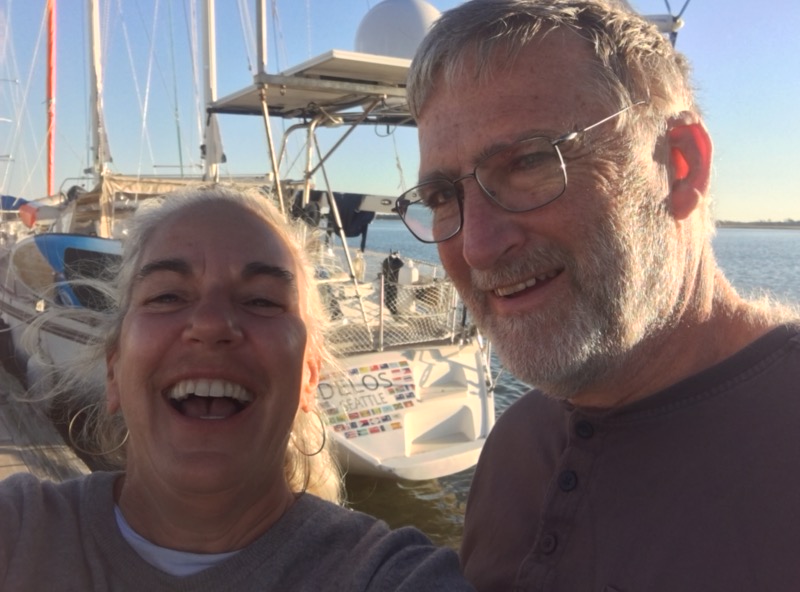
We arrived here at the Charleston City Marina last night, and a few hours later, the most famous Amel Super Maramu around (S/V Delos of YouTube celebrity) docked right in front of us. It’s quite funny to watch a steady stream of groupies come down the dock posing for selfies with the famous boat as a backdrop.
We got the genoa down and folded up, but there still seem to be issues with the swivel that is stuck at the top of the forestay. Understanding what’s wrong and sorting it out will have to wait until I get up the mast.
We have the critical items on our boat taken care of, and now we’ll turn to the customer’s boat that we are delivering to Antigua. Hopefully just a few days of prep and we’ll be ready to go.
Just before we left Annapolis, we retired our old genoa and installed a new one from Island Planet Sails. It is a truism in the sailing world that installing a new sail on a cruising boat can be like buying a new boat. Racers change sails a LOT. Cruisers change sails when they have to. Over the course of the five to ten years of a typical cruising sail’s life it stretches out of shape, and it no longer presents a proper airfoil shape. Because this happens so slowly, the drop in the boat’s performance is not noticed by the crew.
It is easy to forget that a sail is not a flat piece of canvas, but has a carefully designed 3-dimensional shape. When that shape is compromised, the sails performance drops dramatically. When a new sail is installed, suddenly the boat’s performance takes a quantum jump. “Wow!” is the usual reaction.
The old sail was a cross cut sail. It has relatively few seams (about a dozen), so the labor costs are low. It also can use lower cost cloth. On the downside, it is more prone to stretching and shape changing over time. The loads in the sail are also not well oriented to the strongest directions in the cloth, so even when new it tends to distort more.
Our new sail has a radial cut. instead of large horizontal panels of cloth, it has triangular pieces that all radiate out from the center of the sail in a star-like pattern. Our sail was assembled from about 50 individual pieces of sailcloth. That’s a LOT of sewing.
The benefit of all this extra work is that the loads on the sail are all oriented to the strongest direction of the weave of the sailcloth. As a result the sail stretches very little, and keeps the shape the designer built into it. The downside of a radial cut sail is pretty much all cost. The sewing and the need for more specialized and expensive sailcloth add a lot of dollars to the final bill.
Speaking of sailcloth, our sailmaker gave us three choices for a radial cut sail. In order of decreasing relative cost: HydraNet Radial (125), or ProRadial (100) both from Dimension-Polyant, or Challenge ProRadial (80) from Newport.
The choices as presented to us were that the Challenge Newport fabric was more stretch prone, and would have a shorter life span than the Dimension Polyant. That seemed a good reason to pay the 20% premium for the Polyant product. The Hydranet was presented as a premium fabric with even less stretch, but we were told that we should not expect a longer lifespan. The advice from the sailmaker was for a cruising boat, the significant extra expense was not worth it. We agreed.
Were we happy? Based on the performance of the sail on the way down to Florida, it would be fair to say we were overjoyed. When the autopilot was told to pick the course that resulted in the best VMG upwind, it settled on an AWA of 34 degrees, a good 3 degrees better than we ever saw with the old sail. That might not sould like much, but it is a HUGE improvement in upwind performance. At all reaching angles we saw a significant increase in lift/drag ratio. The result of this is we go faster, and we can carry more sail, at higher wind speeds without heeling excessively, or having helm balance issues. It really was (almost!) like having a new boat.
The new sail is a bit bigger than the old which was branded by one of the major companies. When you are shopping for a genoa for an Amel, you want to talk with a sailmaker who KNOWS the boat. If they ask you if you want a “150% or a 130%, or what?” go talk to somebody else. You want a sail that is the size Amel designed. Same luff length, same foot length. Same tack height. This is important for general performance, and also for fitting properly when using the downwind poles. Yes, it is a big sail, but with a proper foam luff, it will roll up and keep a respectable shape even in a blow.
When you are shopping for sails, also be 100% sure that the sailmaker is supplying cloth that is the appropriate weight for the size of sail. Going one size lighter in weight is one way to reduce the quoted price in a way that the sailor is unlikely to notice–until the sail stretches out of shape long before it should. Ask to see the panel layout, (like the diagram above) and be sure all quotes are a similar design. If they are different, be sure to ask why each designer thinks his is better.
There are only one or two computer programs that all sailmakers use to design the shape of their sails. So that is a given–if they are using the same input data. Most sails these days are assembled at contract lofts in Siri Lanka or to a lesser extent, China. So construction quality has little to do with the name brand on the label. When comparing quotes be sure that you see all the details, and be a pest with questions about the construction and details. Things like how the details of the head, tack and clew attachments are made can make a huge difference in the life of the sail, and how well it fits and works on your boat, and is a way that a sailmaker can cut costs.
There is nothing wrong with saving money, just be sure that you are saving the money in those places YOU decide give the best performance/cost balance.
We are finishing up here in Fort Lauderdale, we have a fresh clean bottom, and most of our projects are completed. After a period of time drying out on the hard, Harmonie will be back in the water in a day or two. Very shortly after that, we will be off on another adventure. This time we will be delivering another Amel Super Maramu, from Charleston, South Carolina to the Leeward Islands in the eastern Caribbean, specifically to the island of Antigua.
We don’t often discuss the “business” side of our cruising life here, but it has recently taken on a life of its own. It certainly isn’t a way to get rich, but it does put money into the cruising kitty, and after a very expensive year of boat projects, that is a good thing. If you are interested: our commercial website
The plan right now is to sail Harmonie north to Charleston, and there we will pick up our delivery and take 8 to 12 days to sail her to Antigua where she will meet her new owner. After some time giving him training on the Amel hardware, systems, and procedures we’ll be flying back to Harmonie and back off to our own adventures.
Right now, if things stay more or less the same, we are hoping to sail to the Bahamas and revisit some of the more remote islands. Assuming that’s possible..
We continue to make excellent time south. We crossed to the eastern side of the Gulf Stream early this afternoon, and are now pointed pretty much straight at our destination of Port Everglades, Florida
Today’s weather had the wind complete its shift from northwest to east while continuing to blow a steady 15 to 25 knots. Even though this has been our first cloudy day on the passage, it has been the first day we haven’t had call to complain about the cold either! The seas are a bit lumpy, but not anything intimidating or uncomfortable. Other than a light sprinkle of rain, it has been good.
The only excitement of the trip so far occurred yesterday. We set the mizzenmast staysail to take advantage of the quartering wind, and for the better part of an hour everything was smooth fast and happy sailing with just the mizzen and jib. I was looking out behind us, and saw the “cat’s paw” ripples of an approaching wind gust. Since the wind had lightened up a bit, I was thinking this was a good thing. Not so much.
Although the wind gust wasn’t that strong, it was at least 30 degrees off the direction of the steady wind. This immediately backwinded both sails, and spun the boat around. The lightweight nylon of the staysail did not survive this abuse. It took us quite some time to sort out the resulting mess and get moving along again.
Right now we are about 300 Miles due north of Port Everglades in Fort Lauderdale, and about 130 miles off the coast of Georgia. Our arrival at Port Everglades is going to be 36 to 44 hours, sometime Saturday before noon. Everybody is happy and healthy, so all is good!
We the dock left Annapolis at 7:30 yesterday morning, and have been sailing continuously since. Strong west to northwest winds have been powering us along a lot faster that our usual average speeds, we are running pretty steady at 8 to 8.5 knots. We are staying near shore so even with 20 knot winds, the seas are pretty flat. We could push a bit faster, but this is comfortable.
Nothing exciting to report. No interesting wildlife sightings, and the weather, although breezy, has been quite clear.
It looks like we are on track for an arrival late Friday night in Fort Lauderdale. We are looking forward to warmer temperatures. Our windy weather is being driven by the cold front that passsed hours ago, and it is chilly!
All the projects that we need to do are done, and the last of the stowing and packing is happening. We have our crew aboard, and the weather looks good for an afternoon departure tomorrow for a non-stop trip down the bay and out into the ocean straight down to Port Everglades, Florida.
Yesterday we mounted our new jib. After over 50,000 miles the old sail has been getting a bit tired and out of shape. This new sail is also a little bit bigger than the retiring canvas and matches the original dimensions that Amel used on the boat. It has been built with a radial design and specially adapted cloth designed for long life in this application, D-P Pro Radial. An all polyester woven cloth, it was a mid-price point that came well recommended from the sailmaker for a sail of this design.
Dave Benjamin at Island Planet Sails has done a good job on our Amel canvas in the past. We expect this one to be just as good.
For the first time in a long while we will be traveling with crew. Our friend, fellow sailor, and fellow Amel owner, Aras will be along to help stand watch. Having a watch schedule of 3 on/6 off is a lot more relaxing than 3 on/3 off.
Our weather forecast looks excellent. All the models agree that we should have 3 or 4 days of good fast passage making weather. It is a bit unusual that all the weather models agree in detail so far out, especially this time of year. Almost makes me suspicious of what they are saying, but we will take what we get!
One more frontal passage tomorrow morning, the wind then turns around to the north west, and off we go toward points south.
The weather routing software has us staying inside of the Gulf Stream this trip. We’ll see if that holds up.
What a difference two weeks makes! It hasn’t been our choice to linger in northern latitudes this long, but rather the choice of our insurance underwriter.
Our old insurance carrier wanted us north of Florida until November 1st, our new carrier says November 15th. The timing here is focused on avoiding the worst of the tropical storms. This time of year two weeks really changes things. Cold fronts roar across the continent more frequently, following each other closer, and reaching further south. Our weather window for a comfortable ocean passage south gets tighter.
Toward the end of this week (or next at the latest!) we will be heading south. First making the 150 mile run south down the Chesapeake Bay to Norfolk, Virginia. Once we get there we will wait while we seriously watch the weather for an opening to run south.
The exact date of our departure is right now being driven by the delivery of two international packages that are delayed in customs clearance. New dodger canvas is on its way from Amel in France, and a new sail is coming from Siri Lanka. Bet you didn’t know that Siri Lanka is a center of sail manufacture these days.
The delay does have a bright side, we get to enjoy the glory of colors that the deciduous forests of northeastern America show every fall. If you are from some other part of the world, and have never experienced it, all I can say is: You have no idea! Hillsides lit up with yellow and red as far as you can see. All the more precious because it is so fleeting. A complex mix of rainfall, temperature, wind, and other stuff combine to make the peak of color quite unpredictable by calendar. You just have to be there.
This year had regular steady rain all summer, making a great growing season, which leads to a better than average color show.
Amel owners, as a group, are highly suspicious of changes to design decisions made by the builder. This is a good thing, as a rule, because almost all of the decisions made by Amel in the design and construction of their boats are excellent ones. There are areas where technology marches ahead and it is appropriate to revisit the original ideas.
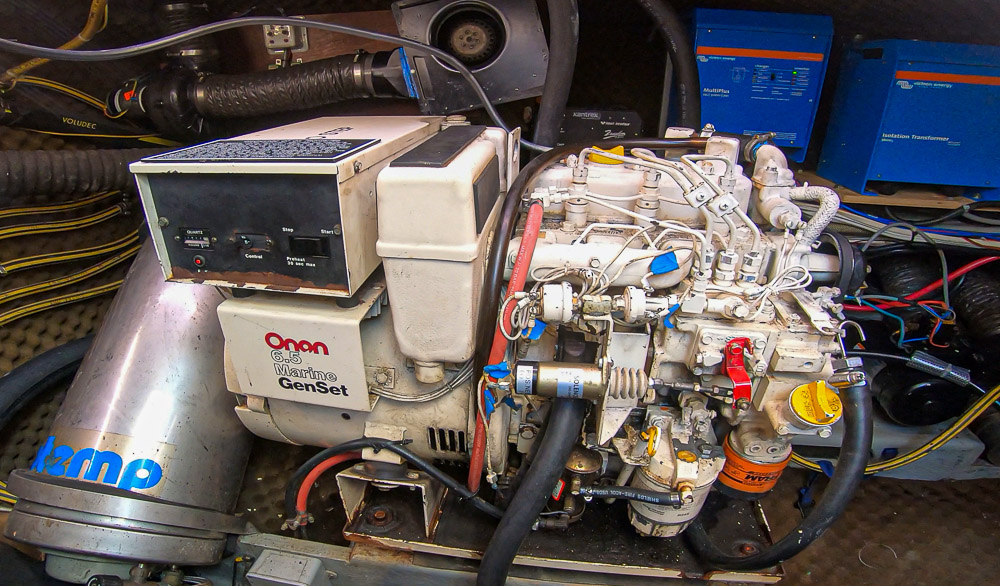
In our case, it was time to revisit things in our electrical system. As we have previously reported, a lack of required spare parts pushed us into deciding to retire our old Onan. We took a step back and evaluated how we used this unit, and if there were better alternatives for us and the way we used our boat.
What we had…
Our Amel is not especially complex for a cruising boat of her size these days. We have 220VAC power outlets in each cabin, two air conditioners, clothes washer, space heaters, and a water heater. Unusually, Amel installed a parallel 120V AC system that we feed only from a 2kW inverter. Other than a few specialized items, this is mostly used for the microwave in the galley.
When away from the dock, we have been running our 6.5kW Onan for about 2 hours every other day to charge batteries, and make water for our routine use. (We have a 40 litre/hour watermaker that draws about 25 amps at 24V). Once a week or so, we’d add another hour to the cycle to run the laundry and make the extra water needed for that.
The Onan fed 220V AC to two battery chargers, one 70Amp unit in our Victron inverter/charger and a 100 Amp unit from Quick. The highest output I ever saw from these units combined was about 120 Amps in total, or about 3200 Watts, about half the capacity of the Onan. In five years of cruising on Harmonie we have run an air conditioner away from shore power exactly once. So we have never really used any more than half the output of the generator.
Our 3kW Victron inverter charger easily drives all of our routine AC needs, including startup loads for the air conditioners. We didn’t need a 6.5kW generator to keep us in the life style to which we have become accustomed.
What We Wanted
Once we realized we were looking at a unit significantly smaller than the original installation, many options were open. Our criteria looked like this:
Minimize fuel use to extend our operating time away from supplies.
Reduce weight
At least 95 amps of 24 Volt charging capacity. (Minimum recommended charge rate from out battery manufacturer)
Minimum capacity of 3kW
At least as quiet as the old unit.
Minimal modifications to existing infrastructure.
Good integration with our existing Victron monitoring equipment.
What We Got
Very different in look and function…
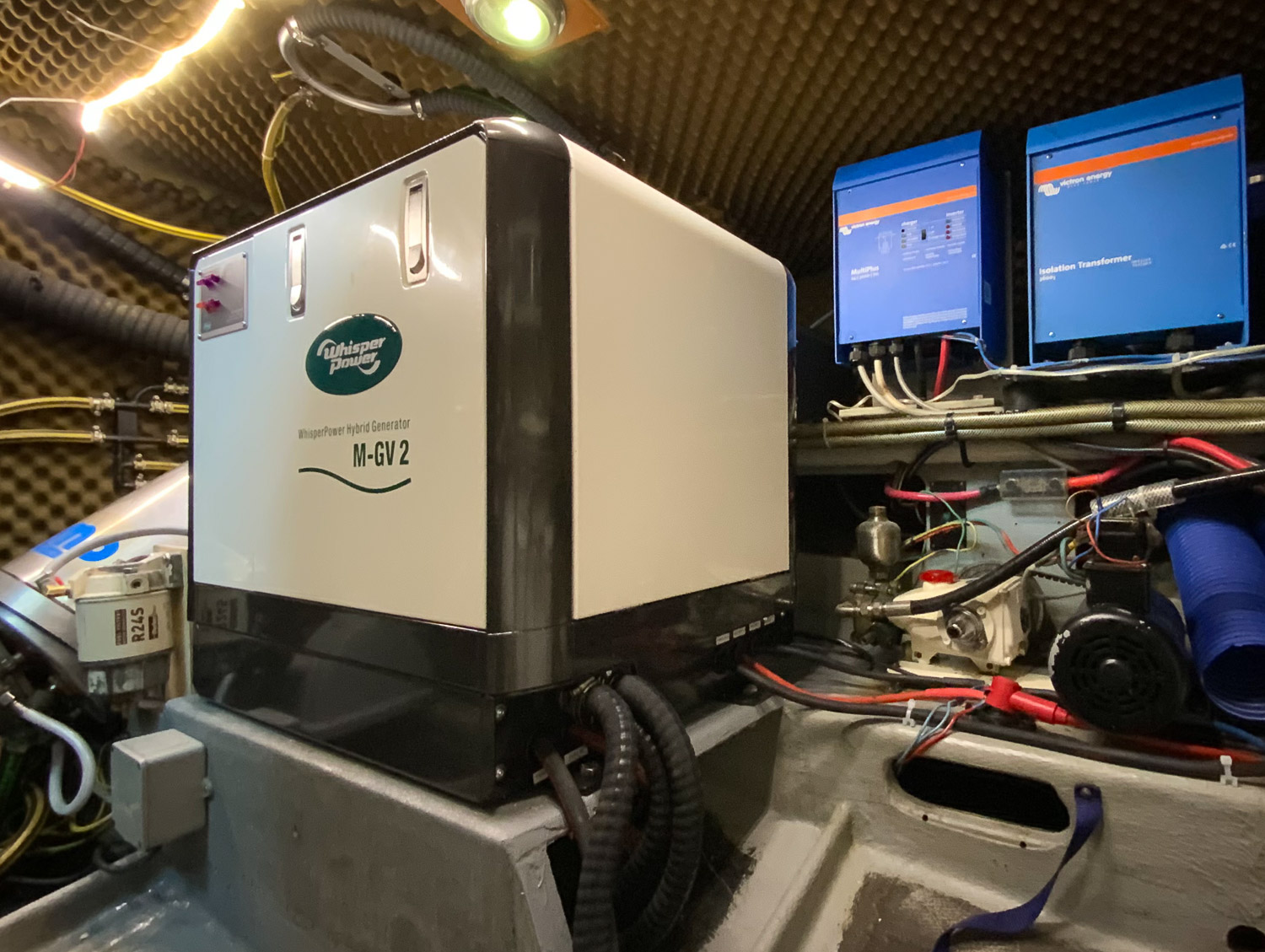
We settled on a generator quite a bit different than the original. We decided on a WhisperPower M-GV 2 variable speed DC generator. Here is a bit of the thinking involved:
Since we were using our generator almost exclusively as a battery charger, doesn’t it make sense to have a generator actually DESIGNED primarily to charge large battery banks?
The capacity of the unit was well matched to what we were looking for, 150Amps at 24 Volts, or about 3.5 kW.
The weight of 140 kgs was very attractive, as was the specified fuel usage. A reduction of about 100 kgs, this has put our boat on an even keel for the first time.
The drive engine for this unit is a 2 cylinder Kubota Z482 engine, a well known and very common system of proven reliability.
WhisperPower is a Dutch company spun off from Mastervolt a number of years ago when Mastervolt decided to get out of the generator business. They are not well known in the US, but are a significant presence in the European yacht and alternative energy market, especially as a high-end OEM supplier.
Connecting to our Victron system with a simple relay connection, our main electrical monitoring panel can start and stop the generator either manually, or automatically based on the state of the batteries.
The permanent magnet alternator technology is far simpler than the field coil system used in synchronous generators. No routine maintenance is required on any moving parts other than the Kubota engine.
Being fully water cooled means a full sound shield can be installed and the engine room is cooler, and quieter than before.
We are able to use the waste heat from the engine to heat our domestic hot water, giving us hot water while away from the dock for “free.” This used to be done from our main drive engine, but that was of limited utility since we didn’t really need much hot water underway, and never ran the drive engine at anchor.
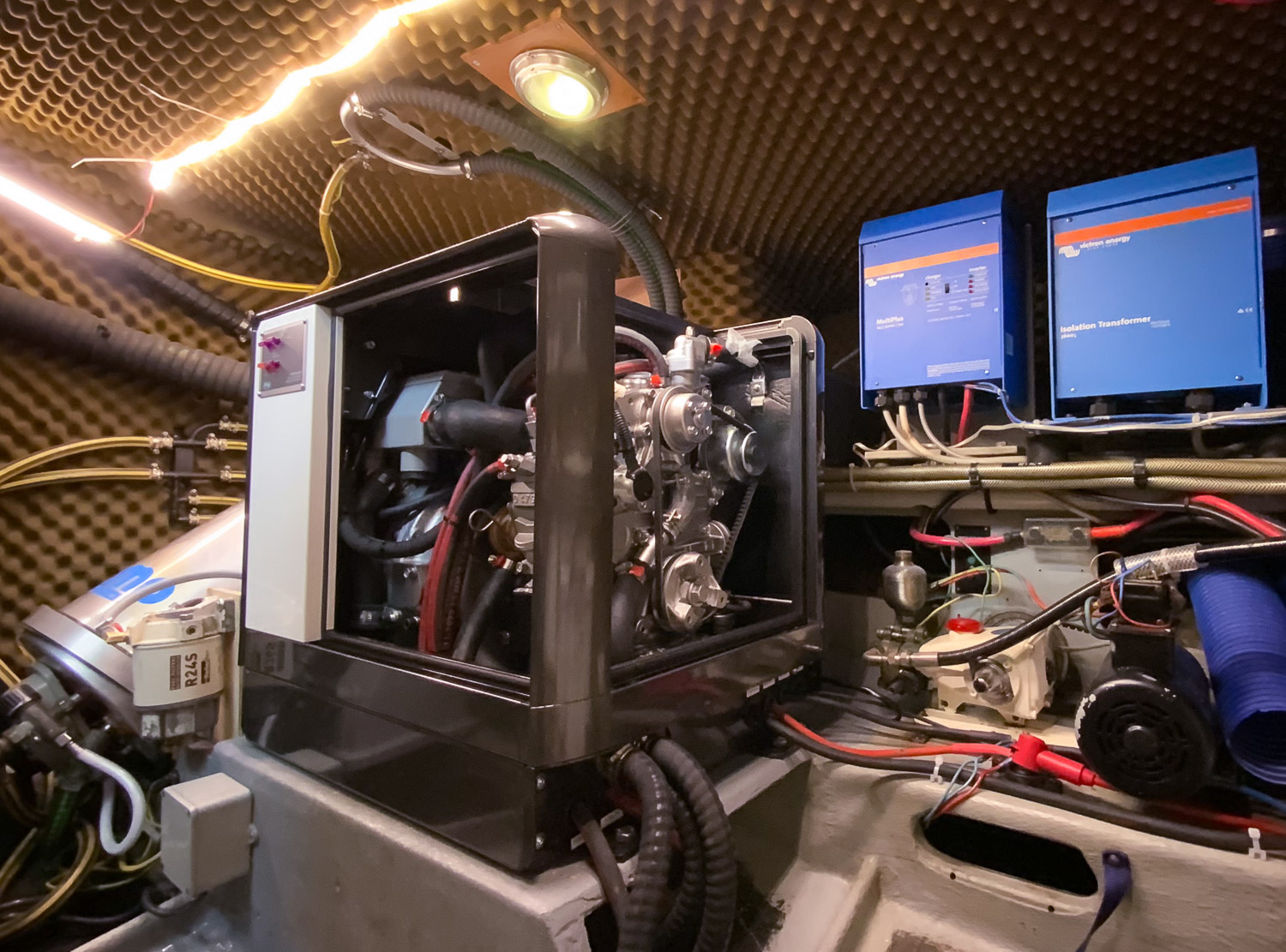
With the covers popped off, maintenance access is excellent.
The “PowerCube” takes shore power of any voltage and frequency, or the output from the generator, and converts to the proper voltage to charge the main battery bank.
How We Will Use It
Based on our testing so far, if we start charging when the batteries are about 30% discharged (70% SOC) and run them up with the generator to 7% discharged (93% SOC) that will take almost exactly 90 minutes of run time to put 107 Amp-hrs (3 kW-hrs) of recoverable energy into the batteries. This would have the generator start off at full output for about 30 minutes, and then taper down to about 25% output over then next hour. This will keep the engine running at its most efficient for most of the cycle, with a chance to cool down a bit at the end before shutting down.
Based on our historical usage, this will happen every other day or so. On a good sunny day, the batteries will then be fully topped off with the solar panels by the end of the day.
How much of this we will automate, we have yet to determine. The Victron monitoring system lets us to automatically start and stop the generator based on state of charge of the batteries, DC power usage, AC power usage, Battery voltage, inverter temperature, inverter overload, … Pretty much anything except phase of the moon! Automation has its advantages, and potential problems. We’ll see how those play out in the real world.
For more…
If you want more of the gory technical details, see this link on our project pages…
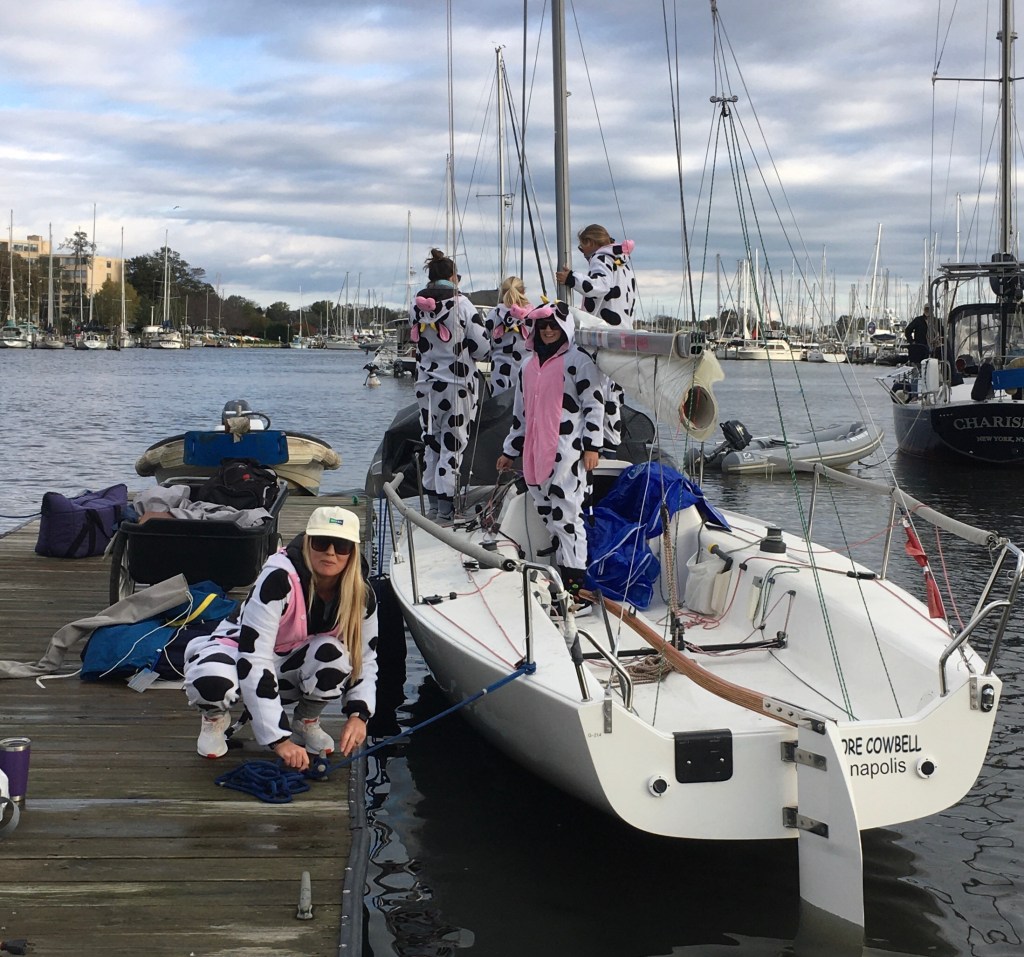
Every serious sailboat racing team competes on two levels. One, of course, is who’s boat is faster. The other is who can look best out on the race course. This usually consists of color coordinated foul weather gear, and such.
A local all female racing team on the boat named More Cowbell has taken this to a new level:
And for those of you who might not get the reference for the name:
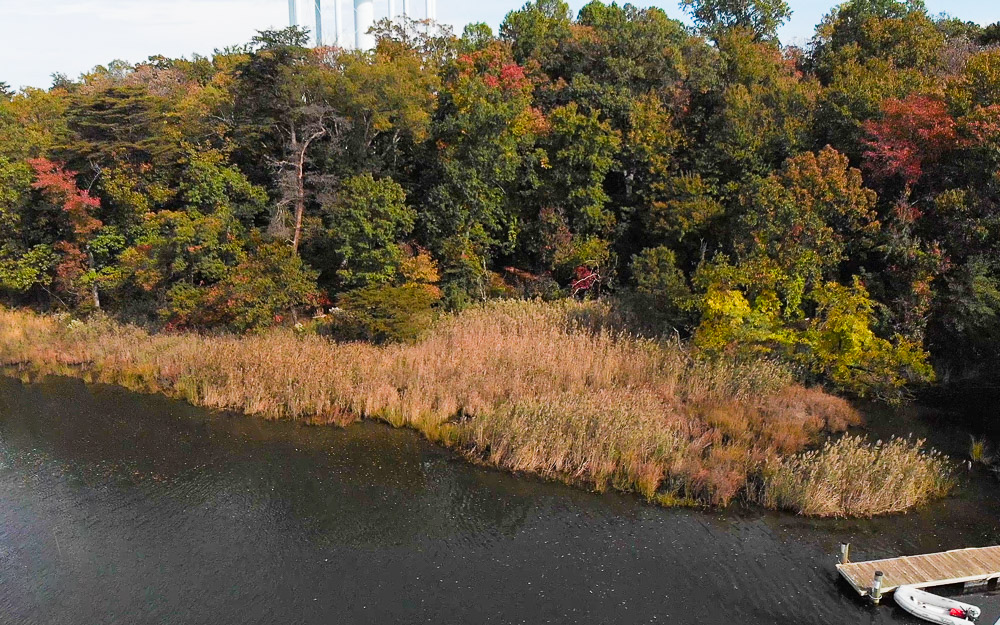
The colors of autumn are beginning to tinge the trees here in eastern Maryland. For us, this can only mean one thing: Time to head south! That will happen in a few weeks, but in the meantime we are once again putting the final tie downs on our fall maintenance and upgrade projects.
We have been working hard on one major, and several minor, projects that are finally coming to completion. Our major project is the installation of a new generator into Harmonie‘s engine room. This major change to our boat’s electrical system has resulted in a long cascade of changes, modifications, and upgrades. From the outside, little has changed, but on the inside Harmonie has undergone a major refit and changed from a boat with a 1990 energy system, to one with a system as modern as any 2020 model year vessel.
Bill has spent 8 hours a day for weeks buried in the engine room (his version of a “man cave”) rerouting wires and plumbing, and making the structural changes needed to accommodate our new generating system. 25 years of modifications and repairs were all brought up to standard, routed in a logical fashion, labeled, and made neat and clean. A master breaker box was installed to collect all the main circuit breakers that had been scattered in various places around the boat.




 fetchinketch