Our time here on Grenada is coming to a close. It has been truly a delightful place to visit. To all of our friends who recommended this as a place to spend “hurricane season,” thank you very much.
It is one of the happy places. The locals genuinely love and are proud of their island. Not a lot of them are rich by any standard of the average American, but the cost of living is low, and the basic necessities are cheap. As one of our taxi drivers said, “There is no reason anyone here should go to bed hungry. Food grows on every tree.”
We just celebrated the local holiday of “Thanksgiving.” Which I expected to be a typical harvest festival, but it is not. It is actually a celebration of the American lead “intervention” in 1983 that put an end to a violent marxist coup. Most of the locals do not call it an invasion, and seem to be extraordinarily happy that it happened. Americans, both individually, and in the abstract, are welcomed here.
There are many examples of foreign aid here. The Chinese continue to build housing complexes to replace stock lost to the hurricane in 2005. The Japanese rebuilt several bridges. The locals are happy to accept the largesse, but also openly refer to these projects as “bribes.” In the case of the Chinese to gain a vote against Taiwan in the UN, and for the Japanese, to leverage a vote in the UN in favor of Japan’s whaling industry. When similar projects from the USA and Canada are discussed, they are presented as simple gestures of good-will.
Crime, unlike on some of the neighboring islands, is extremely low, and the scenery is lush and gorgeous.
Plans…
From here in Port Louis, in the next couple of days, we will be heading north toward Carriacou, the northernmost island in the country. We have an urgent need to replace a seacock valve that requires the boat be lifted out of the water for a few hours, and the boatyard in Tyrell Bay can do that for us.
From there, we will head to Martinique. Bill will (probably!) be headed to Panama to do a delivery of an Amel to Texas. Once that 2 to 3 week project is complete, we will continue to move north. Another customer for a pre-purchase survey awaits us in St Thomas, and then we get to explore more of the Bahamas before returning to the USA.
It’s a rule: When you fish in places most other people do not, you catch things most other people do not. If you have followed our fishing explorations at all, you have seen that we have extended our fishing world not just by moving to new places on the ocean’s surface, but by fishing deeper…
We recently took Harmonie out to try our luck again at what is called “deep drop” fishing. There really is not a specific number for when fishing gets “deep”, but we were targeting fish at about 1200 feet (360 m). By anybody’s definition, that’s deep.
We were looking for snowy grouper, and queen snapper–which we did not find–but on our first drop to the bottom, we did hook one of these a quarter mile under the boat:
At 65 pounds, one of the bigger fish we have landed recently, the first one in a long time that took both of use to heave over the rail. I looked at as it came aboard and said, “What in the….????”
My first guess was a fish I have had at sushi restaurants, and had a vague idea what they looked like. A quick check of my references and I was pretty sure. An “escolar.” To make a long story short, after much fussing and back and forth, I have changed my mind. It’s a closely related species, an oilfish.
These are quite unusual fish in many ways. They are part of the “deep scattering layer” A dense group of fish, squid and plankton that are highly light-adverse. The very large eyes, with the intensely reflective retina are typical for a creature that hunts in near total darkness. They migrate every day from more than 1000 feet deep during the day, to near the surface at night. This is an impossible thing for most fish to do.
Fish muscle and bone is heavier than water. To counteract this, most fish have a gas filled chamber, the swim bladder, in their bodies that adjusts for this and gives the fish an overall density equal to the water they swim in, and lets them hover motionless. The problem is any fish with a normal swim bladder that tried to rise from 1000 feet deep to the surface would explode as the gas in its swim bladder increased in volume by 30 times as the pressure dropped. So a fish that needs to do this needs must have another approach.
The escolar and the oilfish solve this problem in a different way. If I can’t hold a bunch of gas to make me float, then I’ll just make the density of my muscle lower. They do this is by storing large amounts of oil in their flesh, enough to make them just about exactly the same density as water so they maintain a neutral weight in the water without having to worry about gas exploding as they migrate every night.
But these are not “oily” fish in the same way as, say, a herring. The meat is firm, snow white, and very tasty. Raw and cooked they are delicious. If you have ever had “white tuna” at a sushi restaurant, you have almost surely had escolar. If you cook these, the oil melts and runs out of the meat at an amazing rate. It’s like cooking bacon. But the oil has no “fishy” smell or taste.
There is a catch to this…
The fats these fish store in their bodies are not “normal” animal fats or fish oils. They are “waxy esters.” Humans do not have the digestive enzymes to breakdown this type of fat, so if you eat enough of it, it basically acts like a lubricant laxative. While the result is not unhealthy, it is decidedly unpleasant. The general recommendation is that a serving of 6 ounces or less is perfectly safe to eat for most people.
We have found that Bill tolerates this fish quite well as tablefare, Karen…. not so much. So we’ll just skip donating freezer space to these in the future.
I am reminded of a story from our travels several years ago, where we were in Turks and Caicos at a dock with several super yachts. The crew had been out deep drop fishing that day, and told us they had caught a large oilfish that they cooked up as a “special” dinner for the charter guests. I am guessing that this particular set of charter guests wasn’t very popular with the crew. I’m betting there was quite the impatient line for the toilet the next morning… Moral of the story: Always be nice to the help.
There is a lot to learn about food here in Grenada from one exchange Karen had in the grocery store. She commented that it had been days since they had any ginger root at all. The local lady behind her explained, “It’s been raining for three days. Nobody want to be out there digging in the mud!”
Every weekday, there is a van parked along the road with its tailgate open. Inside are many dozens of dozens of eggs being sold by the owner of 2,000 hens that lay the eggs. In the grocery store, chickens look like nothing you have seen in a stateside grocery in a generation. Not the overbreed monstrosities, but something the size and shape of a real bird. Almost no extra fat, and very tasty.
With rich volcanic soil, a stable climate and an even supply of rain, the locals brag that you can plant anything and it will grow.
Here at the marina, there is a small “farmer’s market” every Saturday. There is at least one real farmer there every week. Jenny runs a small farm up in the hills. and a little while ago ran an open house at her homestead. It was an interesting mix of locals, ex-pats of a wide variety, and visitors. Food, music, and a fascinating setting.
The Farm
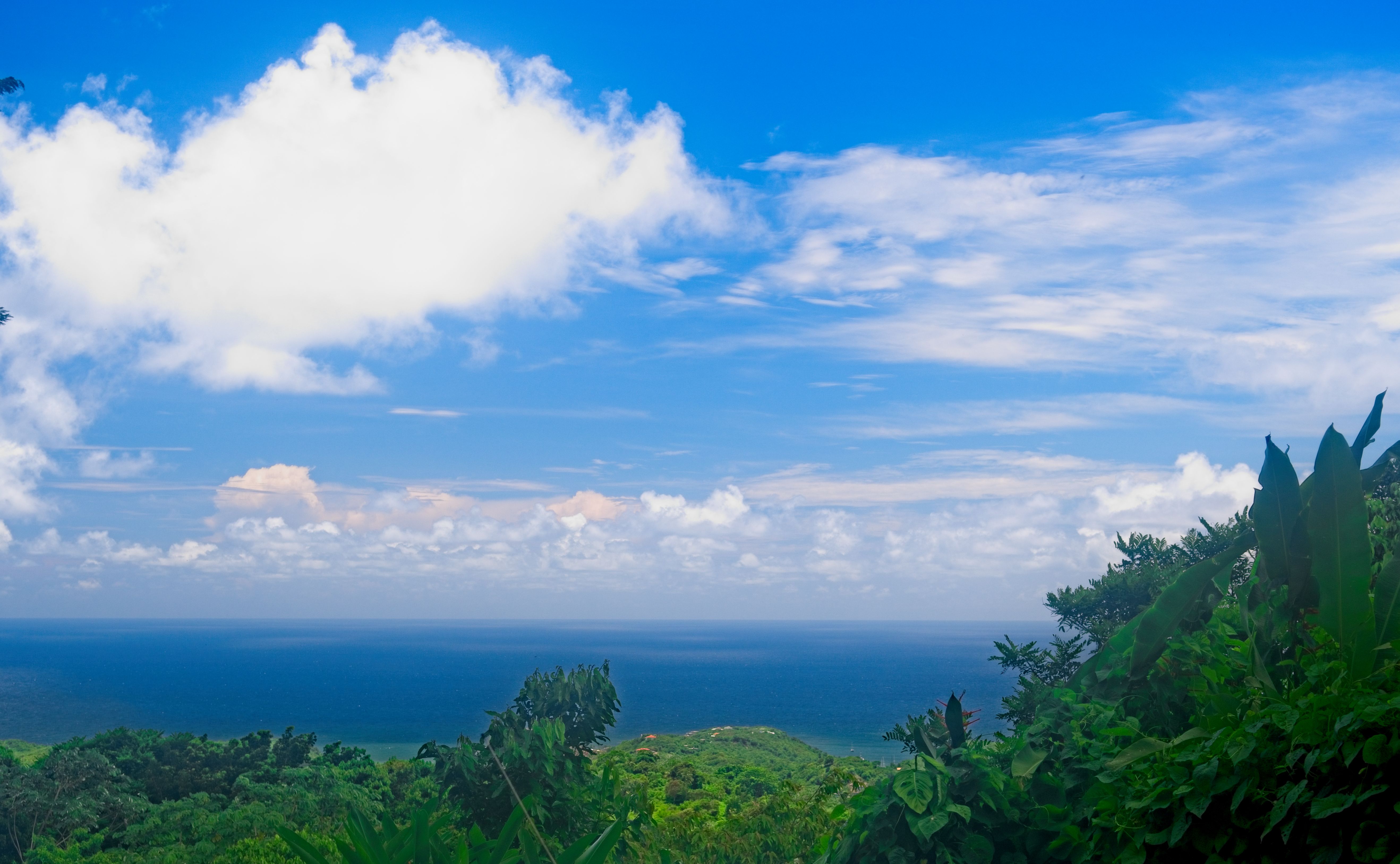
Located up a steep, narrow, and winding road on the southeast side of the island, Jenny’s farm is just like almost every other patch of land on the island: steep. Flat ground is very rare. The view out to the ocean is spectacular.
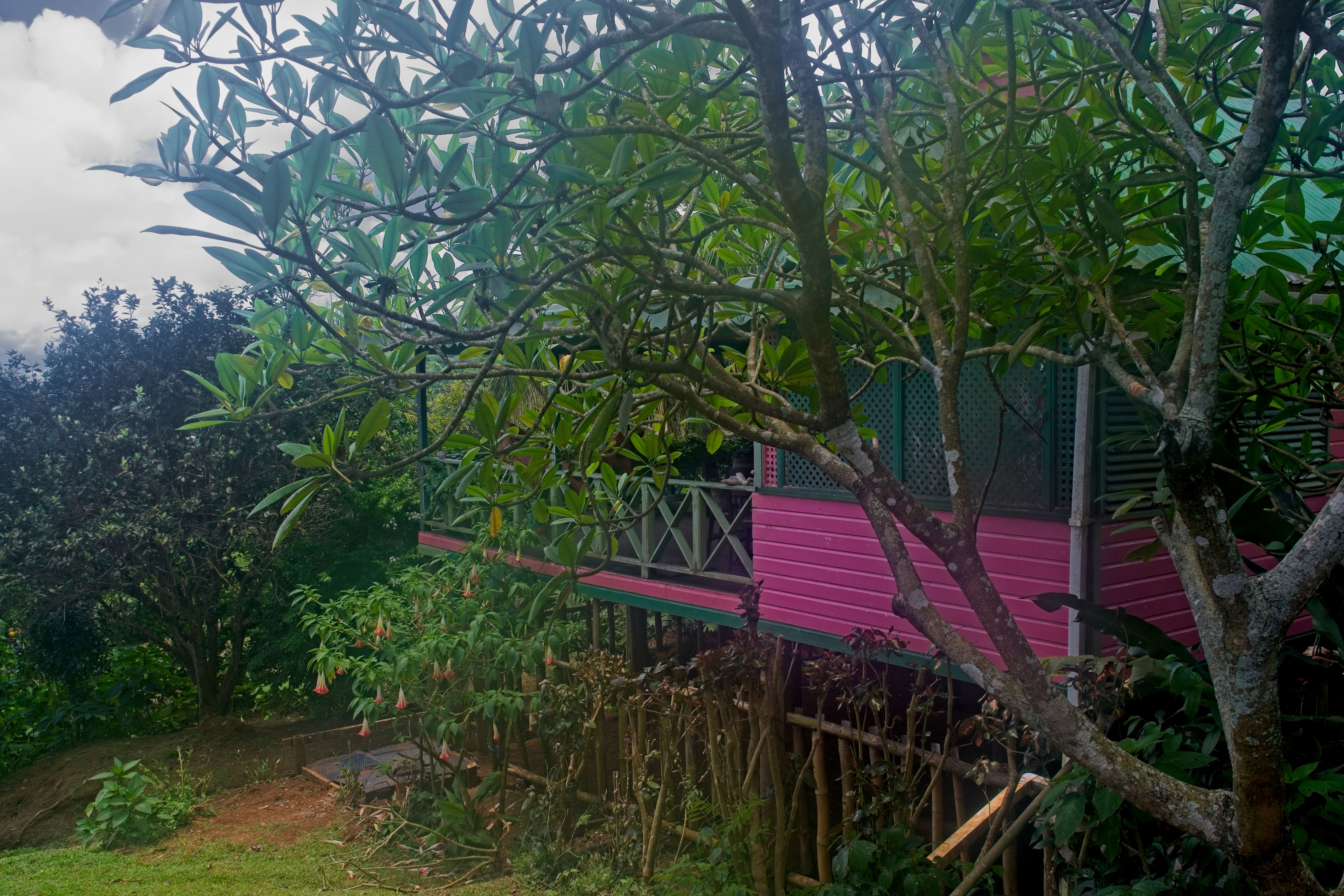
The “farm house” is a particularly tropical design. There are shutters, but no glass in the windows. Cold is not an issue in this climate, and at this altitude, the valley below funnels the tradewinds up and through the house. Even this close to the equator, air conditioning is not needed.
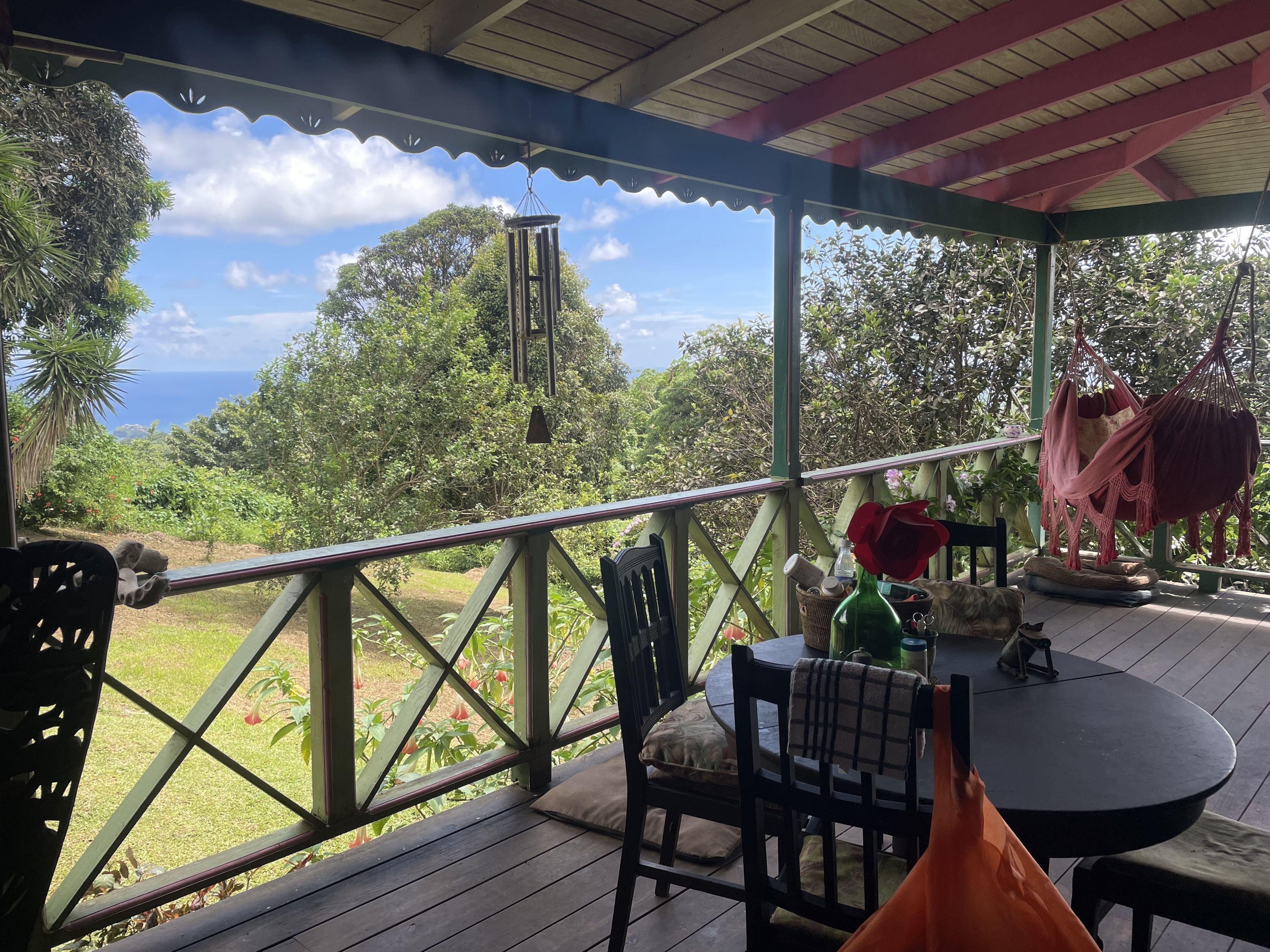
The house is surrounded by a wide porch, with an overhanging roof, ensuring that ventilation can continue even in the frequent rain showers. The whole setup makes the difference between “indoors” and “outdoors” sort of fuzzy.
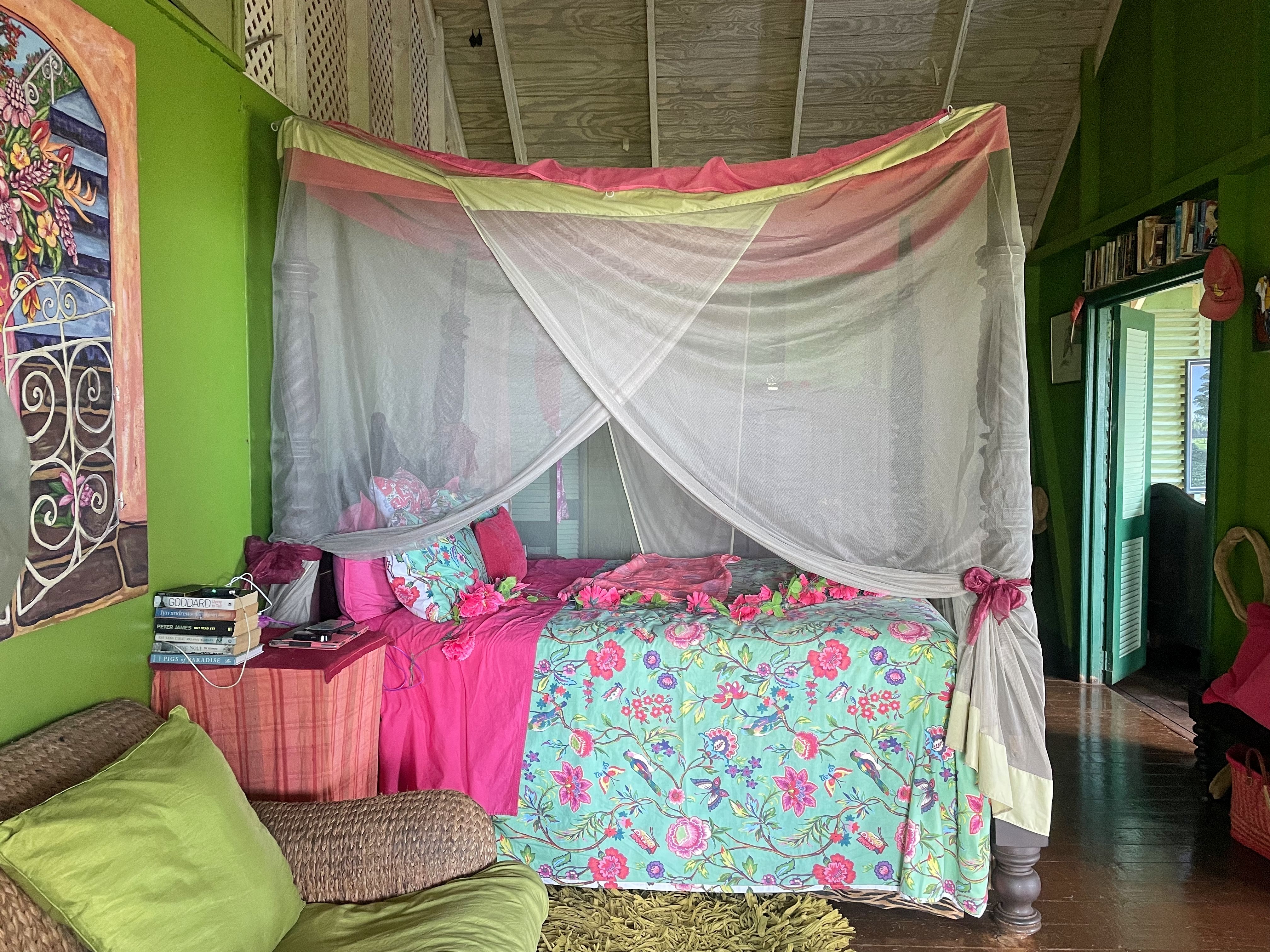
Of course if you open your house to the world, you have to occasionally expect some guests who will have varying degrees of welcome. With neither glass nor screens on the windows, mosquito netting is an important bed accessory.
If you look closely you might see another pair of guests in the bedroom a bit larger than a mosquito… (answer below)
Jenny has an obvious soft spot for animals. She hosts over 20 rescue dogs, a blind pig, a lame donkey, and I am sure more critters that we missed. Oh, the guests in the bedroom picture? Up high on the ceiling, just left of center, a pair of small bats sleeping for the day.
The Big Crops
The big cash crops here are soursop, nutmeg and chocolate. Although there is a lot of land devoted to agriculture you can drive down the roads all over the island and never see anything that looks like a traditional farm. Especially from a distance, you see a lush green hillside that looks like any other patch of tropical forest, but it is actually is a carefully managed farm. Nutmeg and cocao trees grow in mixed culture with bananas and other fruit.
You might never have hear of soursop, but it has become a recent favorite of the woo-woo health crowd and is supposed to cure everything. You know magical thinking is involved when a tea made from the leaves is touted as a cure of all kinds of things, but ONLY if made from an odd number of leaves. Yeah, right. If you are thinking about soursop as a cure-all, there is as much evidence for it as a cause of a type of Parkinson’s as well. So there is that.
Lucky for the local farmers it grows well here, and they have ready export markets to Trinidad and the USA. The fruit has become so valuable as a cash drop, that soursop rustling has become a thing. Last week two locals were fined under a new law to about half a year’s average annual income for picking fruits from trees they did not own.
Nutmeg was a huge crop here. Brought here by the British in the early 19th century as part of their effort to break the extremely lucrative Dutch monopoly on nutmeg in its native Indonesia. In 2003 Grenada was 2nd or third (depending on who is telling the story) in world nutmeg production. In 2004 Hurricane Ivan destroyed almost all of the trees on the island. New trees have been planted and are now coming into fruit bearing age.
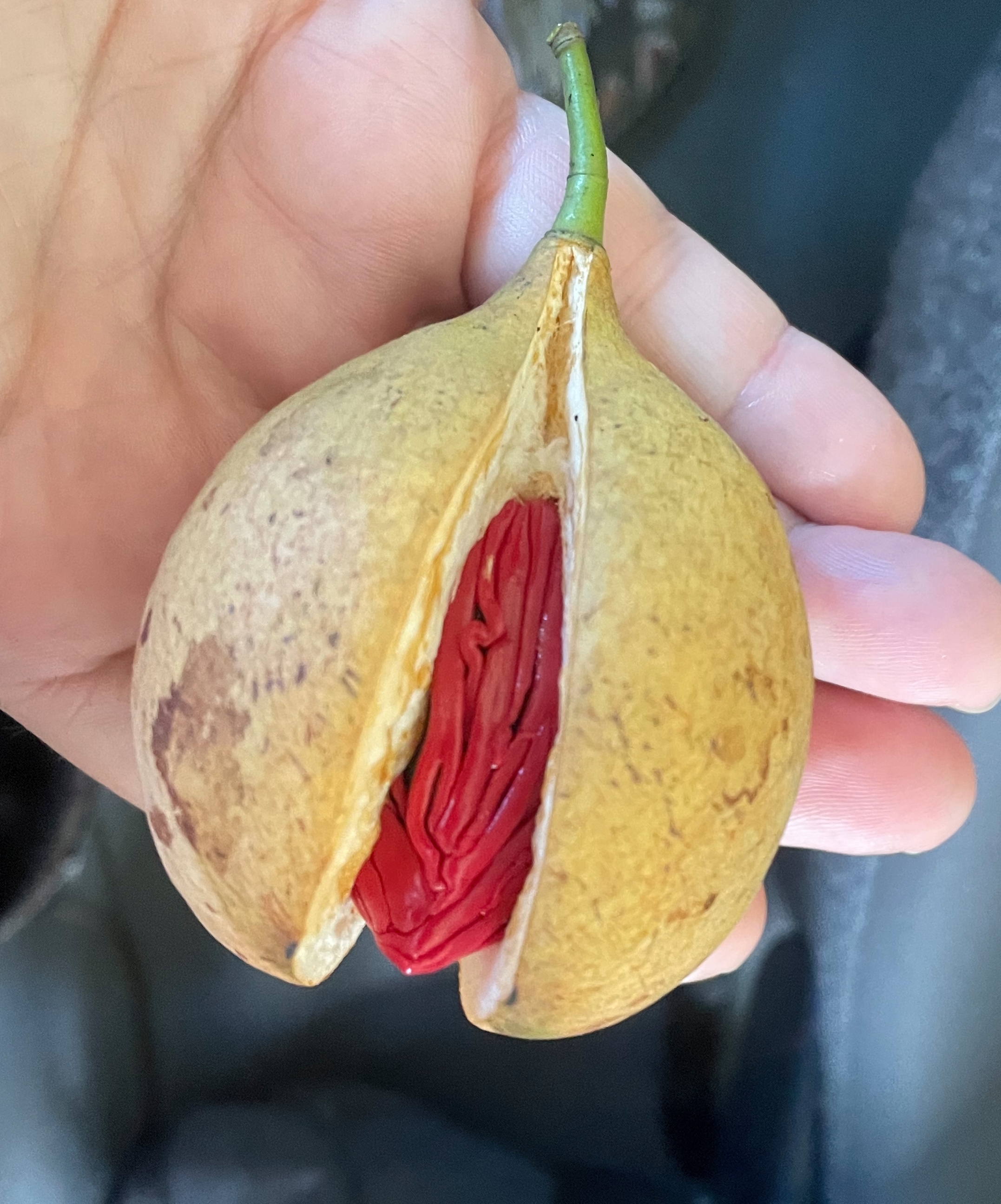
Nutmeg is a medium sized tree, a bit unusual in its a pyramid shape, where most tropical forest trees have high spreading crowns. The fruit has four parts:
The complete fruit of the nutmeg tree.
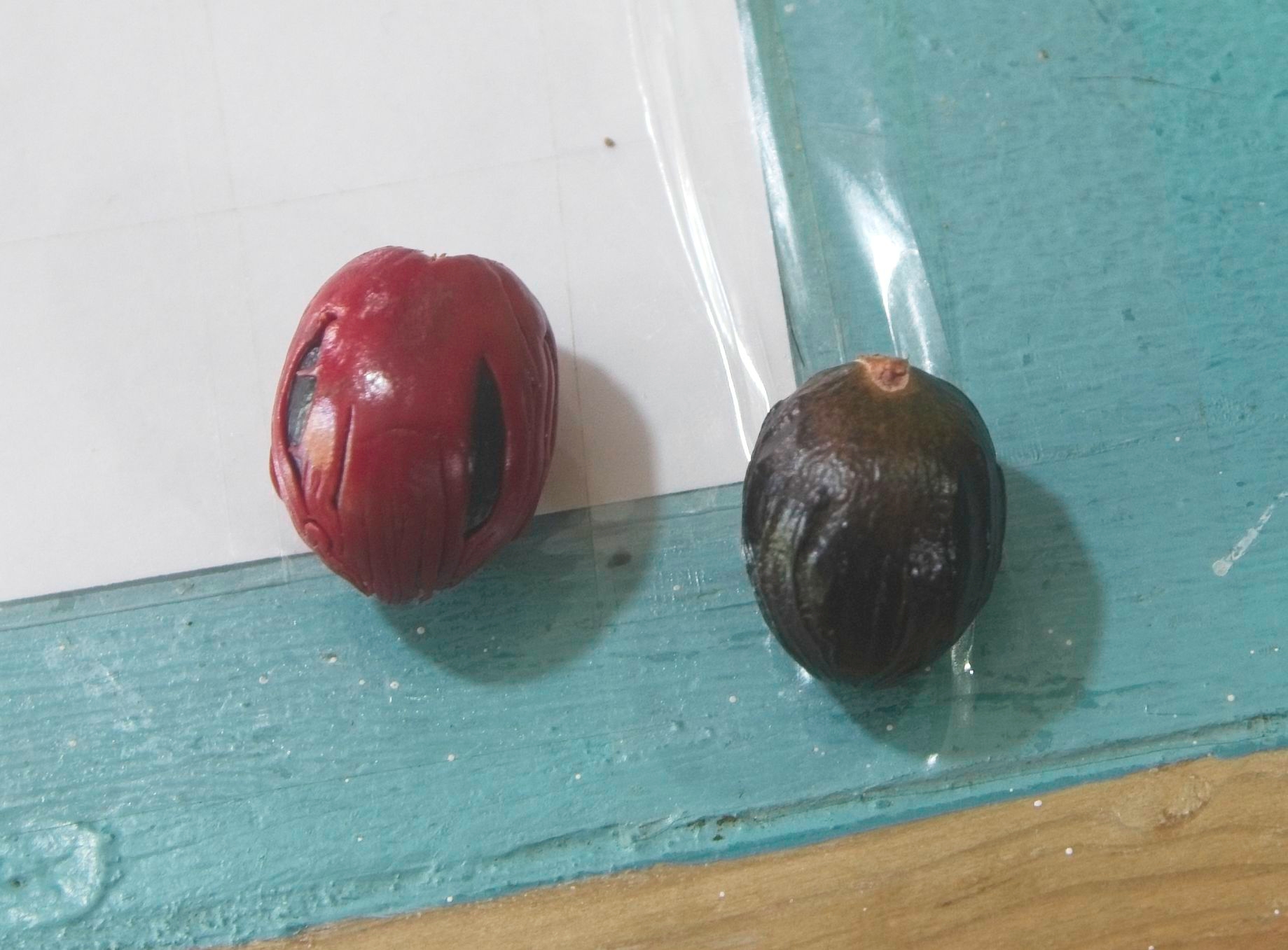
The yellow outer pulp, a red lacy lining, a hard shell, and the inner nut. The outer pulp is sometimes consumed as a sweet fruit, the red lining is actually the spice “mace”, the inner nut is the actual nutmeg, the most valuable part. The shell of the nut is the only part that has minimal economic value. It is widely used as a garden mulch here on the island. When fully ripe, the fruit splits open and the mace and nut fall to the ground. This makes it easy to spot a cultivated nutmeg tree, the ground under them is kept clear to make it easy to harvest the ripe nuts.
On the left, the nut wrapped in mace, and on the right the raw, unshelled nut.
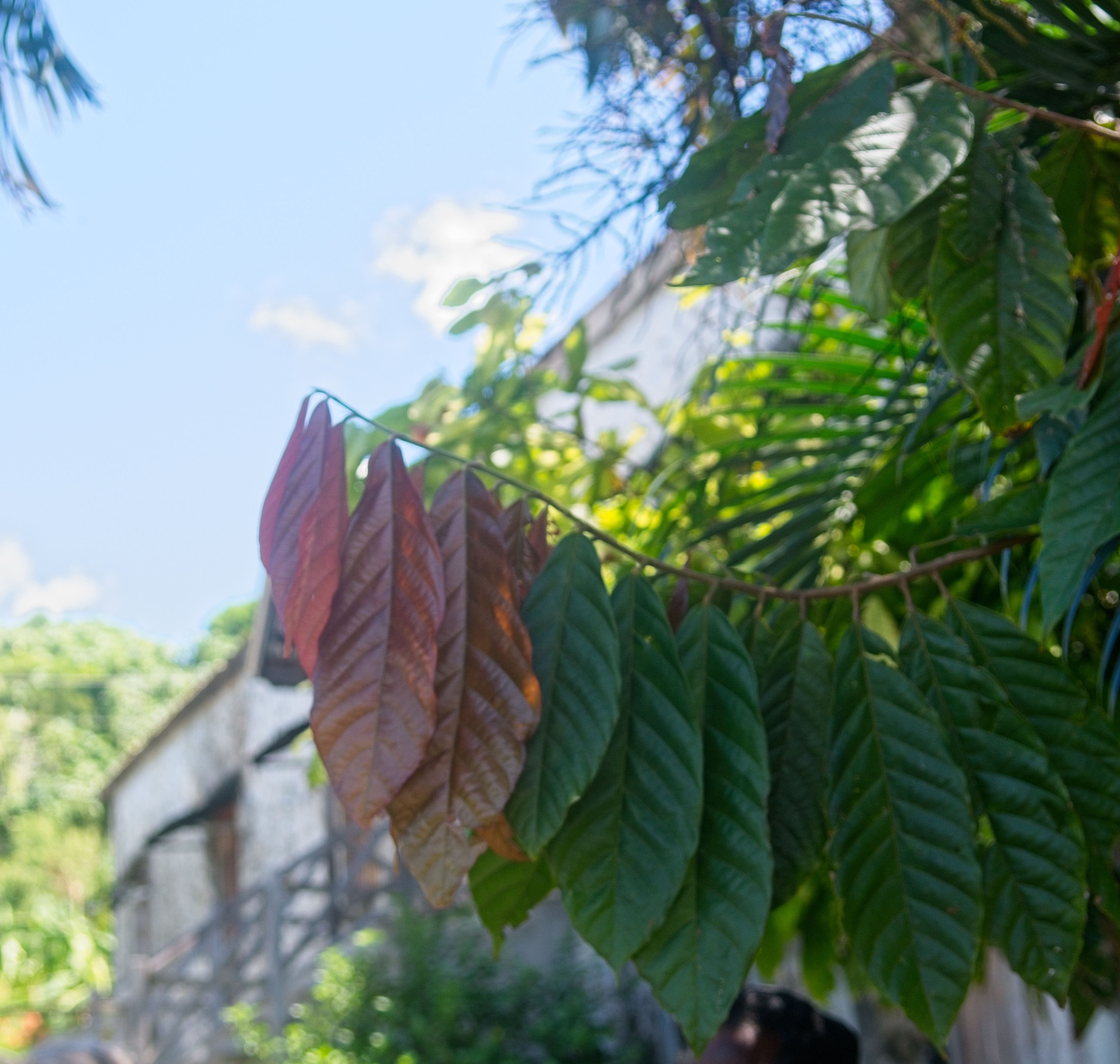
The Cocao tree grows very well here. It is easily recognized by its large drooping leaves, and the red-brown color of the young leaves.
Cocoa leaves.
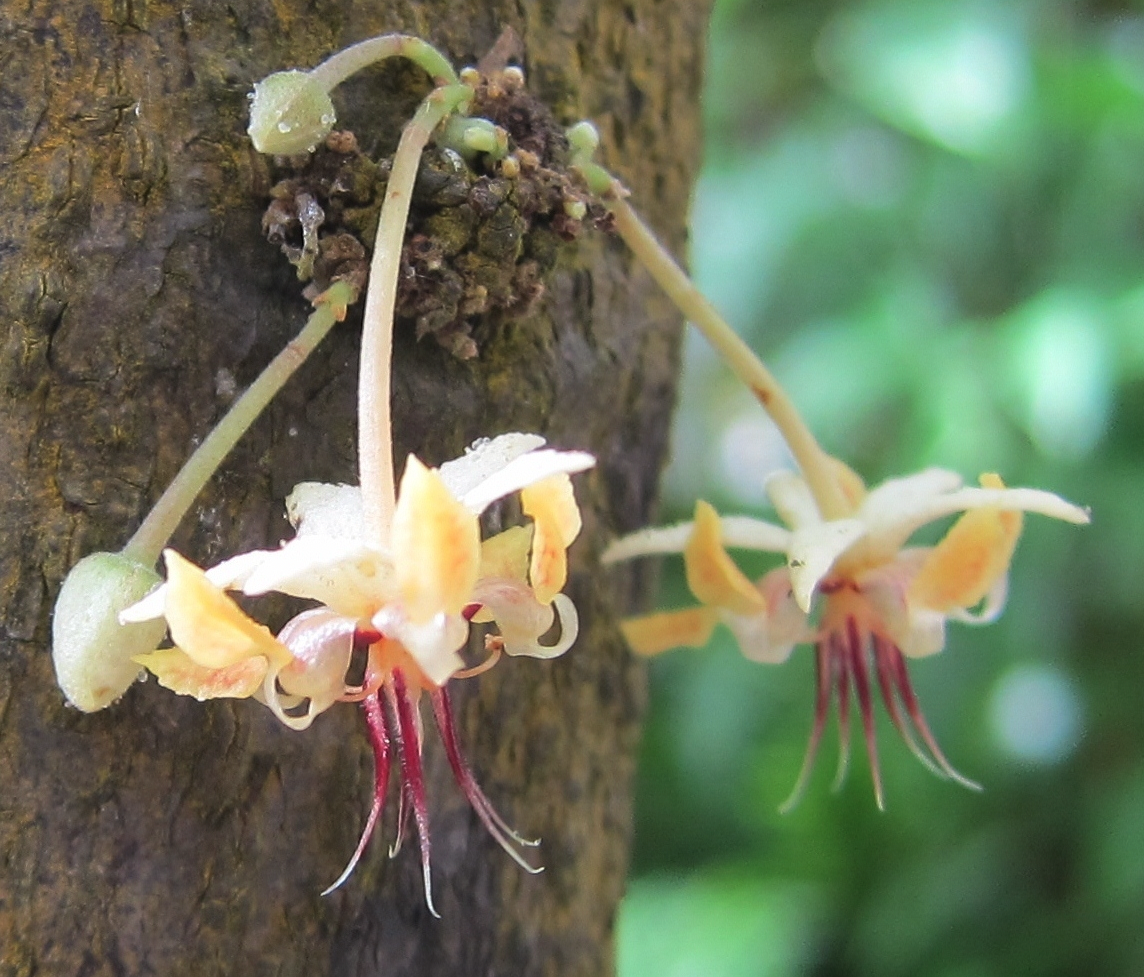
The small trees have an unusual fruiting habit. Instead of flowering on new growth, the rather small flowers sprout from the trunk and main branches.
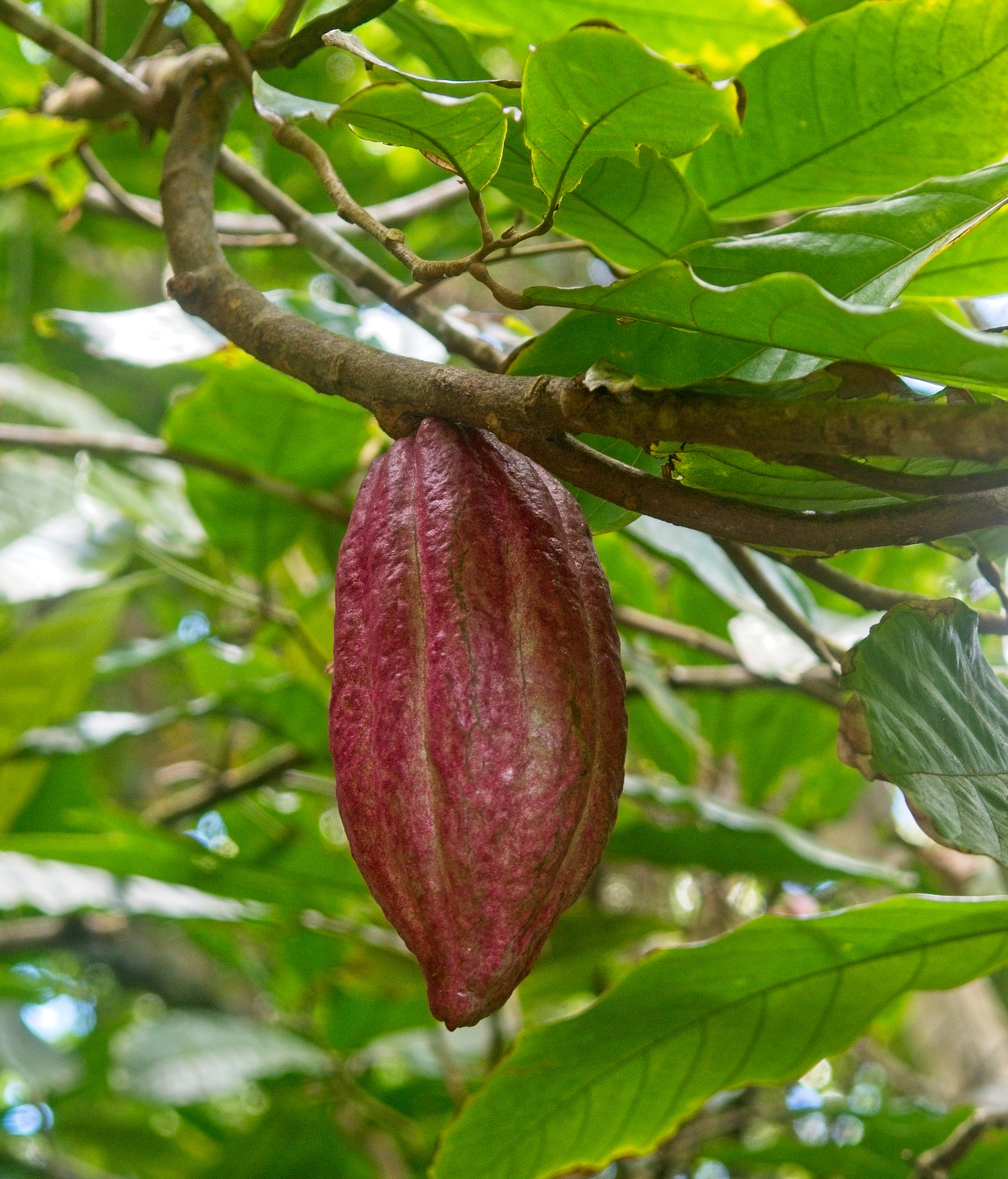
The large seedpods that follow are red or yellow as they ripen depending on variety.
Inside the raw fresh pod, the seeds are encased in a white sticky goo that is sweet and tastes like mango. At this point the seeds themselves are bitter and inedible. In the local markets, this is “wet cocoa.”
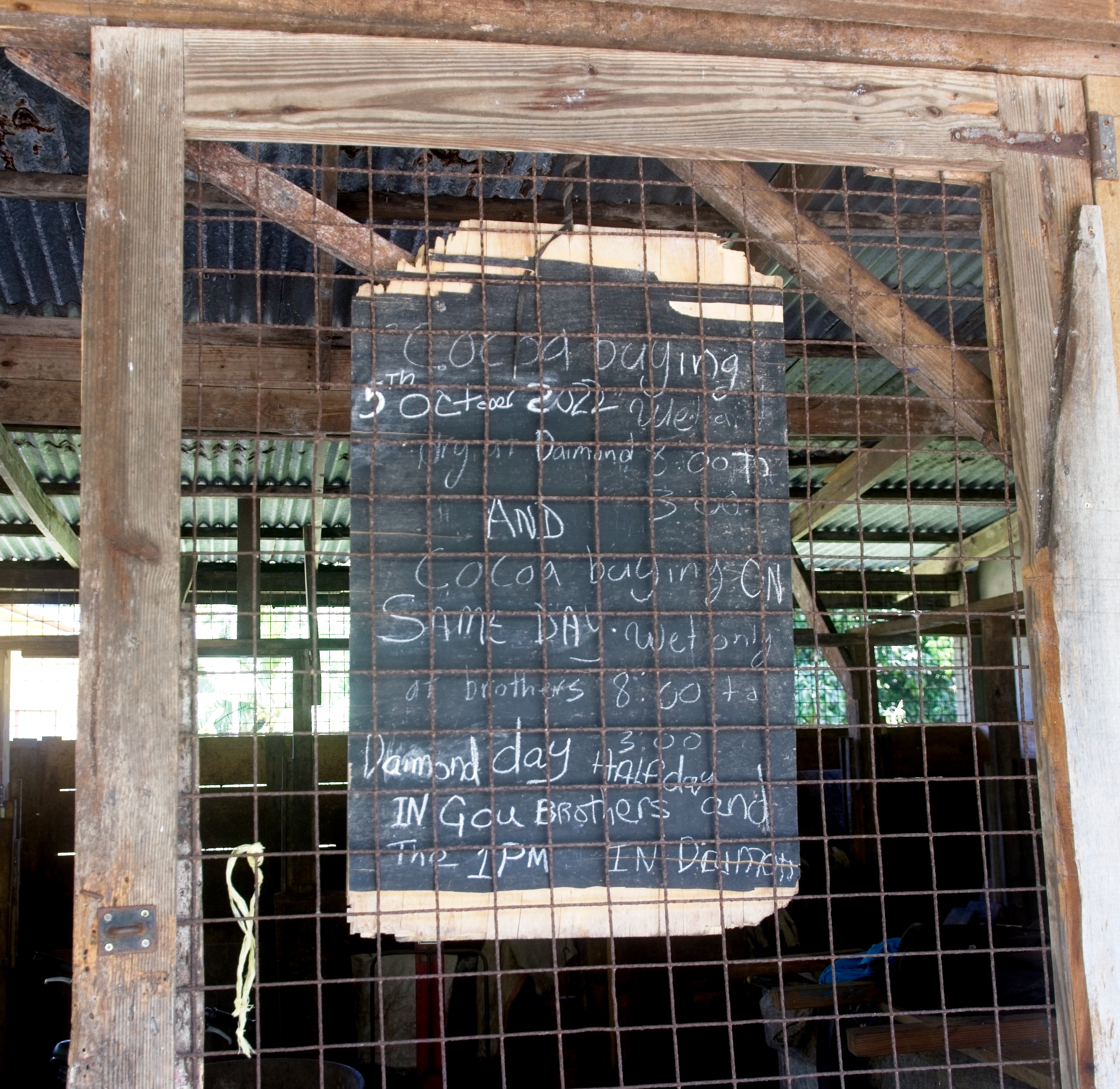
The local chocolate factories buy the seeds from the farmers. The chalkboard lists the places they will be buying this week:
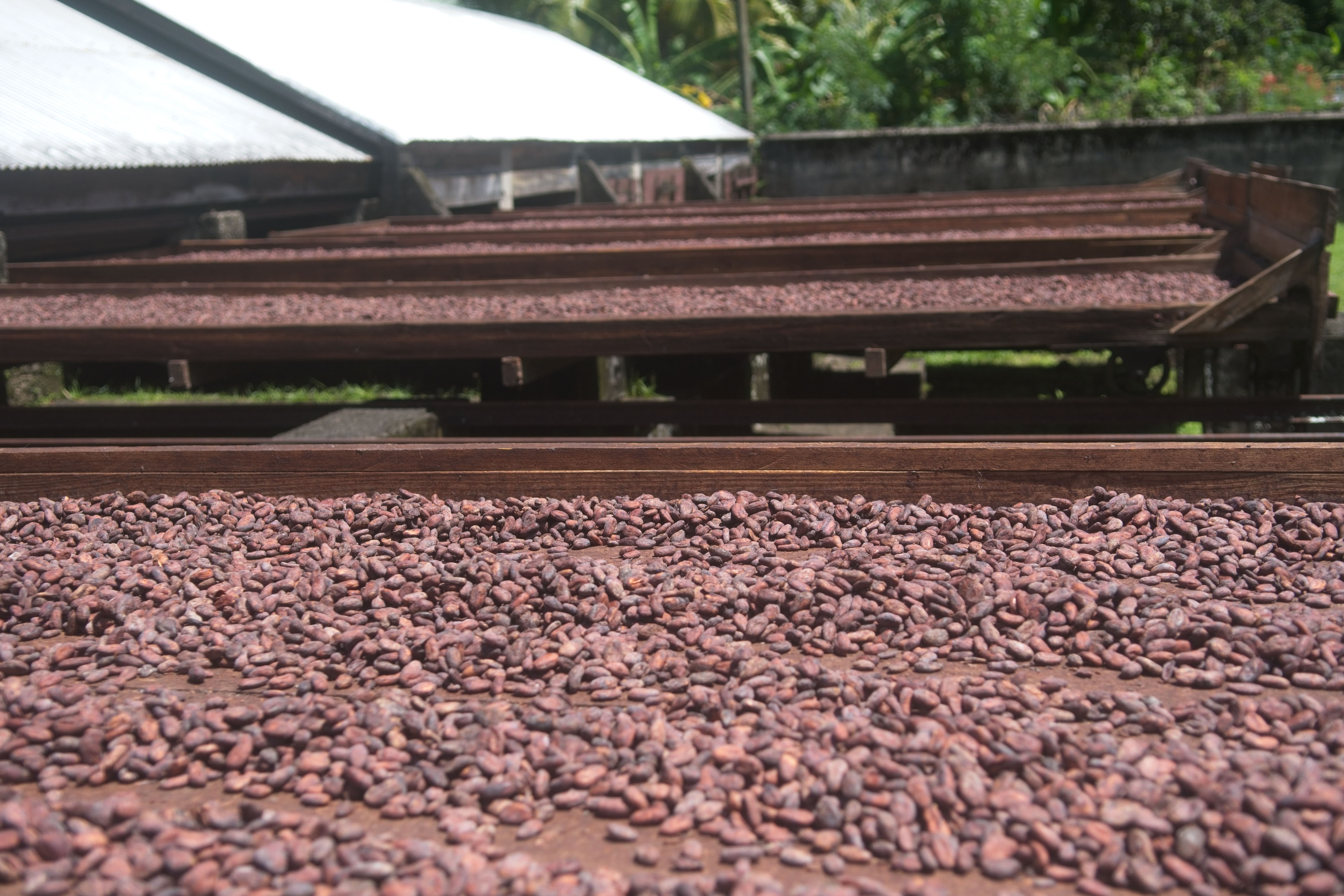
The first step in processing is to cover a pile of the wet seeds in banana leaves and leave them to ferment for about a week. They come out of this process a dark brown, and are ready to dry in the sun. Spread on large trays that run on rails so the crop can be pushed under cover if rain threatens.
After a week in the sun, you now have “dry cocoa.” They look a lot like large kidney beans. Some of the larger farmers will do these steps at their farm, to add to the value of their crop. This is the first stable product that can be stored or exported.
The “beans” are now roasted, and the shells removed. This results in a product called “chocolate nibs.” The nibs are very rich in the fat known as “cocoa butter,” so much so that when the nibs are ground a thick liquid known as “chocolate liquor” is the result.
From here on, the processing consists of matching controlling the amount of cocoa butter. If enough cocoa butter is removed that the product is just solid at room temperature, you have “100% chocolate” or “baker’s chocolate.” If essentially all the cocoa butter is removed, you have cocoa power, as would be used to make hot chocolate. Intermediate amounts of cocoa butter make various other grades of chocolate. “White chocolate” is made just from the cocoa butter itself.
We have arrived back in Grenada. The primary reason for our side trip to Barbados was to get my (Bill’s) passport renewed at the US Embassy there. Although there is an embassy in Grenada, it seems to carry minimal staffing and could not give a specific timing when they could accept an application. That process was smooth and uneventful. Now we wait…
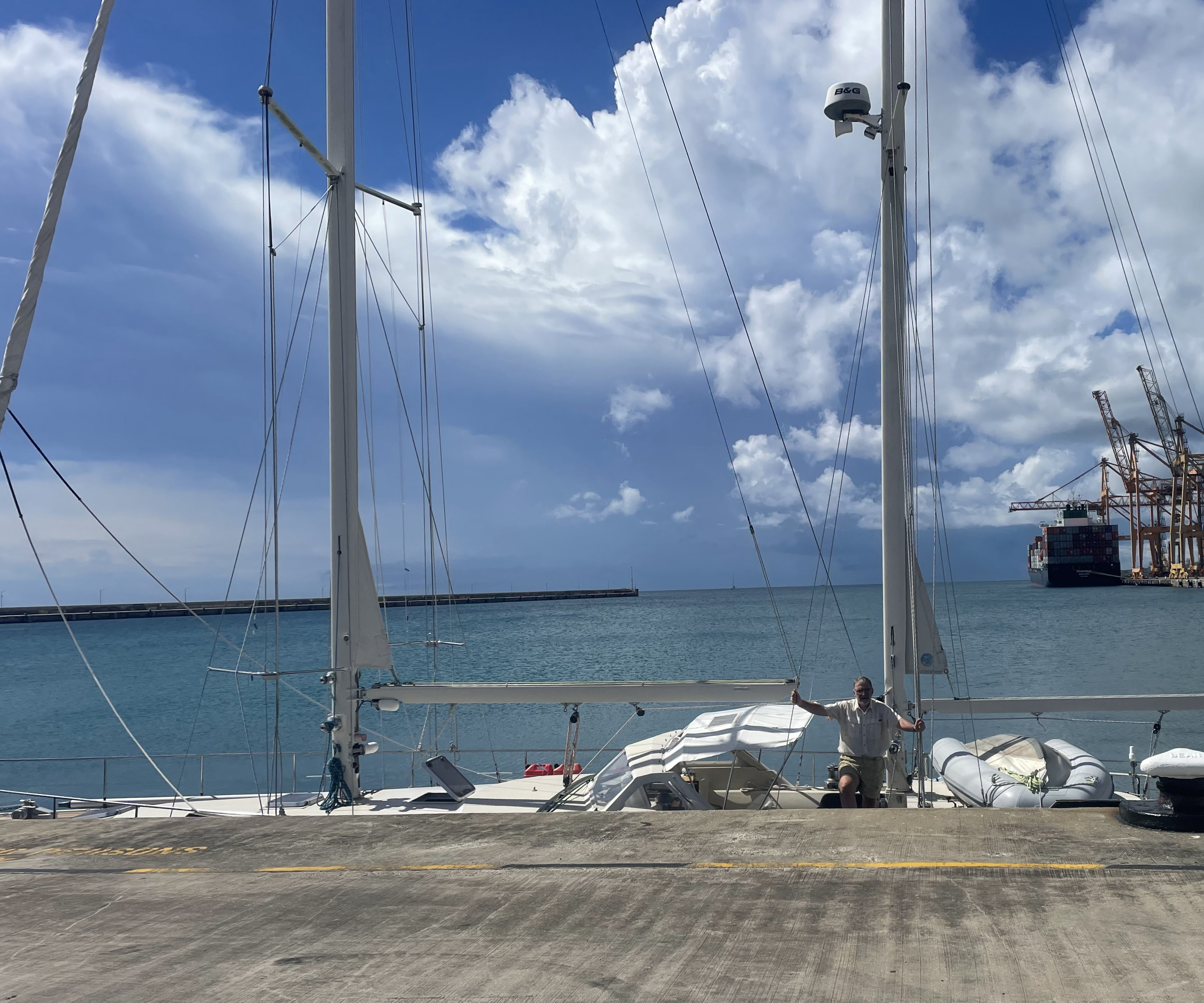
When we first arrived in Barbados we were instructed to tie up in the main ship harbor to clear customs. We felt like the smallest of small fry tied up to a dock designed for ships that outweigh us by a factor of 50,000 times.
Harmonie tied to the customs dock in Bridgetown, Barbados.
When we returned to the customs office for our clearing out procedure, there was another boat had taken our spot:
The yacht Octopus tied to the same spot.
This is the bow of the SuperYacht Octopus built by the late Paul Allen, founder of Microsoft along with Bill Gates. If you are interested in this 417 foot monster you, and 11 of your closest friends, can charter her (and all her toys) for $2,200,000 per week.
Our sail back to the waters of Grenada was uneventful. We couldn’t get much fishing in during the crossing, the amount of sargassum weed in the ocean here is enormous. Once in the lee of Grenada we did get some lines out, and had good luck getting wahoo to bite, but couldn’t reliably turn strikes into hookups. The one we DID hook we lost at boat side… bummer….
We anchored off Grenada for the night, and lit the flood light on our stern for entertainment. We were not disappointed. Soon we had many small fish swarming in the water. Before long, a bird was darting back and forth grabbing small fish. It was moving so fast and was in the light for such a short time we couldn’t really get a handle on what kind of bird it might be. So out came the camera gear.
It’s a challenge getting a photo of a fast flying bird during the day in full sun. At night, with a (relatively) dim lamp it’s orders of magnitude harder. Not exactly expertly, but good enough we can make a positive ID, and good enough you can see the fish he is feeding on in the water…
Our nighttime fish eating visitor….
Yep… not a bird, but a bat! I had no idea there were fish eating bats. The “Greater Bulldog Bat,” bigger than most bats I am familiar with. Larger than a pigeon, smaller than a big seagull. How does a bat “see” the fish underwater? Well, apparently it doesn’t. Instead it uses its sonar to detect the ripples on the surface made by the fish just under the water, and then grabs them with its legs. Nature never ceases to amaze.
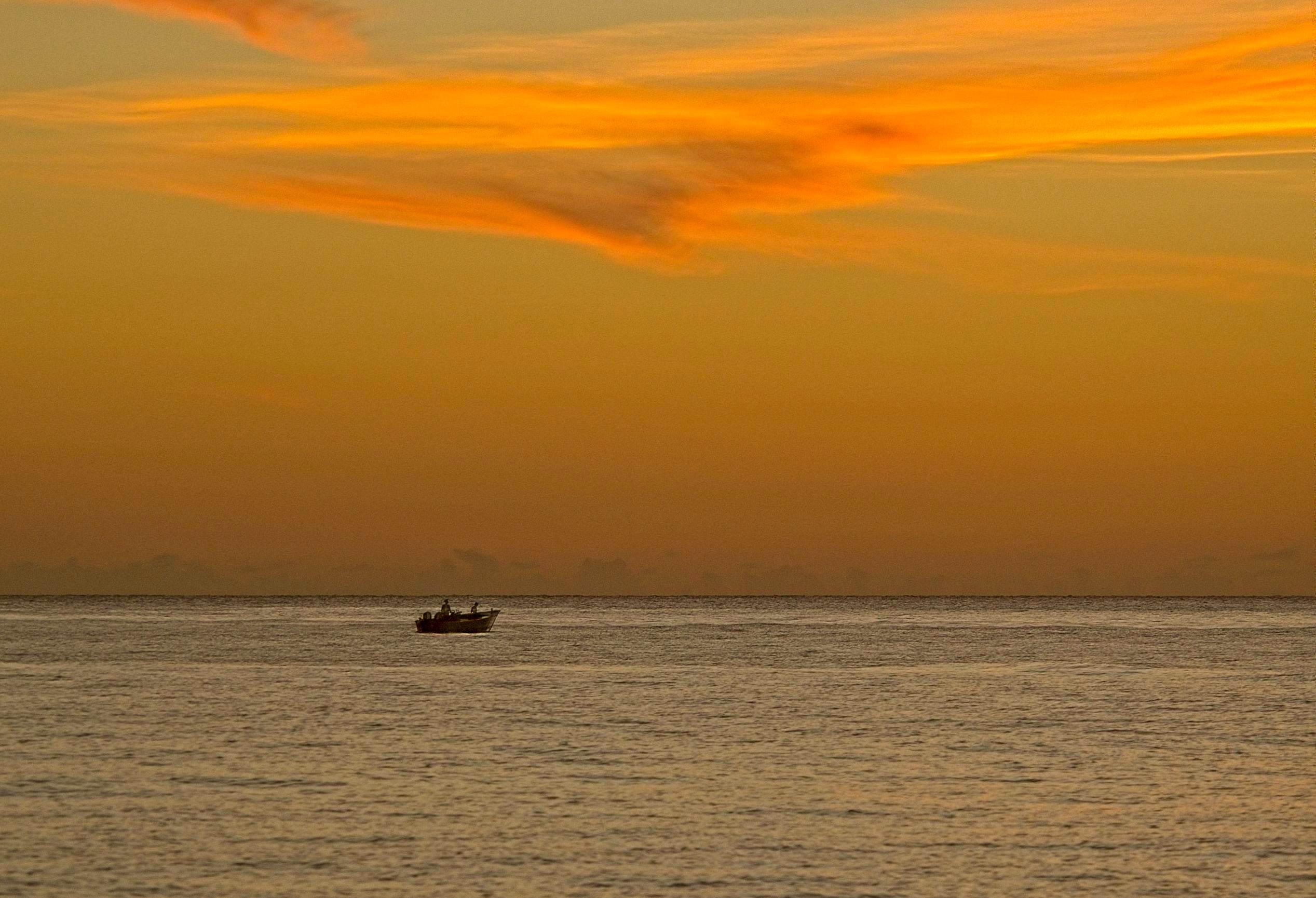
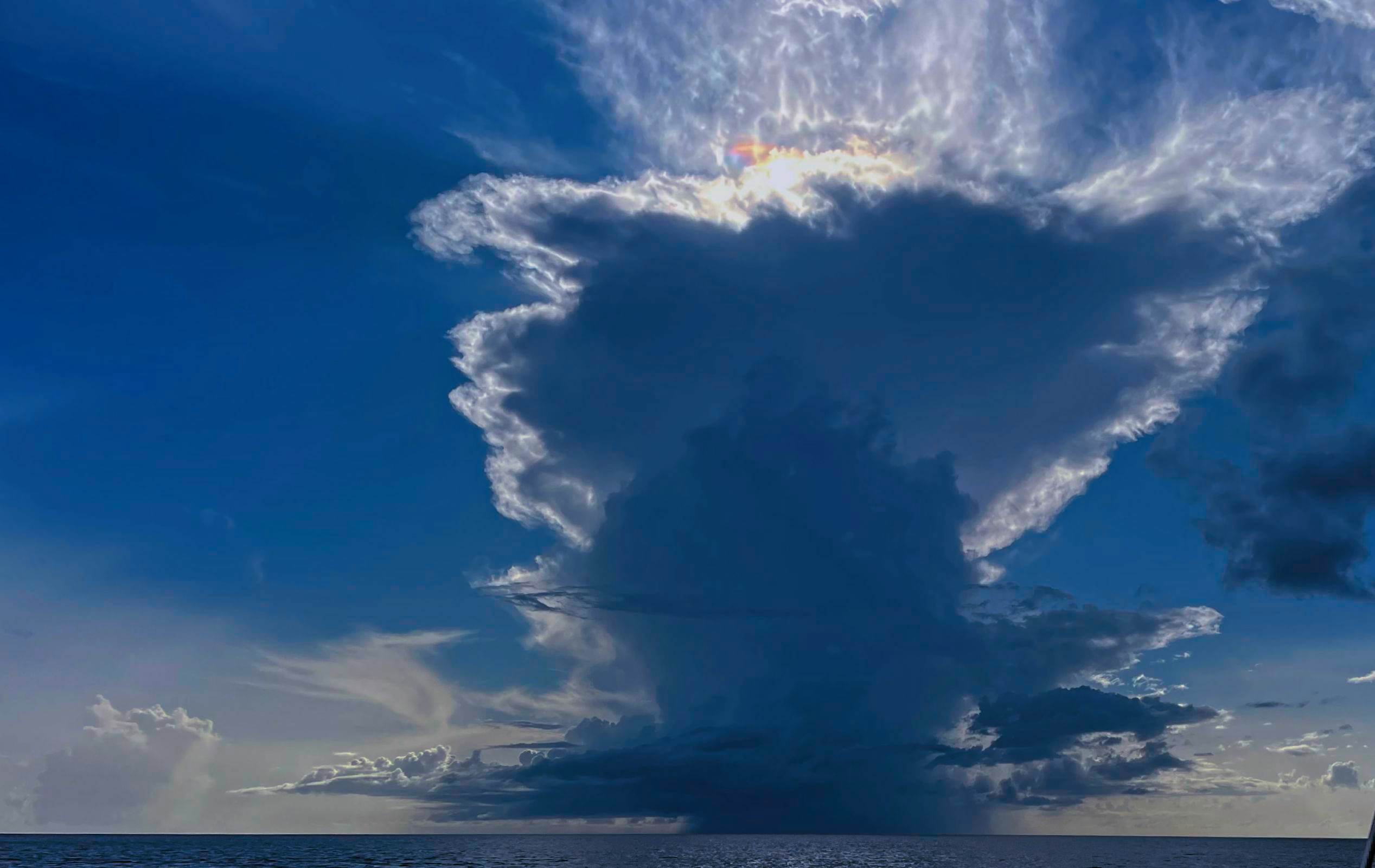
Local fishing boat, Grenada.Typical summer afternoon rain squall over the Caribbean Sea.The entrance to Port Louis, Grenada is guarded(?) by the hospital.The long-line tuna fleet, downtown St George’s, Grenada.
Barbados is the most densely populated of any island in the eastern Caribbean, but for cruising sailors it is distinctly off the beaten path. There are two major reasons for that. First is that it is literally 100 miles off the route that most cruising boats take, the other is that it is an island that is very nearly round, and it has an extremely limited choice of mediocre anchorages.
This lack of visiting boats leads to a couple of follow-on effects. The local regulatory infrastructure is not really in tune with the needs of cruising boats, and the amount of information about cruising the island is limited and is frequently limited, conflicting, out of date, or just plain wrong. It is not even mentioned in our printed cruising guide to the Windward Islands.
Almost all of the data sources we consulted (including the official Barbados web pages) indicated that Port St Charles in the northwest corner of the island was a port of entry, and a place we could easily clear customs. We called the marina there before we left Grenada to confirm the schedule, and found out that they are no longer a port of entry, and we would have to clear in in Bridgetown.
Upon our arrival in Bridgetown, we contacted “Bridgetown Signal” on the radio to let them know of our approach, and we asked permission to anchor in Carlisle Bay and dinghy in to clear customs. Our advance information from usually reliable sources suggested that this was pretty standard. Not true, or at least not true today. They instead directed us to enter the main harbor and tie up to one of the cruise ship docks and only then go to customs.
This is more than a bit of a pain, tying a 53 foot sailboat to a dock designed for a 100,000 ton cruise ship is not simple. Everything from the bollards to the fenders is just not to our scale. Getting off, and back one, the boat is a gymnastic exercise.
Harmonie at the big boy dock. The perspective here is a bit deceiving, it’s a LONG way down to our deck from the quay surface.
Fortunately the weather was benign, and the process went smoothly. The local customs officials were reasonably efficient, but obviously not used to such small vessels. Once we cleared in, we were released to go to the anchorage.
There are a number of boats in the Carlisle Bay anchorage, but they are all local boats and tourist day boats. Not one other visiting cruising boat is visible.
Carlisle Bay is a pretty terrible anchorage. Ocean swell consistently wraps around from the south west, and hits you sideways as you sit to the easterly blowing tradewinds. This means that boats roll… a lot. None of the usual tricks of trying to turn the boat into the waves work for very long because the wind and current change direction through the day. Whatever you do for a comfortable set at noon fails at 17:00 and then it changes again by 23:00.
We broke out of the marina the other day, and spent some time out fishing. Today, we are taking advantage of favorable winds, and we are sailing over to Barbados. Should be about a 30 hour sail. Usually, this would be straight upwind, but there is enough south in the weather today, we should have an easier time of it.
Why Barbados? Well, because it is there… but more specifically I (Bill) need to renew my passport, and the US Embassy in Grenada is not currently set up to do that. There are a couple of hoops to jump through, but it seems like this is the best way to get that done in the time we have here in the eastern Caribbean.
Barbados is a round island with no natural harbors, and being 100 miles off the beaten path it is not frequently visited by cruising boats. A lot of the online information about formalities is out of date, and inconsistent. We think we have the current data… we’ll find out when we get there!
Sometimes people have a boat located at Point A that they need at Point B and do not have the time themselves to do the move. People purchase a boat in one place and need it to be in another, and they need help with the move. If a boat is much different than a new owner has previous experience with their insurance company might want a sign-off by a licensed Captain that the new owner had the basic skills needed before they are allowed to sail “solo”. For what ever reason, sometimes people need the services of a “Delivery Captain.”
I have done deliveries many times. Sometimes Karen comes along as crew, sometimes the owner(s) are the crew. Most of the deliveries I do are of Amel yachts, and that’s because that is the sailing community where I have the most connections. But other sailboats, and even power boats are welcome.
For many new owners, a delivery with an experienced Captain along is an opportunity to quickly learn the boat, sailing, and a lot of nitty-gritty details about long range cruising. As a wise person once said:
Smart people learn from their mistakes. Wise people learn from other people’s mistakes.
How it Works
Most Delivery Captains are independent, and can have their own way of doing things. Typically, they charge by the day, or sometimes by the mile. Trips much longer than average are sometimes quoted at a fixed price. Expenses for travel, living, and boat costs are billed through at cost without markup. Typically, the contract is executed with an advance payment of 50% of the expected charges, not including expenses.
A detailed contract should be presented as part of the initial quote process. Costs and expectations should be clear. Do read them. Do not hesitate to bring up any of the contract points for discussion or negotiation. If there is a hard budget for the total cost, the time to discuss that is up front, NOT at the end of everything when you get the final invoice.
You should expect the contract to specify some of the minimum gear expected to be onboard the boat. Pay careful attention to this. The Captain included this list because he considers it minimum required for the safety of the boat and crew. If there are deficiencies that will not be corrected before the Captain picks up the boat it is important to discuss them ahead of time.
The captain will expect to be named as an “also insured” on your policy, and he should have credentials ready to submit to your insurance company for their approval. The completion of this paper work can take longer than you expect, so get it started as soon as possible. No responsible captain will leave the dock without the insurance issue being settled.
As part of the quote evaluation, consider the travel costs involved. If your boat is starting and/or ending its voyage in a remote location, bringing a captain in and getting him home again might be a significant part of the cost. Hiring a skipper to sail a boat from the Canary Islands to Antigua will require a significant travel budget. A delivery from Miami, Florida to Annapolis, Maryland, not so much.
Understand that travel expenses can be expensive, and difficult to predict. This can be especially true at the end of a long delivery. It is not unusual that a delivery with an expected time at sea of 10 days can easily take 12 days, and then add on a potential delay of a week for weather before departure, and you realize that you can not know with certainty the final arrival date. There are a couple strategies to deal with this, and for potentially expensive travel, the boat owner should be in the loop on whatever decisions are made, since he will be paying the bill!
Challenges
The primary issue with any delivery is usually the condition of the boat. Especially for long passages, ensuring the boat is really ready to spend a week or more at sea is a MUCH more complex and comprehensive inspection than the typical survey done in support of a purchase. Starting from scratch, getting a boat ready for sea can take several days of hard work. Inspections, testing systems, maybe a short trial run, getting provisions aboard.. all take time.
Crew?
On most of the deliveries I have been involved with the owner(s) have been along. There are some delivery skippers who joke (maybe it’s not a joke?) that they charge extra for that. I enjoy to opportunity to meet and interact with people on this level. I honestly enjoy the chance to teach people about their new boat, and give them a flavor of what cruising can be like.
Finding the Right Fit
Finding the right delivery skipper for you and your boat can be a challenge, especially if you as the owner want to go along on the sail. It is essential that everybody onboard gets along for the length of the trip. A captain with a good background in boat repair and maintenance is important, and can make the difference between a on-time delivery and and large boatyard bill from somewhere half-way along. Familiarity with boat’s like yours is a good thing. In many cases it is not REQUIRED that the Captain have a formal license, but that does give you a bit of an assurance that the individual takes his profession seriously. It will also smooth the process for insurance approval.
Do not be afraid to ask for contact information from previous clients.
As we navigate the oceans of the world, we sometime find that it is more complex navigating the local officialdom than the high seas. In the case of Grenada, we have pretty much worked out what we need to do to import things at the lowest cost.
Import duty on the island is complex, and can get expensive. Most of the eastern Caribbean islands use a common customs schedule which is a large book that lists the duty due on thousands of different classes of goods. The amount due can vary from nominal (5% or less) to pretty steep (greater than 50%). And duty is calculated on the value of the goods PLUS shipping PLUS any taxes paid.
There are (legal!) ways around this for people in our situation. The exemption we can work within is for “ship’s stores.” A vessel in transit through Grenada to another country is allowed to buy and import things at a fixed rate of 2.5%. This can be done at the local chandleries, you show up with your boat paperwork (cruising permit, and documentation) and they register you for duty free purchases. Easy.
If you are actually importing things yourself it gets a bit more complex, and the services of a customs broker, while not technically required, make the entire process MUCH easier. Here is the procedure that has worked for us.
We signed up for an account with E-Zone Grenada to act as our broker.
Packages are delivered to their warehouse in Miami, and held there. Once we supply the invoices listing the value of the items they are released and take the weekly cargo flight to Grenada. At this point, all the paperwork is treated as a normal importation, and full duty is calculated.
In the meantime, we take the invoices and boat paperwork to the customs office here in the marina. The items are reviewed, and the customs officer issues a “Permit to Ships Stores,” universally known on the island as the C-14. The customs officials here in the marina have been very accommodating, and easy to deal with.
Once the package arrives at the broker’s warehouse in Grenada, we receive an invoice for the shipping, brokerage charges, and full duty.
We go to the warehouse with our valuable C-14 form, and present it to have the duty recalculated at the much lower “Ships Stores” rate.
Pay the brokerage fees, revised duty and shipping and we’re off!
Nothing very difficult, once you know the drill, but as always there are a couple things that can catch you up and greatly increase your bill while adding no value to you.
The shipping and brokerage charges are per box as delivered to the Miami location. Those can add up if you have several boxes coming at once. If you have someone in the USA who can consolidate boxes for you, and then ship them on to the broker in Miami you can save a lot.
Another issue that can bite you is when you pay what is called the “dimensional weight” for the shipping from Miami to the island. We have all had the experience of a box shipped from Amazon or other online supplier with a very small, light object in a greatly oversized box. Amazon doesn’t care and doesn’t charge you extra, but the air freight company carrying your order from Miami down to the island most certainly does. If the weight is low relative to the package size they will charge you by the volume of the package, and that can get expensive in a hurry. This is also best solved by having a friend or family member repack things before shipping them on to Miami.
All these steps and rules are different in each country, but you do gradually learn the common bits.
We are enjoying Grenada. It is a very interesting place. Sometimes interesting in a fun way, and sometimes in a way that makes for good stories…
Port Louis Marina, St George’s, Grenada.
The Marina
Port Lois Marina in St George’s is well run, reasonably priced and exceeds our expectations. The staff is endlessly helpful. The facilities are modern, well maintained and clean. The cost is reasonable. Pretty much a great base to explore from.
The Weather
We are only 10º north of the equator, so it is hot and humid. Pretty much every day, the weather is the same: Hot and humid, with occasional showers. Much of the time the tradewinds blow which helps, but the marina is in a well protected harbor surrounded by high hills so the breeze is not reliable. The air conditioning systems on the boat are getting a workout most days.
Weather forecasts here are so bad it is almost funny. There is no weather radar that covers the local area, and the weather approaches from the east, where there is no real detailed information about what is headed this way. A few weeks ago while I was traveling in the states, at 5AM Karen was literally thrown on the floor out of bed when the boat rolled on its side in a gust of wind. What the…!??!
It turns out a tropical wave, of which about one rolls through every week, decided to get a bit of an attitude as it approached the island. The airport (about 10 miles away) reported sustained winds of 70 knots. Most of the morning was pretty wild and crazy. Completely unforecast, and a surprise to everybody. Other than a few downed powerlines, no damage that we saw.
Getting Around
The bus system here is pretty great. There are nine routes across the island, and the fare is EC$2.50 (about US$0.90). The buses are run independently, and pretty much all of them are minivans configured to seat about 15 very friendly people.
Each bus has a driver, and a conductor. The conductor’s primary job is to keep on eye on the sidewalk to be sure no potential customers are missed, and he collects the fares. During the day you rarely have to wait more than three or four minutes for the next bus. They are all crowded, but somehow they always seem able to squeeze one more passenger in. Everybody is polite and accommodating.
Party Time!
Mom, daughter and sound truck.
This past week was the Grenada version of carnival, or as it is locally known, “Spicemas” or more likely, just “‘Mas.” Of the local celebrations we have seen, this one was not one of our favorites. There was almost no live music, rather all recorded techno-dance stuff, and really, really, REALLY LOUD. How loud? Our boat was over a half mile away, and the “music” had our hatches literally vibrating to the beat.
People who know me (Bill), will likely know that loud music has never been my cup of tea, but this was too loud even for Karen who described walking past one of the trucks and having the breath knocked out of her chest.
Getting Stuff Done
We always do our best to follow the rules wherever we are. Trying to be the kind of visitors that any place is happy to welcome and have back. As part of that, we did our research ahead of time and discovered that to get a local fishing license we needed to go to the Fisheries Department in downtown St George’s. So we hopped on the Number 1 Bus, and off went on an afternoon adventure.
The Fisheries Department is located above the Fish Market. Since this was half a block from the bus terminal, it was easy to find. After that, things got a bit more… confused. Wandering in we are eventually greeted by someone, and when we explain out reason for being there, she sends us to the “third door on the right”. We knock, and enter, and explain that we are there to get a fishing license. The two young ladies in the office look at us like we have two heads. Like they have never heard of such a thing, except we are in the fisheries department… “Maybe you need to go to the next door.” So off we go to the fourth door on the right…
Once again we are in an office with two women, who in the absence of any other work give us their full attention, and have NO IDEA what we are looking for. We try to explain that we want to fish recreationally, no selling of fish, and we want to have whatever permits are needed. They ask many very simple questions, and finally decide that they need to bring in the boss. Really???
After a few minutes the boss comes in and we explain what we want to him. He seems puzzled, like this is the first time this has ever come up. He says that this office can not issue a fishery registration to a foreign vessel, we will have to go to see the Minister of Agriculture.
By this point, I am convinced we are not speaking the same language. There are many non-Grenadian boats we have seen in our marina and in the local yacht club sport fishing locally, and I am sure they have not gone through this.
We get back to the marina, and Karen grabs one of the local charter boat captains to get the scoop. Turns out no permits are necessary for sport fishing, only for commercial fishing for market. Oh well, it was fun and educational…
Hunting Season.
Karen first heard about hunting season in Grenada from a local taxi driver. We saw a poster for hunting season in the fisheries office. It was more than a bit out of date, but so were ALL of the posters on the wall… but it had the basic scoop…
The taxi driver described a dinner of Mona Monkey. “Like eating a burnt baby.” This year hunting season opens Oct 1. Apparently you can put in an order with a local restaurant and hunter for a monkey dinner. Karen might try an iguana, I haven’t yet decided if I want to eat a “burnt baby.” Mona monkeys are not native, and can be serious pests in the agricultural regions of the country.
Our sail from Bequia down to Grenada was epic. Fast, and fun. Just the boat blasting along through the water as fast as she can.
We are settled into Port Louis in Grenada just soon enough for… the first tropical storm of the season to blow right over the top of us. Shouldn’t be much of an issue actually. Although is is ironic that the place we picked to be as safe from hurricanes as possible is bullseye for the first Atlantic tropical storm of the year.
Why Grenada? It is outside of the normal route of severe tropical weather. Because it is so close to the northern coast of South America, it is hard for a serious hurricane to spin up here. It DOES happen, but they are very far apart. Our insurance company was happy to cover us here, so all is good. The marina we are in is very well protected, and we are securely tied down.
Because of the relative safety from severe tropical weather, Grenada is a popular summering ground for boats that spend the rest of the year cruising the Caribbean. We are sandwiched in between two other Amels here. Another Super Maramu who we met 4 or 5 years ago in the Chesapeake, and Amel’s newest and grandest model, the Amel 60.
Grenada is a beautiful island, and one we are very much looking to explore.








 fetchinketch