We are now underway. We cleared out of customs in Sint Maarten yesterday afternoon, and were on time for the 10:30 bridge opening this morning. Back out on the ocean, we are headed west.
Instead of sailing straight to the Bahamas, we are making a stop along the way in Puerto Rico. We be spending a little time there helping a client on an Amel54 with some upgrades and repairs. A win-win arrangement. We get a few extra dollars in the cruising kitty, and they get work done without trying to sort out which of the local mechanics actually knows his stuff.
We’ll be arriving at Culebra and checking into the USA there early tomorrow morning. We will be exploring for a few days, then heading to Palmas Del Mar Marina for about a week, then continuing on to the Bahamas.
Right now we are enjoying the delight that is a downwind sail. 15 to 17 knots of wind have us sailing fast and flat. There are some rain showers around but nothing big and scary.
Simpson Bay Lagoon during “The Season” (December to May) is visited by a crowd of SuperYachts. In the world of very high end yachting it is generally agreed that a yacht becomes “super” when it is more than 40 meters (131 feet) long.
They come here because it is a well protected harbor, there is a large airport for easy access to the private jets that bring owners and guests to and from, and because the yachting infrastructure here is deep and wide. At times there can be more than a BILLION dollars worth of yachts docked around the lagoon here.
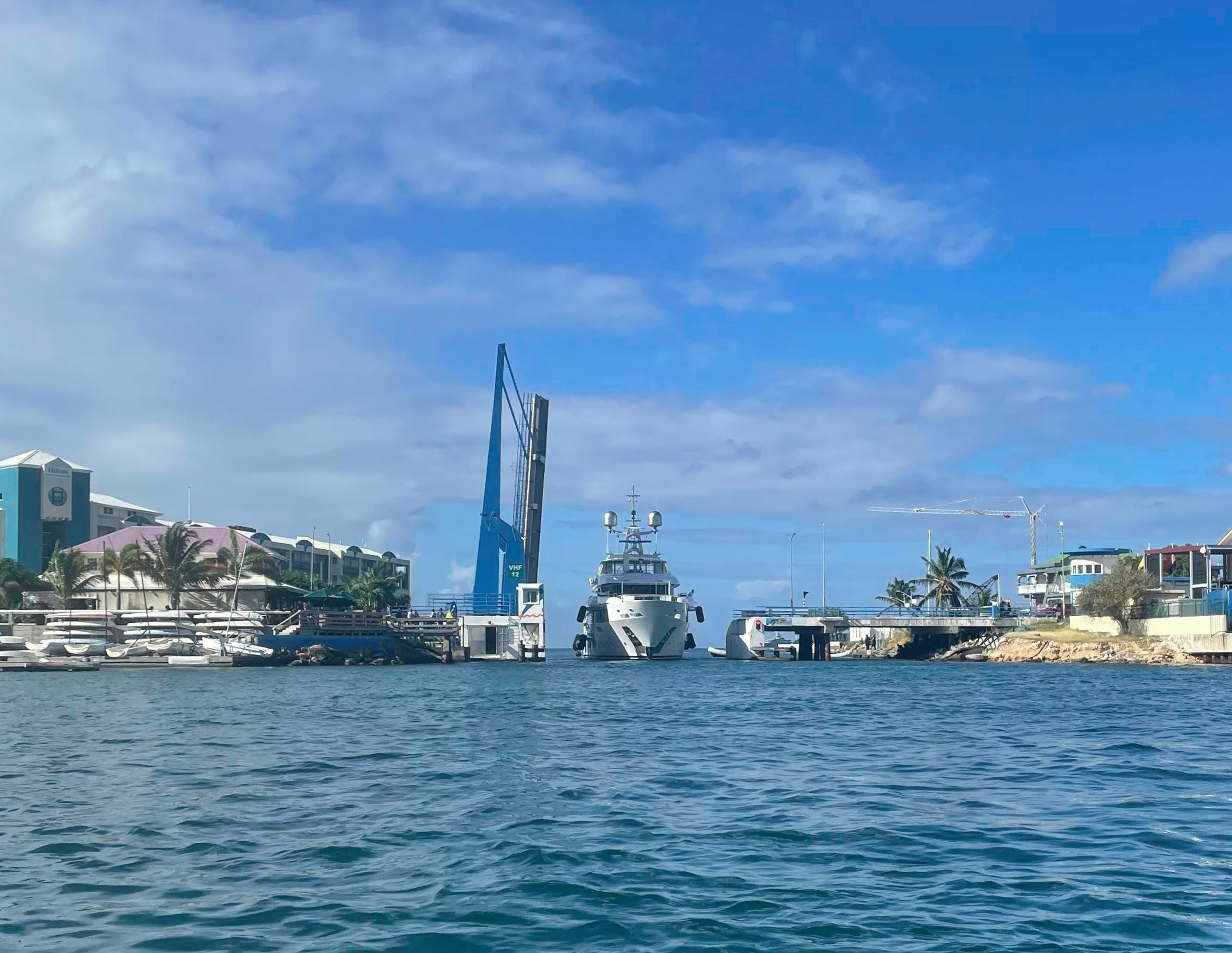
To get into the harbor here, you need to come in through the Simpson Bay Bridge, only 15 meters wide (49 feet) if can be a challenge for some of the larger yachts that can have beams of more than 12 m (40 feet).
A normal superyacht passage through the Simpson Bay Bridge.
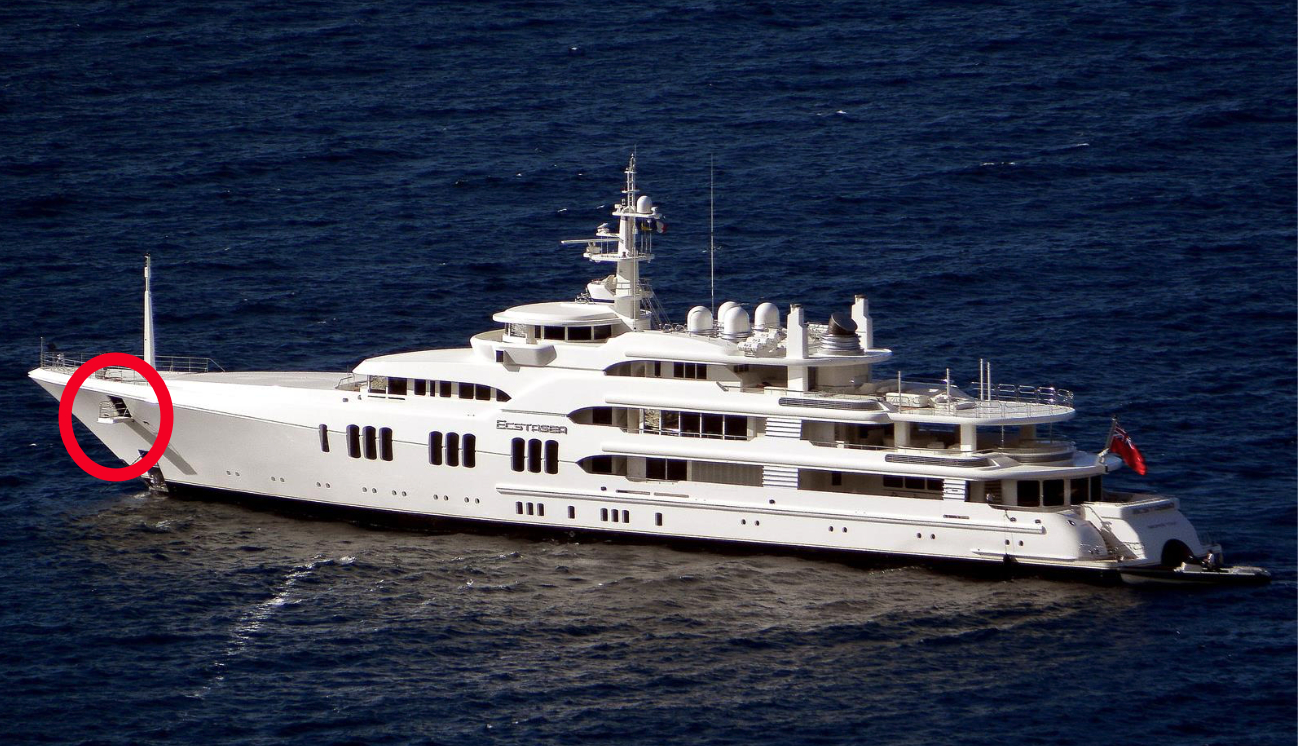
The first star in our story here is the Motor Yacht Ecstacsea, 86 m (284 feet) long (!) and 12 m (40 feet) wide. She is huge. In this picture, note the small fold-down bridgewing on the bow, that will be important…
Another important thing to know: Right on the north side of the bridge is the open air bar of the Sint Maarten Yacht Club. Watching (and recording!) the large yachts transiting the bridge is a popular local activity. Three years ago Ecstasea was coming into the lagoon here in Simpson Bay, and for reasons I don’t understand she had her starboard side bow bridgewing open. The results were pretty spectacular…
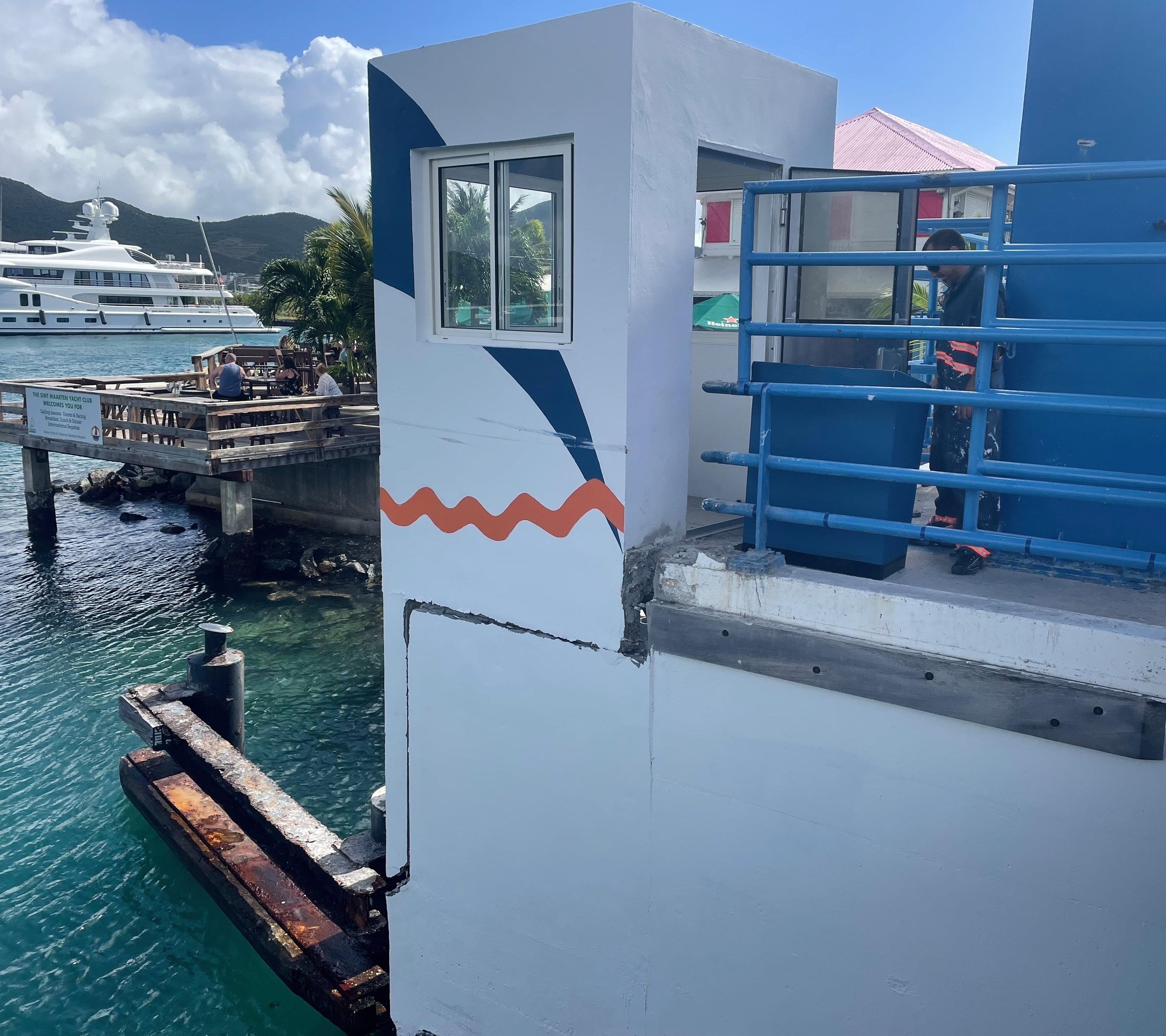
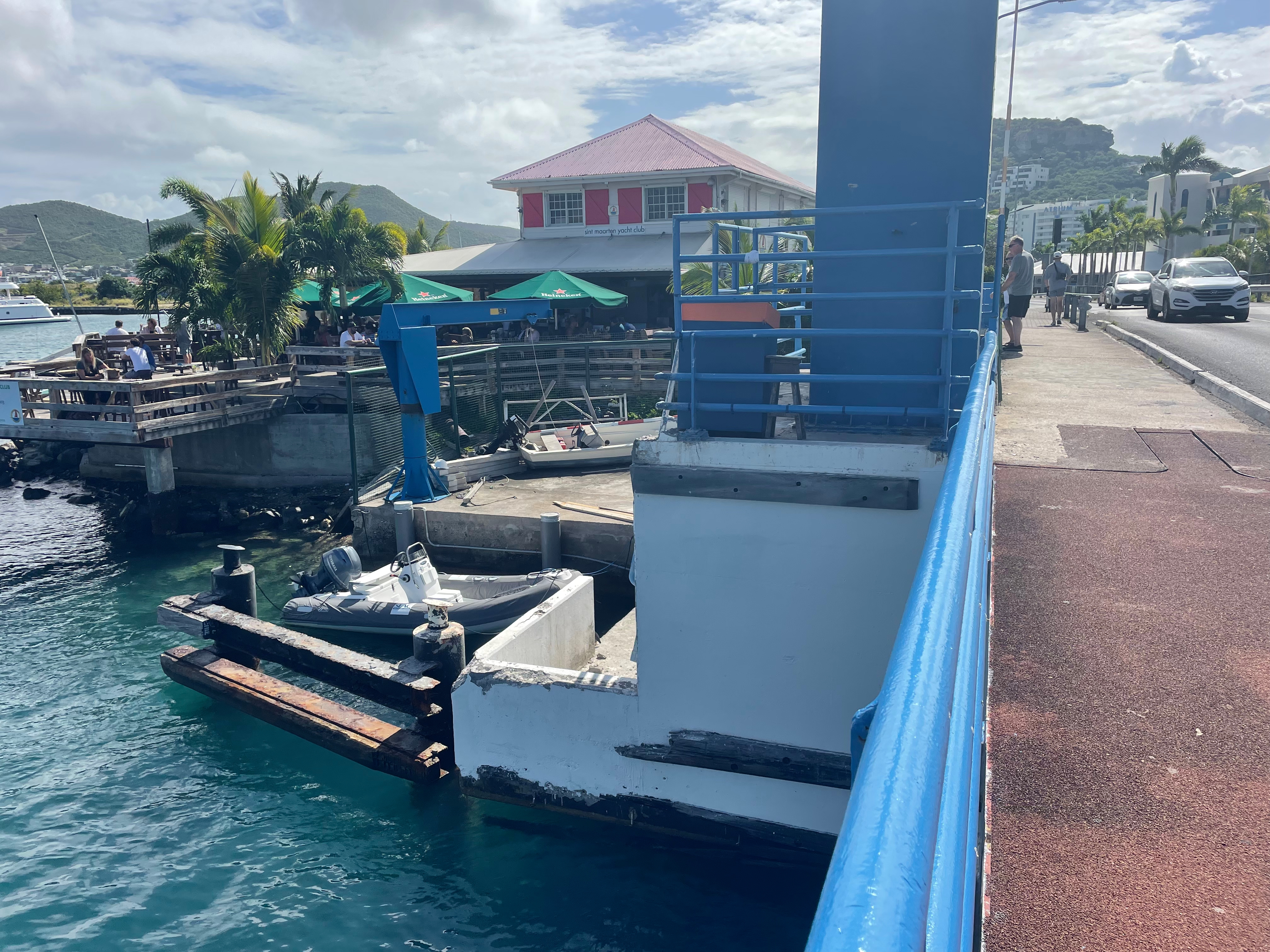
When we were here last spring, the bridge operators were still dealing with a flimsy weather cover over a temporary control panel. If we fast forward to our arrival here in the first week of January 2023, we see there is a whole new permanent concrete shack in place.
Bright, shiny, it’s only 3 weeks old. The fancy new paint job featuring the bridge authority logo is barely dry. But… wait a second… it’s not looking too secure on its foundation. And are those scuff marks on the side? Yep… the day before we arrived it got hit, AGAIN! You can see the mechanic working there to install another “temporary” control panel. The impact not only ripped the shack loose, it also tore all the cables used to operate the bridge. The tenders have had to manually throw switches down in bowels of the bridge.
A few days later, the new control panel is in operation, and the shack is gone. The bridgetenders are back to open air operation in all weather. Hopefully, they can get a little sun and rain protection before too long.
And there is video of this one too, thanks to the bar patrons!
Maybe when they rebuild it this time they will give it a little set back from the edge? Either that or paint a bull’s eye target on it!
Our Plans
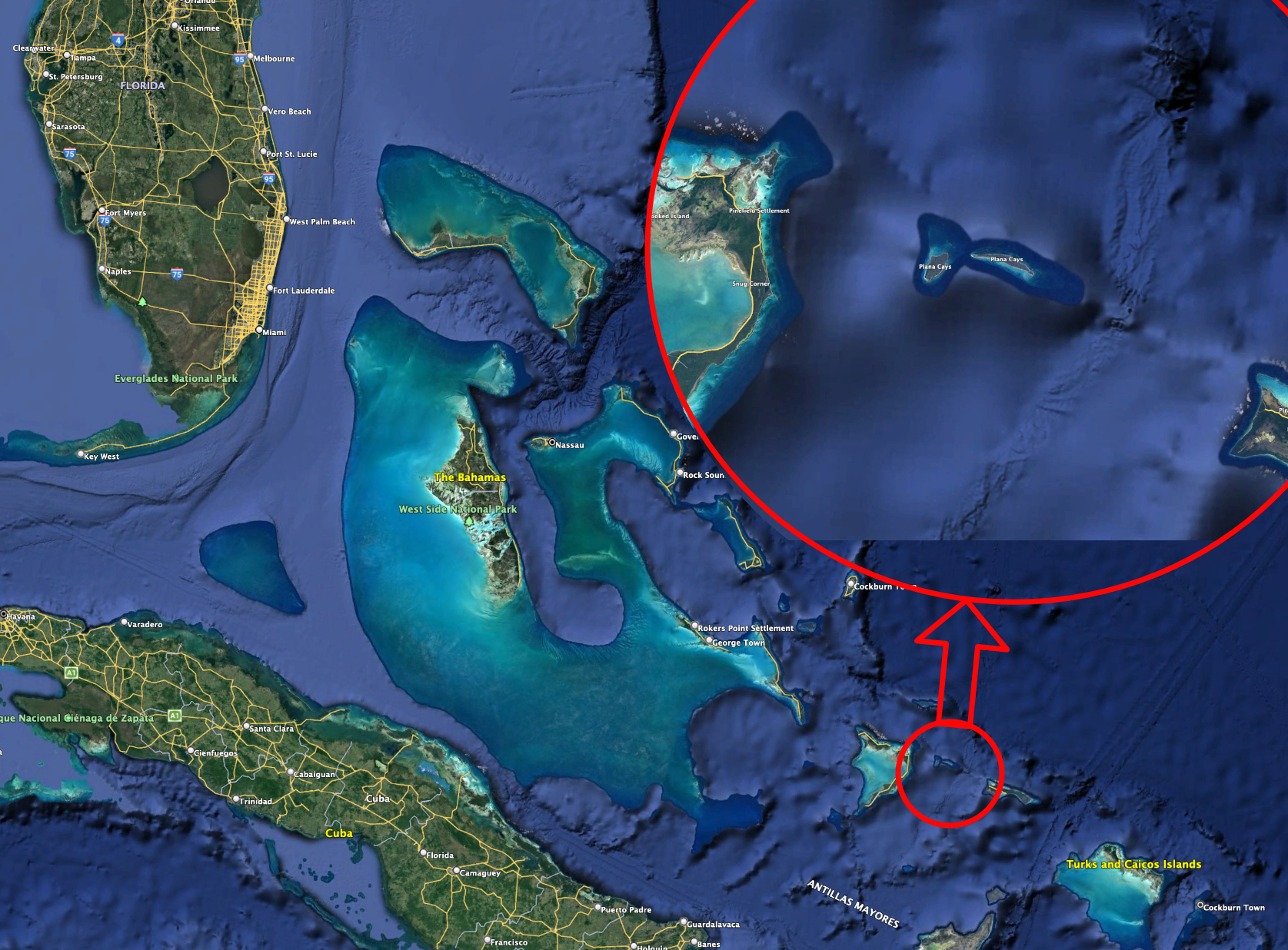
We have taken advantage of the local infrastructure to get some boat projects done, and once we get a few more business things complete, we’ll be sailing away. Right now our target to sail off is Wednesday, the 25th. Out next expected port of call will be Matthewtown, on Great Inagua Island in the Bahamas, about a four day sail. We hope to be exploring the Bahamas for some time.
One of the first rules of troubleshooting a complex system is:
“There are no coincidences.”
The rational here is that if multiple symptoms appear at the same time, they always have a common cause, because that is just the way things work.
Rule Two would be:
If it worked before you touched it, and now it doesn’t: You broke it.
Again, a perfectly logical rule. When something breaks, something changed. If you were messing around with the parts, it is a very good bet you did something–by mistake or by accident–that was the cause of the problem.
Here the true story of a sequence of failures we recently experienced, that proves rules are meant to be broken.
The First
While motoring recently, we had the odd experience of all our engine instruments shutting down. Using the very sophisticated diagnostic test of wiggling the key, we determined that the problem was a bad connection inside the key switch itself. Which is actually a good thing, because these are common parts and easy to get. We actually ordered it from the Volvo dealer ahead of us on Saint Martin so it would be ready when we got there.
The next day, a new symptom appears: The engine will not stop when commanded to by the key switch. This is not too surprising since we already know the key switch is on its way out. Good thing we already have one on order! In the meantime, we just have to climb down into the engine room and push the emergency stop lever. A pain, but not anything too bad. Certainly better to have an engine that is a pain to stop, but starts on command than the other way round!
All will be better when we get the new key switch.
The Second…
We arrive in Saint Martin, pick up our already paid for key switch, and install it. The problem with the instruments goes away, as expected. But the engine STILL won’t stop! Hmmmm… I must have wired things wrong. So I did a deep dive into the absolutely TERRIBLE Volvo wiring diagrams. I check, double check, and triple check everything. It is all correct.
Then I notice that the preheater is also not working. This is something we never need here in the tropics, but it is an extra clue. Careful study of the wiring diagram shows that the only common thing shared between the two systems is a ground relay. Opening up the electrical box on the engine and identifying the right relay I find that the coil of the relay shows an open circuit. How very odd. Obviously broken, but these relays are VERY reliable so this is weird. But, broken is broken! Back to Caraïbes Diesel for a relay.
And… What? A THIRD??
Install relay, and all is good. The engine starts, and stops. Except… the tachometer is not working. Well, this should be an easy one. After all, I was fussing around in the instrument panel, so I must have knocked a wire loose. I mean, see Rule 2 above. I touched it, I broke it!
Except—not.
It’a not a bad connection. It is actually a problem with the alternator which is where the tachometer gets its data about engine speed. I look really hard for SOMETHING connecting these problems. Because see Rule 1 and Rule 2. But there are NO connections. There is just no way ANYTHING I did could have affected the alternator. Yet, the alternator is just not working. All the tests confirm, the alternator is doing nothing. It spins, but makes no power to push into the battery. As bizarre as it seems, this is a completely separate problem not connected with the others.
We remove the alternator, and take it to the local service shop. They go through their tests, and discover a stuck brush. A simple cleaning of the internals makes it all right. In addition to having things better again, it was nice to know that if we were actually stuck in a place without the infrastructure that is here in Saint Martin, we COULD have fixed it ourselves.
Rule Rewrite
In 26 years this engine has run for nearly 10,000 hours. In the time we have owned the boat, it has run for nearly 2000 hours. It has had a few minor problems, all things we could easily diagnose and repair. Yet, in the course of only three hours of operation THREE separate–and totally independent–problems came up.What are the odds? If I had been paying a professional mechanic working on my engine, who reported this sequence of events, it would have been very hard to believe him.
So I am going to rewrite Rule 1:
“There are no coincidences–until there are.”
Trying to sort out these problems would have been a lot faster if they had occurred completely separately in time. In that case I would not have spent so much time trying to figure out how they were connected, because they HAD to be connected, right? (See Rule 1!)
The Heroes
We have two heroes in this story. First was Caraïbes Diesel on the French side of the island. They are the big Volvo Penta dealer in this part of the Caribbean. They had the parts we needed, and worked with us to be sure we got them. People (including me!) complain a lot about the prices of parts from Volvo Penta, but if you need them–and they have them–they are priceless. Thank you Isabelle and Xavier.
The staff at Electec on the Dutch side of the island was also fantastic. It is an amazing supplier of electrical parts, watermakers, and all kinds of engine oil and fuel filters. They have stuff on the shelf that you would never find anywhere else for retail pickup. The service department had our alternator sorted out in less than 24 hours. They also had–in stock–the parts we needed for our watermaker. If we had needed it, they even had an exact match for our alternator in stock.
In our travels we have gotten several steps ahead of our posts, so I hope you can forgive a couple quick posts to catch up.
Here are just a few more photos and historical commentary from the Iles des Saintes.
Local History
The local waters were the scene of a naval battle in 1782 between the French and British fleets that had a large impact on history in ways you probably haven’t heard of. The short version of the story is the French fleet that was heading to invade the economically vital British colony of Jamaica was routed. Its Admiral taken prisoner, and many ships of the French ships of the line sunk or captured. This was shortly after the humiliating British defeat at the hands of the Americans in Yorktown, Virginia in 1781–with French assistance—that marks the end of hostilities in the American Revolution.
In the usual American version of history, that’s the end of the story. But… The negotiations of the final arrangements were still ongoing. The Americans and their Allies—the French—started out in a superior position at the treaty negotiations. The Americans, for example, were demanding that ALL British possessions in North America were on the table, most significantly, Canada.
When word of the decisive defeat of the French fleet in the Caribbean arrived in Europe, it changed the dynamic. Suddenly the French were not the powerful ally the Americans were counting on, and the Americans decided to reach a separate peace. The colonies north of Massachusetts (i.e., British Canada) were no longer part of the deal. How would the world have been different if Newfoundland, Labrador, and Ontario had become part of the United States?
Our Photos
There are still existing fortifications in the Saintes, but they date from after the fall of the French monarchy, and were never actually involved in any hostilities. The largest of the forts is Fort Napoleon on Terre de Haut. Now a general history museum and botanical garden specializing in local cactus.
Fort Napleon
Speaking of botanical curiosities, on this island you occasionally see trees with a red stripe painted on the trunk.
A bit faded, but the red paint is there….
These trees produce copious quantities of fruit resembling small green apples.
The “Little Apple of Death”
Do NOT touch! These are manchineel trees, one of the most poisonous trees in the world. So much so that just standing under one in the rain can lead to a nasty blistering rash. If you are going to explore off road in the Caribbean at all, it’s a good idea to learn what they look like.
Houses here are frequently set up to have living space flowing from indoors to outdoors. Here is a beautiful example where the kitchen and sleeping rooms are “in” and the dining and living rooms are “out.” Located close to 1000 feet up the mountain, the constant trade winds keep the living areas comfortable all year.
And what scenic set of photos would be complete without an image of our very own Harmonie at anchor?
Since we would encourage everybody cruising the Caribbean to visit this delightful place at least once, here are some practical tips that are current as of the beginning of 2023.
The red outlined areas on the charts are places with moorings, and anchoring is not allowed. The green area is where anchoring is permitted. More of the deep water in the harbor is also available for anchoring, if you are good with anchoring in 40 to 60 feet (12 to 20m).
The largest mooring field is the most convenient to town, but none of them are too far to ride in a dinghy. During busy holiday weeks with lots of charter boat activity, the main mooring field fills up rather quickly. It can be rolly, both with waves wrapping in and with the frequent ferries, the more remote fields are quieter.
The moorings are of a type we have seen around several of the islands, and they cause a lot of trouble for people who don’t know how to use them.
This is the mooring ball, and the way a lot of people tie to it. Do NOT do it this way.
First Problem: This skipper has put a line from one cleat on the boat straight through the steel ring, and back to the boat. This is a disaster ready to happen. As the boat swings back and forth in the wind and waves, the line will rub on the ring, chafing through and setting the boat adrift, much more quickly that you might expect. Solution: Tie a separate line to each side of the boat, and attach to the ring using a round turn, and a bowline. Yes, a bit harder to execute, and more of a pain when you leave, but infinitely more secure.
Second Problem: When the wind dies, as it does most nights after midnight, the buoy will drift along the boat’s hull. That big steel ring will scratch up the boat’s hull. Not a disaster, but aggravating for sure. Solution: Pull TIGHT on the ring. The ring is actually not attached to the float, but passes through it straight down to the anchor. If you pull the lines very tight, the ring will pull up, and now the boat can not drift into it in light and shifty winds. Almost nobody seems to understand that this is how these are supposed to work.
On a boat with freeboard too high for crew to reach the ring, there are two approaches that work. First, do not put the bow of the boat along side the ball, and hope your crew can get the line through–somehow. Instead, put the crew on the swim platform on the stern and BACK to the buoy. Now the ring is an easy reach. Pull the lines around to the bow, and all those people who were watching your approach in the anchorage and wondering what the heck you were doing, will see what a brilliant sailor you are! Second approach: Have a small line of about 2 fathoms in length with a monkey’s fist in the end. Throw the monkey’s fist through the ring, snag it with the boat hook, and use the light line to pull your main mooring line on through. Very salty.
If you are coming from somewhere other than Guadeloupe, you’ll need to clear customs here. Like on all the French islands, you find the customs computer, and “do-it-yourself.” Here the computer is located at Les Saintes Multiservices, located on the 2nd floor in the building just south of the ferry landing. There is no sign, you just have to know.
Of course you could also come over from Guadeloupe by ferry. There are at least two boats each making three round tips a day.
Finally, for my pilot friends, there is an airport, but no scheduled service. I am not knowledgable enough to understand for sure how complex the approach is. Here is a picture looking straight downwind. Obviously, a straight on approach isn’t possible. In the week we have been here, I have seen one plane come in, and he obviously had several turns to make during his final approach to make his way between the hills.
We are tied up in the bay of Terre-de-Haut, an island part of the Iles des Saintes group that is just south of, and part of, Guadeloupe, which is in turn an overseas department of France.
Our trip up from Martinique was about 15 hours, and was—mostly—uneventful. It varied from near calm in the lee of Martinique’s Mount Pele and the mountainous rainforests of Dominica, to howling winds of 30 knots in parts of the passages between the islands. We had some minor issues with the engine, that will hopefully be easily put to rights.
Our first impressions of this island agree with the advance reviews we got from friends who visited: It’s delightful. It’s very obviously a tourist destination, but one that is not crass or overly commercial. Most of the visitors are day-trippers from the main island of Guadeloupe and they come over on the many ferries that arrive all through the day.
The downtown streets have a very European flavor.The Sea Eagle II is less than 2 years old, and at 266 feet in length is the largest aluminum hulled yacht ever built. She dwarfs one of the local commercial ferries.The part of the anchorage where the “rest of us” live, with the mountains of Guadeloupe and its cloud forests in the distance.A Christmas Tree, a sleeping cat, and local decor outside one of the shops.
Customs and immigration formalities here, like at all of the French islands are pretty… informal. A local business hosts a computer, you show up, pay €3, enter your information, and you’re done. We tried to pay for the mooring at the same time, but we were told, “A week free.” That’s certainly bettter than the €15 a day we were expecting!
We are not sure how long we’ll be staying here, but hopefully we’ll have more of interest to report.
Some of our friends and readers are in warm places, some are struggling with (or maybe even enjoying?) an unusually cold and snowy holiday. No matter what your weather, stay safe and enjoy!
Santa? Is that you?
No matter if Santa comes down your chimney, or down your hatch, here’s hoping you have all been good… or at least good enough to fool Santa to getting you what you want!
What is Christmas without good home cooked food?
In a day or two, our business here in Martinique will be complete. Our plan from here is to jump to the Iles des Saints, another small group of French islands between here and Guadeloupe. From there we might stop in Saint Martin, or jump directly to the Bahamas.
One of the fun things I get to do is work with people who are new to Amels. Sometimes it is their first “big” boat. I have been there, and I know the complexities can seem overwhelming. I try hard to break it down into digestible pieces. Watching new owners fully realize the robust, safe nature of these boats, that frequently sail way better than they might expect, is a pleasure. Frequently, my introduction to new Amel owners comes when they need a Delivery Captain to help them move their boat.
When you are contracted to do a delivery, it is always a crapshoot. You are taking a boat you have no personal knowledge of on a long trip, maybe over a thousand miles. Sometimes things go very well, sometimes they can go very badly. Every delivery skipper has horror stories about the boat that wasn’t ready, and/or the owner who was a jerk. This delivery was neither of these. The owners were delightful people. The boat wasn’t perfect (none ever are) but well within the range of control of the people involved. It was as good as can be expected.
With “typical” weather, a trip from Panama to Corpus Christi, Texas should take about 14 days. We finished this one in 10. If I was to sit down and write a weather forecast that was as perfect for this trip as possible, what we experienced was quite close to that. The only drama was around the charging of the batteries.
Everything was nominal–until we were about 30 hours away from Corpus Christi. At that point the belt that drives the 24 Volt alternator on the main drive engine had a “spontaneous disassembly event”. Not a big deal, we have spare belts. The owner digs them up from his parts bin, and says, “It’s one of these.” Except it is not. A bit of checking, and it turns out he did a very reasonable thing: He asked a parts supplier for all of the belts used on this model of Volvo engine. He didn’t realize that the 24 Volt alternator was an add-on by Amel, and doesn’t show up on any of the Volvo parts lists. Oh well, this isn’t a huge problem, we can still charge the batteries with the generator–as we have for the past 9 days.
HA! King Neptune decided to have a bit of fun at our expense, and sent his boat gremlins our way. The next morning, we started the generator (which is brand new, and has less than 10 hours on it) starts, and runs for a few seconds, and then shuts down. Another try, and the same thing. A bit of diagnosis, and the issue is clear. The brand new generator has a problem with its speed control. If the speed is not within fairly narrow parameters, the controller shuts the engine down. This is a problem with a solution beyond the means of a boat out on the ocean, so we switch to “low power mode” for the boat, shutting down everything not essential for navigation. With only a day’s sailing left, it doesn’t really matter if the food in the freezer thaws. The instrumentation suggests that we have enough residual energy in the batteries to get to our destination, and we do. We even have enough battery juice to use the bow thruster to get into the slip.
In some ways, we were lucky. If this had happened at the halfway point of the trip, we would have had a much more complicated situation. As it is, the owner has a warrantee claim with the generator manufacturer.
I am now back on Harmonie in Martinique. In a few days, we will be untying dock lines here, and sailing north. Our exact itinerary is still being worked on. Stay tuned.
If fast is fun, we are having a ball! With 17 to 20 knots of wind on the beam, we are barreling through the water at 9 to over 10 knots.
Skies are clear, with a bright moon. The sea is quite flat. Our only visible company is a large cruise ship heading back to Houston after her visit to Cancun. We are off the tip of the Yucatan peninsula and have just crossed that imaginary line from the Caribbean Sea to the Gulf of Mexico. From here it’s about 680 miles to our destination in Corpus Christi.
A few minor issues have come up typical of a boat sailing after too long idle, but they have all been handled. Our weather forecast continues to look promising, so life is good!
The delivery of this Amel Super Maramu continues to go well. A few teething problems, but a lot less than you might expect from a boat that has been docked for five years. The new owners did a great job in the last year fixing things that needed to be fixed.
Our trip so far has been just about perfect. A few rain squalls, but mostly we have been on a calm sea, on a close or beam reach sailing fast. Right now we are in 11 knots of true wind, on a close reach, covering ground at about 7 knots. Smooth and easy sailing. We have about a week before we expect to arrive at Corpus Christi, and the weather forecast continues to look pretty darn nice.
Today we had to do a fair bit of dodging boats hauling lobster pots on the banks off of Honduras. We are now in deeper water, so are not likely to come across any more. We were also entertained by shearwaters who followed the boat all day feasting off the many flying fish the boat flushes into the air.