One of the fun things I get to do is work with people who are new to Amels. Sometimes it is their first “big” boat. I have been there, and I know the complexities can seem overwhelming. I try hard to break it down into digestible pieces. Watching new owners fully realize the robust, safe nature of these boats, that frequently sail way better than they might expect, is a pleasure. Frequently, my introduction to new Amel owners comes when they need a Delivery Captain to help them move their boat.
When you are contracted to do a delivery, it is always a crapshoot. You are taking a boat you have no personal knowledge of on a long trip, maybe over a thousand miles. Sometimes things go very well, sometimes they can go very badly. Every delivery skipper has horror stories about the boat that wasn’t ready, and/or the owner who was a jerk. This delivery was neither of these. The owners were delightful people. The boat wasn’t perfect (none ever are) but well within the range of control of the people involved. It was as good as can be expected.
With “typical” weather, a trip from Panama to Corpus Christi, Texas should take about 14 days. We finished this one in 10. If I was to sit down and write a weather forecast that was as perfect for this trip as possible, what we experienced was quite close to that. The only drama was around the charging of the batteries.
Everything was nominal–until we were about 30 hours away from Corpus Christi. At that point the belt that drives the 24 Volt alternator on the main drive engine had a “spontaneous disassembly event”. Not a big deal, we have spare belts. The owner digs them up from his parts bin, and says, “It’s one of these.” Except it is not. A bit of checking, and it turns out he did a very reasonable thing: He asked a parts supplier for all of the belts used on this model of Volvo engine. He didn’t realize that the 24 Volt alternator was an add-on by Amel, and doesn’t show up on any of the Volvo parts lists. Oh well, this isn’t a huge problem, we can still charge the batteries with the generator–as we have for the past 9 days.
HA! King Neptune decided to have a bit of fun at our expense, and sent his boat gremlins our way. The next morning, we started the generator (which is brand new, and has less than 10 hours on it) starts, and runs for a few seconds, and then shuts down. Another try, and the same thing. A bit of diagnosis, and the issue is clear. The brand new generator has a problem with its speed control. If the speed is not within fairly narrow parameters, the controller shuts the engine down. This is a problem with a solution beyond the means of a boat out on the ocean, so we switch to “low power mode” for the boat, shutting down everything not essential for navigation. With only a day’s sailing left, it doesn’t really matter if the food in the freezer thaws. The instrumentation suggests that we have enough residual energy in the batteries to get to our destination, and we do. We even have enough battery juice to use the bow thruster to get into the slip.
In some ways, we were lucky. If this had happened at the halfway point of the trip, we would have had a much more complicated situation. As it is, the owner has a warrantee claim with the generator manufacturer.
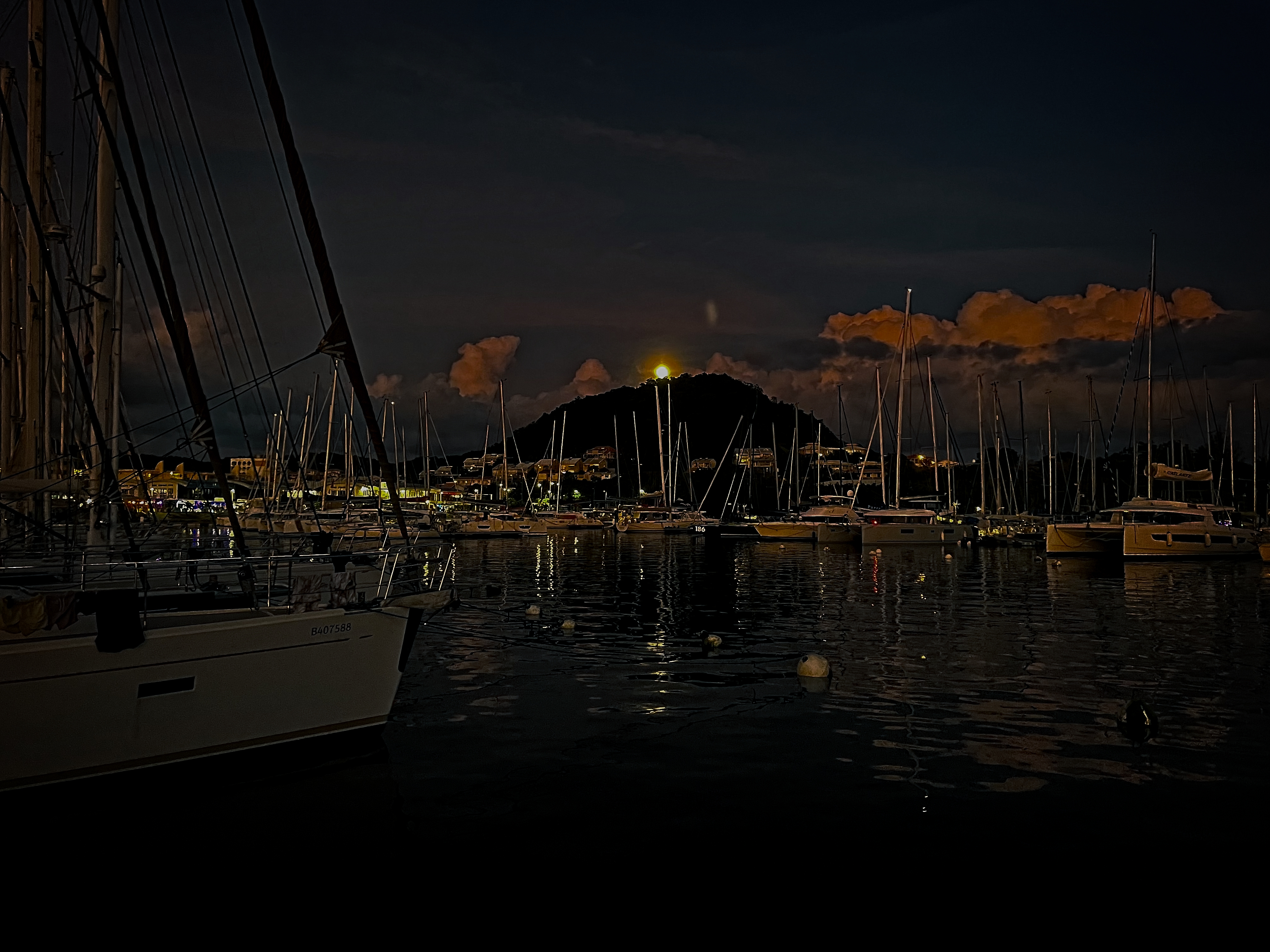
I am now back on Harmonie in Martinique. In a few days, we will be untying dock lines here, and sailing north. Our exact itinerary is still being worked on. Stay tuned.
If fast is fun, we are having a ball! With 17 to 20 knots of wind on the beam, we are barreling through the water at 9 to over 10 knots.
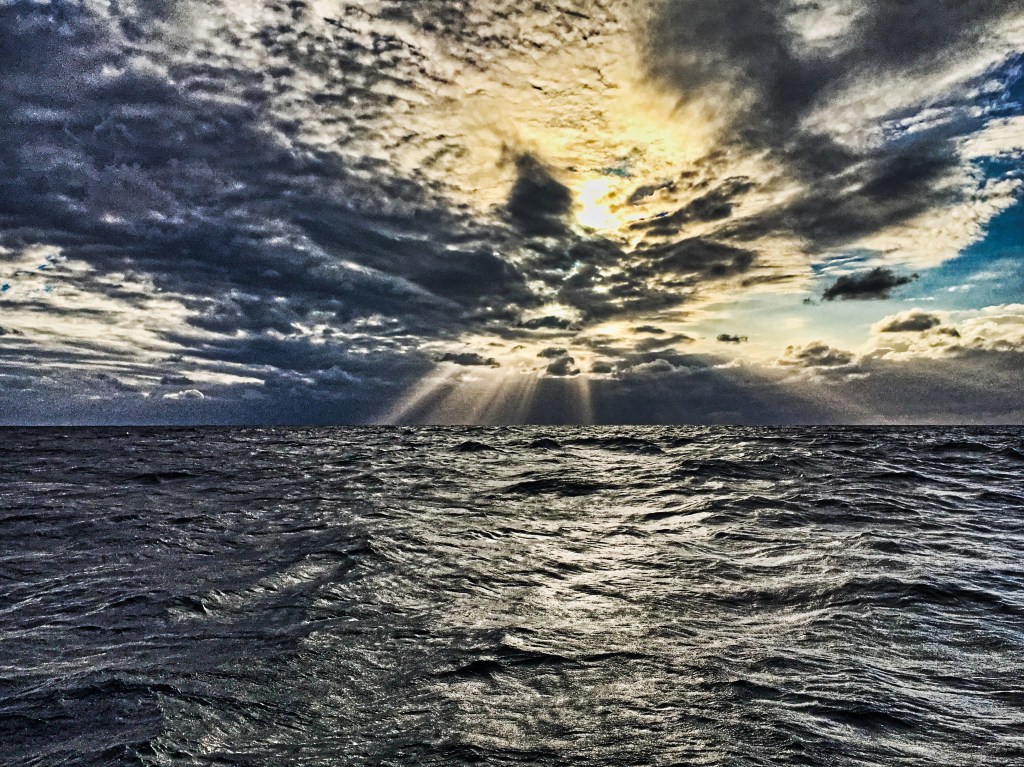
Skies are clear, with a bright moon. The sea is quite flat. Our only visible company is a large cruise ship heading back to Houston after her visit to Cancun. We are off the tip of the Yucatan peninsula and have just crossed that imaginary line from the Caribbean Sea to the Gulf of Mexico. From here it’s about 680 miles to our destination in Corpus Christi.
A few minor issues have come up typical of a boat sailing after too long idle, but they have all been handled. Our weather forecast continues to look promising, so life is good!
The delivery of this Amel Super Maramu continues to go well. A few teething problems, but a lot less than you might expect from a boat that has been docked for five years. The new owners did a great job in the last year fixing things that needed to be fixed.
Our trip so far has been just about perfect. A few rain squalls, but mostly we have been on a calm sea, on a close or beam reach sailing fast. Right now we are in 11 knots of true wind, on a close reach, covering ground at about 7 knots. Smooth and easy sailing. We have about a week before we expect to arrive at Corpus Christi, and the weather forecast continues to look pretty darn nice.
Today we had to do a fair bit of dodging boats hauling lobster pots on the banks off of Honduras. We are now in deeper water, so are not likely to come across any more. We were also entertained by shearwaters who followed the boat all day feasting off the many flying fish the boat flushes into the air.
The delivery process so far has been smooth. Travel to the Islands of Panama went smoothly, and without a hitch. We got underway pretty much right on schedule after filling the tanks with water and fuel.
As is normally expected, winds are uncooperative getting away from the coast of Panama, so we motored for the first 30 hours. But now, the wind has filled in as expected, then boat has kicked up her heels under sail, and we are making good time at almost 8 knots. The forecast is for more of this, almost all the way to Texas. It is fun watching the boat’s new owner’s excitement as they finally get to experience their first real opportunity to sail her as she was meant to.
The boat is doing well. A few minor glitches, but considering the time she spent as a dock queen, she’s doing great.
It’s still avian migration season as birds move from North American south. We had at least three small land bird circle us this afternoon trying to decide if we would make a good place for a break. One warbler has tucked itself snuggly under the dodger for the night.
We are now navigating the shoals off of eastern Nicaragua, our next waypoint is between Yucatan and the western most point of Cuba, and then pretty much a straight shot to Corpus Christi, Texas. Another 10 or 12 days, and we’ll be there.
I (Bill) am off on a long delivery of an Amel Super Maramu. The boat is currently in Bocas del Toro, Panama and it will end up in Corpus Christi, Texas, about a fortnight’s sail.
Of course, I am not in Panama, so the trip starts with a flight from Martinique to Bridgetown, Barbados, from Bridgetown a flight to Panama City, and finally from Panama City to Bocas del Toro on Panama’s northeast coast. Arriving about 30 hours after I start.
Today is Friday: If all is in order I should be on my way with the boat’s new owners out of Panama today, or tomorrow.
The weather looks good, at least for the length of forecast I can count on, although the Gulf of Mexico can be a fickle place. Sometimes not enough wind, sometimes too much. We are past the season for tropical storms to be a likely threat, and hopefully just a bit early to need to deal with a strong cold front barreling down from the north.
In the meantime, Karen will be holding down the fort in Martinique. Once I get done with this trip and get back to Harmonie, hopefully we’ll be out cruising on our own schedule away from marinas for a while. It is definitely past time for us to be in places that are less “people-y” for a while.
Now that we are past the first of November, our insurance company has released us from the box they keep us in for hurricane season. We have left the islands of Grenada behind, and traveled north to Martinique, one of the French islands. Our sail up here was fast and fun, and about 20 hours.
Martinique is the home for the Caribbean service base for Amel, the builder of our boat, so the docks are crowded with sister ships. It’s always fun to see the other boats so much like ours, and meet the owners.
Why Martinique? The prices for dock space here are quite inexpensive (~$600/month), the strength of the dollar makes the high prices for consumer goods tolerable. Prices for boating supplies range from surprising bargains, to insanely expensive (€35 for a roll of masking tape???)
We will need to park Harmonie for a few weeks while I (Bill) take off on a delivery job to help a new Amel owner move their boat from Panama to Texas. Right now I am hanging, waiting, for the last of the preparations to be complete in Panama to have the boat ready to go. It should be about a two week trip.
One of the odd things about being here in part of France, is several weeks ago we read a news article about how there was a critical shortage of prepared mustard in France. Seriously. I dismissed this as just another one of those “click-bait” news stories that are everywhere these days and emphasize drama over facts. Except…
This is the “Moutardes” section of the large supermarket here. EMPTY. Not a single bottle. What is the world coming to? Surely a gastronomic crisis!! French cooking without dijon mustard? Sacre bleu! Fortunately, we stocked up when we where in Sint Maartin, so there is no shortage of dijon mustard aboard the good ship Harmonie! We had some in the creamed eggs on the breakfast table this morning.
If you work on boats, you quickly learn that the best laid plans of sailors when it comes to repair projects mean very little. The boat gods delight in humbling us with unexpected surprises. So it was with more than a little satisfaction that we completed a complex dance today on time, on budget, and with no surprises.
Our problem was with the main seacock in the engine room. Since it was installed in 1996, Harmonie has had a lot of miles under her keel. The internals of this valve has corroded to the point it was so hard to turn we seriously worried we might not be able to shut it in an emergency, or the force needed to turn it would lead to failure of the valve stem. Just routine operation was needing so much torque we had already bent the handle. It was time to change it out.
Our problem child on the left. The red handled valve on the right is the main fuel cutoff and is in excellent condition.
The threads on these fittings are odd-balls. One and one half inch British Standard Pipe, Parallel. (BSPP) None of the major chandeliers in the Caribbean had one, and the only manufacturer in the USA did not have any in stock. Luckily, there was a dealer on Amazon who had one and could ship it to our customs broker in Miami.
It is theoretically possible to do this job with the boat in the water. But it is also possible that things can go suddenly very wrong and leave you with a gapping hole in the bottom of the hull. That is always a bad thing. We decided that taking the boat out of the water was the smarter, albeit more expensive, option.
Tyrell Bay Marina on the island of Carriacou has a 150 ton travel lift, and had space in their schedule to accommodate us. We were the first boat out of the water this morning, and were blocked and at work by 9:30AM.
It took some time and effort to get a 24” pipe wrench on the valve, and then enough leverage on it (with a meter long piece of aluminum pipe) to get things moving, but once broken free, everything was downhill. The new valve was fit in place, and the hoses reconnected without incident.
The new valve installed and ready for the next 25 years of service.
We were back in the water by 15:30. No leaks, no drips. Everything as it should be. Tyrell Bay Marina did a bang-up job at a very reasonable price. We are seriously considering having our next bottom job done here.
I am actually really happy with the change. The new valve from Groco, is a better design than the original. A quality bronze casting, a stainless steel handle, with provision for lubricating the valve while the boat is in the water, and a place to make clean connection for the corrosion control bonding wires. The original wasn’t bad, but this is the best available. Harmonie deserves it! She takes good care of us, as long as we take good care of her.
Our time here on Grenada is coming to a close. It has been truly a delightful place to visit. To all of our friends who recommended this as a place to spend “hurricane season,” thank you very much.
It is one of the happy places. The locals genuinely love and are proud of their island. Not a lot of them are rich by any standard of the average American, but the cost of living is low, and the basic necessities are cheap. As one of our taxi drivers said, “There is no reason anyone here should go to bed hungry. Food grows on every tree.”
We just celebrated the local holiday of “Thanksgiving.” Which I expected to be a typical harvest festival, but it is not. It is actually a celebration of the American lead “intervention” in 1983 that put an end to a violent marxist coup. Most of the locals do not call it an invasion, and seem to be extraordinarily happy that it happened. Americans, both individually, and in the abstract, are welcomed here.
There are many examples of foreign aid here. The Chinese continue to build housing complexes to replace stock lost to the hurricane in 2005. The Japanese rebuilt several bridges. The locals are happy to accept the largesse, but also openly refer to these projects as “bribes.” In the case of the Chinese to gain a vote against Taiwan in the UN, and for the Japanese, to leverage a vote in the UN in favor of Japan’s whaling industry. When similar projects from the USA and Canada are discussed, they are presented as simple gestures of good-will.
Crime, unlike on some of the neighboring islands, is extremely low, and the scenery is lush and gorgeous.
Plans…
From here in Port Louis, in the next couple of days, we will be heading north toward Carriacou, the northernmost island in the country. We have an urgent need to replace a seacock valve that requires the boat be lifted out of the water for a few hours, and the boatyard in Tyrell Bay can do that for us.
From there, we will head to Martinique. Bill will (probably!) be headed to Panama to do a delivery of an Amel to Texas. Once that 2 to 3 week project is complete, we will continue to move north. Another customer for a pre-purchase survey awaits us in St Thomas, and then we get to explore more of the Bahamas before returning to the USA.
It’s a rule: When you fish in places most other people do not, you catch things most other people do not. If you have followed our fishing explorations at all, you have seen that we have extended our fishing world not just by moving to new places on the ocean’s surface, but by fishing deeper…
We recently took Harmonie out to try our luck again at what is called “deep drop” fishing. There really is not a specific number for when fishing gets “deep”, but we were targeting fish at about 1200 feet (360 m). By anybody’s definition, that’s deep.
We were looking for snowy grouper, and queen snapper–which we did not find–but on our first drop to the bottom, we did hook one of these a quarter mile under the boat:
At 65 pounds, one of the bigger fish we have landed recently, the first one in a long time that took both of use to heave over the rail. I looked at as it came aboard and said, “What in the….????”
My first guess was a fish I have had at sushi restaurants, and had a vague idea what they looked like. A quick check of my references and I was pretty sure. An “escolar.” To make a long story short, after much fussing and back and forth, I have changed my mind. It’s a closely related species, an oilfish.
These are quite unusual fish in many ways. They are part of the “deep scattering layer” A dense group of fish, squid and plankton that are highly light-adverse. The very large eyes, with the intensely reflective retina are typical for a creature that hunts in near total darkness. They migrate every day from more than 1000 feet deep during the day, to near the surface at night. This is an impossible thing for most fish to do.
Fish muscle and bone is heavier than water. To counteract this, most fish have a gas filled chamber, the swim bladder, in their bodies that adjusts for this and gives the fish an overall density equal to the water they swim in, and lets them hover motionless. The problem is any fish with a normal swim bladder that tried to rise from 1000 feet deep to the surface would explode as the gas in its swim bladder increased in volume by 30 times as the pressure dropped. So a fish that needs to do this needs must have another approach.
The escolar and the oilfish solve this problem in a different way. If I can’t hold a bunch of gas to make me float, then I’ll just make the density of my muscle lower. They do this is by storing large amounts of oil in their flesh, enough to make them just about exactly the same density as water so they maintain a neutral weight in the water without having to worry about gas exploding as they migrate every night.
But these are not “oily” fish in the same way as, say, a herring. The meat is firm, snow white, and very tasty. Raw and cooked they are delicious. If you have ever had “white tuna” at a sushi restaurant, you have almost surely had escolar. If you cook these, the oil melts and runs out of the meat at an amazing rate. It’s like cooking bacon. But the oil has no “fishy” smell or taste.
There is a catch to this…
The fats these fish store in their bodies are not “normal” animal fats or fish oils. They are “waxy esters.” Humans do not have the digestive enzymes to breakdown this type of fat, so if you eat enough of it, it basically acts like a lubricant laxative. While the result is not unhealthy, it is decidedly unpleasant. The general recommendation is that a serving of 6 ounces or less is perfectly safe to eat for most people.
We have found that Bill tolerates this fish quite well as tablefare, Karen…. not so much. So we’ll just skip donating freezer space to these in the future.
I am reminded of a story from our travels several years ago, where we were in Turks and Caicos at a dock with several super yachts. The crew had been out deep drop fishing that day, and told us they had caught a large oilfish that they cooked up as a “special” dinner for the charter guests. I am guessing that this particular set of charter guests wasn’t very popular with the crew. I’m betting there was quite the impatient line for the toilet the next morning… Moral of the story: Always be nice to the help.
There is a lot to learn about food here in Grenada from one exchange Karen had in the grocery store. She commented that it had been days since they had any ginger root at all. The local lady behind her explained, “It’s been raining for three days. Nobody want to be out there digging in the mud!”
Every weekday, there is a van parked along the road with its tailgate open. Inside are many dozens of dozens of eggs being sold by the owner of 2,000 hens that lay the eggs. In the grocery store, chickens look like nothing you have seen in a stateside grocery in a generation. Not the overbreed monstrosities, but something the size and shape of a real bird. Almost no extra fat, and very tasty.
With rich volcanic soil, a stable climate and an even supply of rain, the locals brag that you can plant anything and it will grow.
Here at the marina, there is a small “farmer’s market” every Saturday. There is at least one real farmer there every week. Jenny runs a small farm up in the hills. and a little while ago ran an open house at her homestead. It was an interesting mix of locals, ex-pats of a wide variety, and visitors. Food, music, and a fascinating setting.
The Farm
Located up a steep, narrow, and winding road on the southeast side of the island, Jenny’s farm is just like almost every other patch of land on the island: steep. Flat ground is very rare. The view out to the ocean is spectacular.
The “farm house” is a particularly tropical design. There are shutters, but no glass in the windows. Cold is not an issue in this climate, and at this altitude, the valley below funnels the tradewinds up and through the house. Even this close to the equator, air conditioning is not needed.
The house is surrounded by a wide porch, with an overhanging roof, ensuring that ventilation can continue even in the frequent rain showers. The whole setup makes the difference between “indoors” and “outdoors” sort of fuzzy.
Of course if you open your house to the world, you have to occasionally expect some guests who will have varying degrees of welcome. With neither glass nor screens on the windows, mosquito netting is an important bed accessory.
If you look closely you might see another pair of guests in the bedroom a bit larger than a mosquito… (answer below)
Jenny has an obvious soft spot for animals. She hosts over 20 rescue dogs, a blind pig, a lame donkey, and I am sure more critters that we missed. Oh, the guests in the bedroom picture? Up high on the ceiling, just left of center, a pair of small bats sleeping for the day.
The Big Crops
The big cash crops here are soursop, nutmeg and chocolate. Although there is a lot of land devoted to agriculture you can drive down the roads all over the island and never see anything that looks like a traditional farm. Especially from a distance, you see a lush green hillside that looks like any other patch of tropical forest, but it is actually is a carefully managed farm. Nutmeg and cocao trees grow in mixed culture with bananas and other fruit.
You might never have hear of soursop, but it has become a recent favorite of the woo-woo health crowd and is supposed to cure everything. You know magical thinking is involved when a tea made from the leaves is touted as a cure of all kinds of things, but ONLY if made from an odd number of leaves. Yeah, right. If you are thinking about soursop as a cure-all, there is as much evidence for it as a cause of a type of Parkinson’s as well. So there is that.
Lucky for the local farmers it grows well here, and they have ready export markets to Trinidad and the USA. The fruit has become so valuable as a cash drop, that soursop rustling has become a thing. Last week two locals were fined under a new law to about half a year’s average annual income for picking fruits from trees they did not own.
Nutmeg was a huge crop here. Brought here by the British in the early 19th century as part of their effort to break the extremely lucrative Dutch monopoly on nutmeg in its native Indonesia. In 2003 Grenada was 2nd or third (depending on who is telling the story) in world nutmeg production. In 2004 Hurricane Ivan destroyed almost all of the trees on the island. New trees have been planted and are now coming into fruit bearing age.
Nutmeg is a medium sized tree, a bit unusual in its a pyramid shape, where most tropical forest trees have high spreading crowns. The fruit has four parts:
The complete fruit of the nutmeg tree.
The yellow outer pulp, a red lacy lining, a hard shell, and the inner nut. The outer pulp is sometimes consumed as a sweet fruit, the red lining is actually the spice “mace”, the inner nut is the actual nutmeg, the most valuable part. The shell of the nut is the only part that has minimal economic value. It is widely used as a garden mulch here on the island. When fully ripe, the fruit splits open and the mace and nut fall to the ground. This makes it easy to spot a cultivated nutmeg tree, the ground under them is kept clear to make it easy to harvest the ripe nuts.
On the left, the nut wrapped in mace, and on the right the raw, unshelled nut.
The Cocao tree grows very well here. It is easily recognized by its large drooping leaves, and the red-brown color of the young leaves.
Cocoa leaves.
The small trees have an unusual fruiting habit. Instead of flowering on new growth, the rather small flowers sprout from the trunk and main branches.
The large seedpods that follow are red or yellow as they ripen depending on variety.
Inside the raw fresh pod, the seeds are encased in a white sticky goo that is sweet and tastes like mango. At this point the seeds themselves are bitter and inedible. In the local markets, this is “wet cocoa.”
The local chocolate factories buy the seeds from the farmers. The chalkboard lists the places they will be buying this week:
The first step in processing is to cover a pile of the wet seeds in banana leaves and leave them to ferment for about a week. They come out of this process a dark brown, and are ready to dry in the sun. Spread on large trays that run on rails so the crop can be pushed under cover if rain threatens.
After a week in the sun, you now have “dry cocoa.” They look a lot like large kidney beans. Some of the larger farmers will do these steps at their farm, to add to the value of their crop. This is the first stable product that can be stored or exported.
The “beans” are now roasted, and the shells removed. This results in a product called “chocolate nibs.” The nibs are very rich in the fat known as “cocoa butter,” so much so that when the nibs are ground a thick liquid known as “chocolate liquor” is the result.
From here on, the processing consists of matching controlling the amount of cocoa butter. If enough cocoa butter is removed that the product is just solid at room temperature, you have “100% chocolate” or “baker’s chocolate.” If essentially all the cocoa butter is removed, you have cocoa power, as would be used to make hot chocolate. Intermediate amounts of cocoa butter make various other grades of chocolate. “White chocolate” is made just from the cocoa butter itself.