Sailing is just all-round better than being tied up to the dock at a marina!
We spent the last 5 weeks tied up in Brunswick, Georgia. We were there to put the boat in a safe place while we did a road trip to visit some friends, and to put some funds in the cruising kitty with some mechanical work on other boats. The marina was nice enough, but this being coastal Georgia, in July it is hot and buggy.
But now we have flown that coop! On Saturday we left the marina and anchored out in the harbor. Yesterday (Sunday) we headed out into the ocean. Our next planned destination is Norfolk, VA, and from there to Annapolis.
Our sail out of the Brunswick Harbor took us out into a nearly windless ocean, so we motored east. We we treated to a large sea turtle, dolphins by the dozen, and snagging a couple fish.
The nighttime showed us a bioluminescent phenomenon unlike any we had seen before. Normally when sailing at night, especially on a moonless night, the small creatures in the water disturbed by the boat’s passage light up with a green glow. Last night was different. All around the boat, in all directions, as far as we could see, it looked like little “light bombs” going off underwater. Sudden flashes of light, some quite bright, at various depths. Some just a very brief flash, others lasting a second or two.
As I write this I am treated to a large group of what I think are Rizzo dolphins swimming by. They show no interest in the boat, they have places to go. And again, just as I write this… another small group of large dolphins go by, of a type I can be sure of.
Right now we are out in the Gulf Stream roughly off Charleston, SC sailing north in very light winds. There are a few spots between here and there we hope to stop to drop a fishing line.
The people we met on West Plana who were there making their living harvesting cascarilla bark had a lot of interesting things to teach us. These are the kinds of people you only meet if you travel the way we do.
Their home base is on Acklins Island, but they spend most of their time on Samana Cay, and visit West Plana Cay periodically. These are very poor people, making use of whatever resources they can find to convert into money. Poor, and friendly.
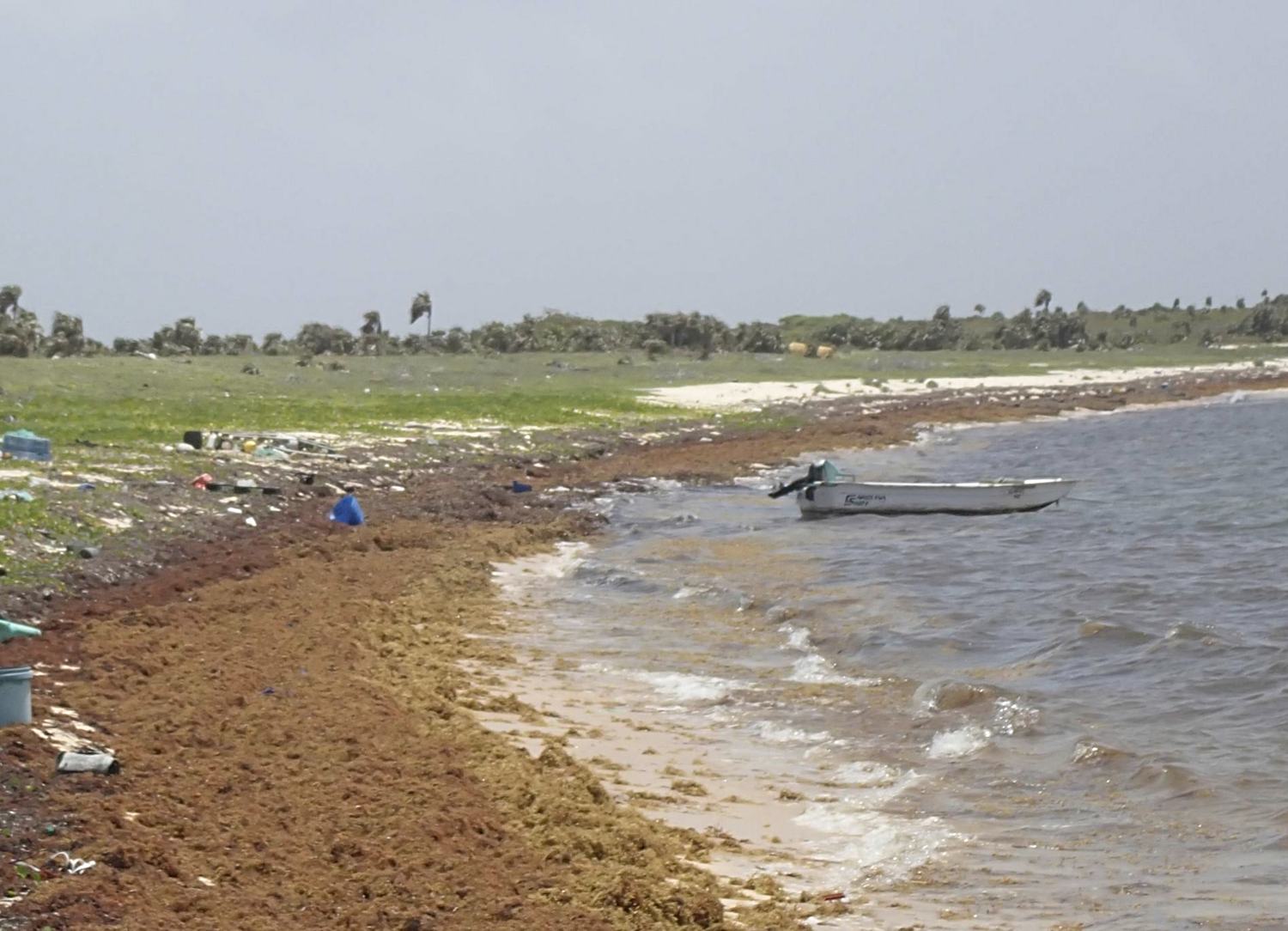
This is the boat they use to cross the 30 miles of open ocean between islands:
Yes, that is an 18 foot open, flat bottomed, skiff. The boat was a bit beat up, but the outboard looked well cared for and relatively new. This boat carries everything they use or need for the 6 weeks they spend on West Plana Cay. One thing that West Plana lacks is potable water. Since we can make all the water we need, the next time they were over on “our” side of the island we gave them 15 gallons.
Bahamian mutton, on the hoof. The island goats are mostly quite small.
In addition to the cascarilla bark, they earn money by supplying the restaurants on Acklins and Long Islands with goat meat, which the Bahamians incongruously call “mutton.” The catch is the chefs want it fresh, which means they need to deliver the goats alive. According to the explanation we got, they deliver a goat to the island, and get paid $100, the butcher gets $400 for the processed meat, and it retails at the resorts for $12 a pound.
One thing I had to know, “How do you catch them???” They are not terribly shy animals, but they don’t let you walk up and pet them either.
“Oh, it is easy! The dog barks at them, they turn to face the dog, and you grab them from behind. Feed them a few palm berries from your hand, and they are tame.”
The prospect of sharing that small boat with one, or more, live, wild, goats while crossing to Acklin Island would not appeal to me… Do goats get seasick?
I promised that we’d post some photos from the last few weeks once we got a proper internet connection… here is the first photo album…
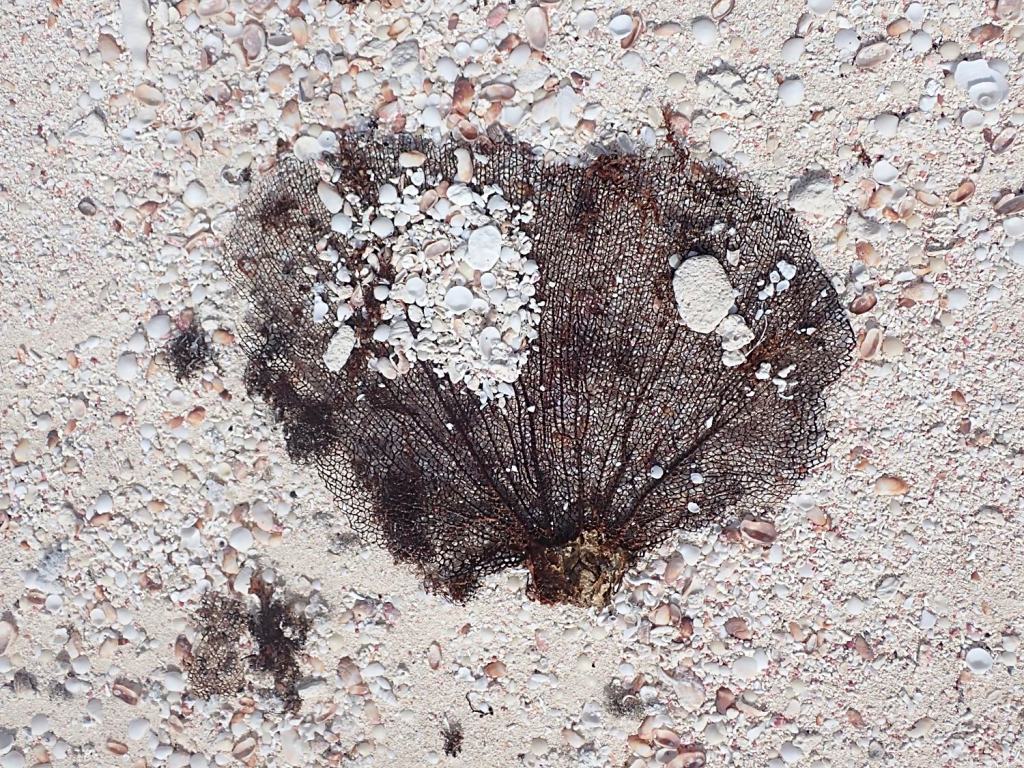
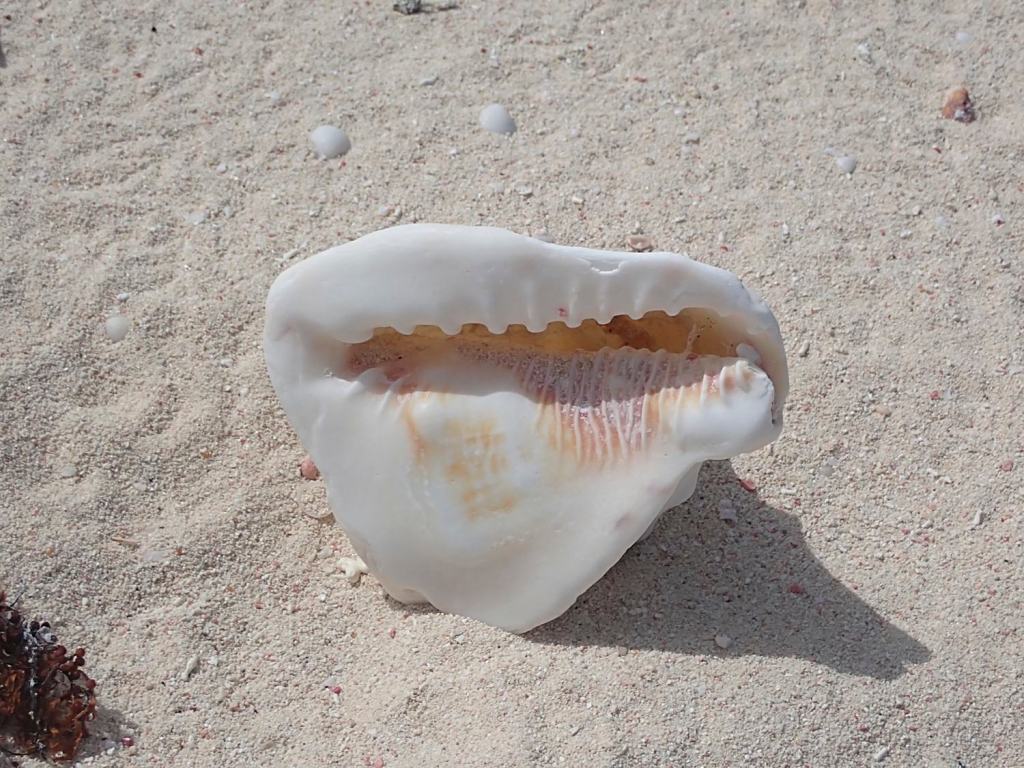
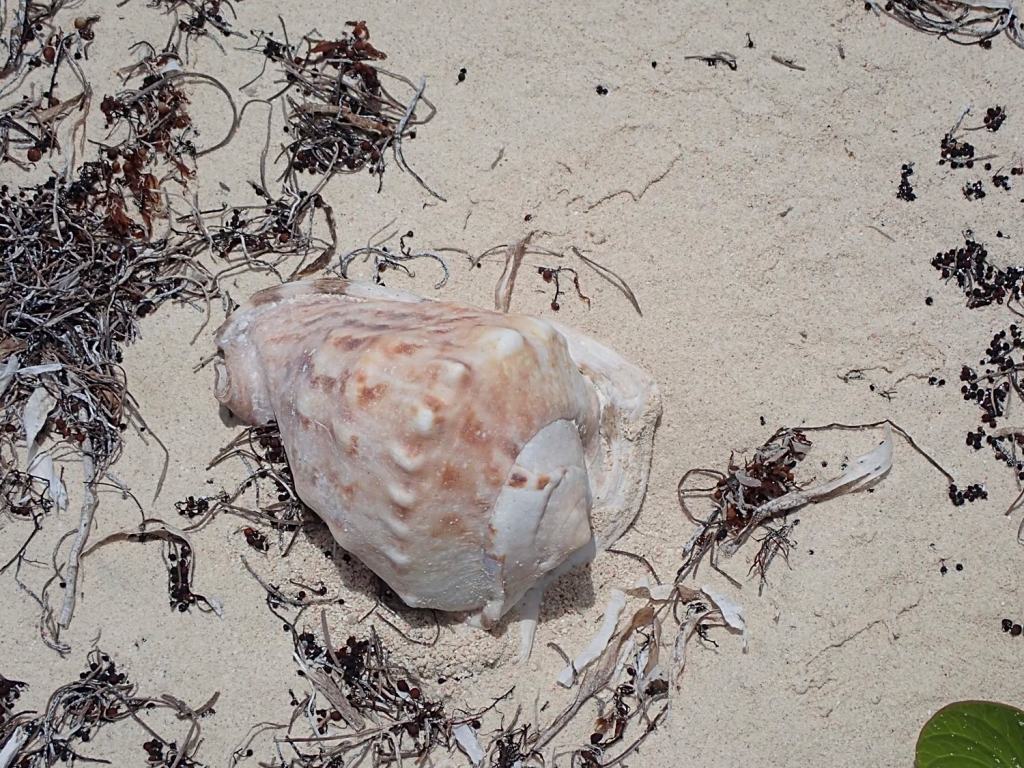
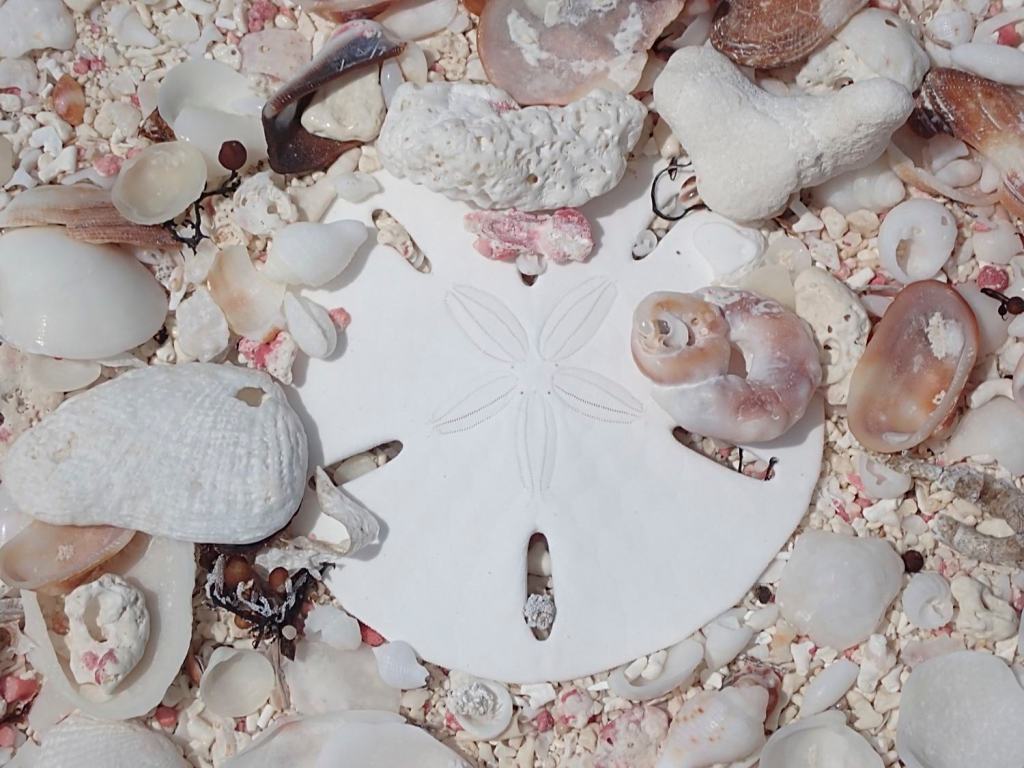
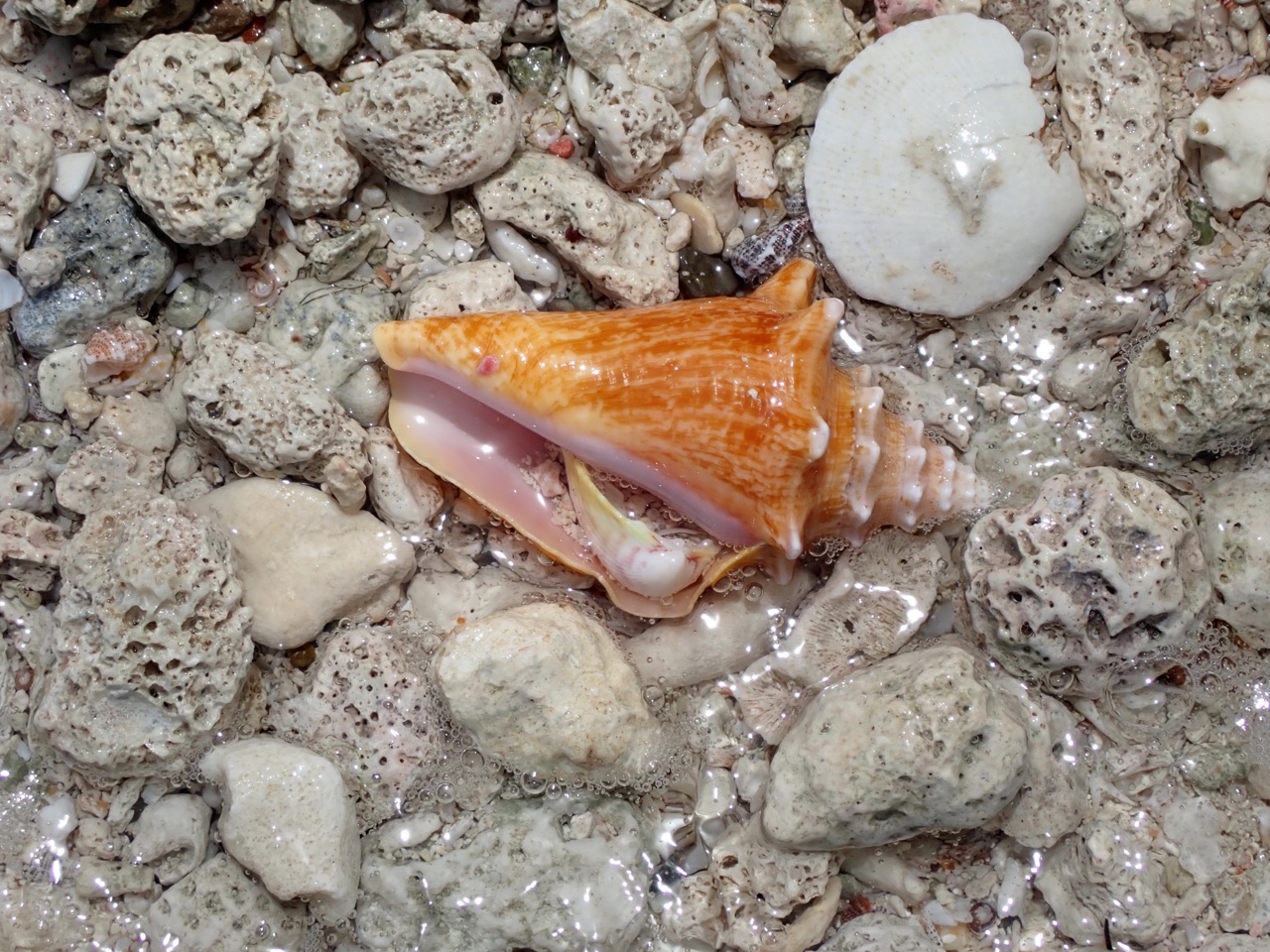
One of Karen’s passions has always been walking a beach looking for “treasure.” The longer the walk, the fewer the people, and the more exotic the shells, the better. As you might imagine, an uninhabited Bahamian out island is hard to top. Since we have been to two of these islands, Karen has been in seventh heaven…
Sea fans are common on the sand.
A Scotch bonnet on a bed of tiny bivalve shells
A helmet shell is always a prize.
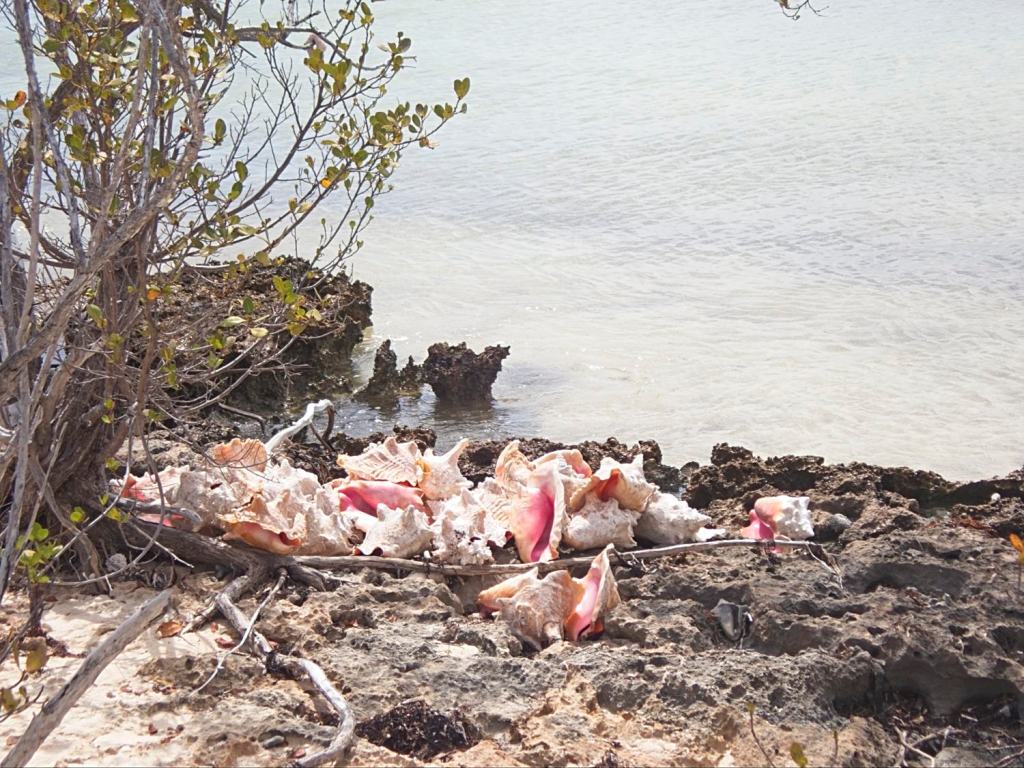
Leftovers from the active conch fishing on Samana Cay
No matter what you read in other places, West Plana Cay has one of the best beaches in the world.
A very large and fragile sea biscuit
Sand as white as snow…
Sea oat and palms
And while not exactly beachcombing, it has been quite a while since we have added a photo to Karen’s Art Project of “Wildlife with Toes” Here is a prize one:
We were motoring the dinghy across the lagoon on the south side of Samana Cay when ahead of us we saw the shadow of a solitary bottle nose dolphin in the clear water. Almost at the same time, he took notice of us, and turned away from whatever serious dolphin business he was up to come by for a visit.
He looped back and pulled up parallel to us, giving us the once over, and apparently we passed muster. He swam ahead of the dinghy, and pulled ahead, then slowed down until his tail was just off our bow. The invitation was clear: “Race you!” I throttled up and the game was on!
For the next ten minutes we traded the lead as the dolphin darted from one side of the boat to the other. Out in front, off to the left, off to the right, underneath, but never behind. We finally broke off the game because we had things to do to get ready to get underway. In preparation for our departure, we hauled the dinghy up on deck, and our new friend slowly swam around Harmonie, looking for more fun.
Getting out of Propeller Bay is every bit as intimidating as coming in. Surf breaking on jagged coral just a few feet from the boat on both sides. The cut is very narrow, but not too long, and we were clear on out in deep blue ocean water again.
We are underway sailing to the northwest. We’ll clear out of the Bahamas at a convenient port, and then head north with the Gulf Stream to Brunswick, GA. This small port town has the advantage of being located just a few miles above the line our insurance company wants us north of for the summer tropical storm season. A short stretch of land travel, and we’ll be off again!
Our grand plan is to migrate back to the east cost of the USA beginning this week. Our first landfall there will be in Brunswick, GA. We’ll take the opportunity there to park Harmonie for a week and visit some friends, before migrating further north.
The first leg of that journey was from West Plana Cay to Samana Cay, another of the uninhabited out-islands of the eastern Bahamas. Only 30 miles apart, they are quite different places, starting with the approach from the sea.
When you get to West Plana, you approach from the west. There is a beach that is several miles long, and you just drive up as close as you want, drop your anchor and you are done. Easy-peasy. Samana—no so much.
Samana Cay is almost completely surrounded by a shallow barrier reef. Between the reef and shore is a shallow lagoon peppered with shallow coral heads. The entrance to the lagoon is a narrow (40 feet) channel several hundred yards long that has breaking waves running on either side of it, and a dog leg to avoid a shallow reef as you get into the lagoon.
From the sea it is an intimidating entrance. Until you are perfectly lined up, all you see are the waves breaking across the shallow reef. It is only when you are perfectly positioned that you can see the narrow lane of flat water, glowing turquoise with the sandy bottom. The actual run in went flawlessly. Despite coral reefs showing above water less than a boat length on either side, we never saw less than 11 feet as we came in. We anchored in the lee of Propeller Cay, and found another tropical paradise.
Unmentioned in any of the guidebooks is that Propeller Cay is a bird paradise. We surely haven’t seen them all yet, but so far we have seen Brown Noddys, Bridled Terns, Frigatebirds, Tri-colored Herons, Oystercatchers, White Crowned Pigeons. There are a few others here in smaller numbers that we haven’t gotten a good enough look at to identify. Pretty amazing.
The snorkeling is pretty awesome too.
We’ll need to be moving on from here soon, but Karen is already plotting a return!
Our destination for this trip has been the uninhabited Bahamian islands of East and West Plana. We arrived on Wednesday afternoon off West Plana, and dropped anchor. The weather forecast for the foreseeable future is pretty much the same: East to Southeast winds 12 to 15 knots, partly cloudy skies, high of 84, low of 79.
Ordinarily, this anchorage is an overnight stopover for boats transiting from the Bahamas to the Turks and Caicos. With boat traffic still dramatically reduced, we expected to have the anchorage to ourselves, and we did—for 30 minutes! Very shortly after we got settled, the 154 foot motor catamaran “Magnet” came around the southern tip of the island from the east. At least they are far enough away they aren’t much of a distraction, and as far as we could see they never went ashore.
Thursday was pretty much exactly the day we came here for. Karen walked most of the way around the island combing the beach for anything interesting, and I took the drone ashore to get some photos.
In addition to the shells and fishing floats (including one of the very rare metal ones!) Karen very unexpectedly came across—people! There were four people living in makeshift shelters made of palm fronds and tarpaulins on the east beach. Turns out they are Bahamians here to harvest cascarilla bark.
Oils extracted from cascarilla is used as a flavoring, most notably in Campari, and also in perfumes. The largest world source of this is from Aklins, Crooked, Samana and Plana Cays here in the Bahamas. These four live six months a year on Samana Cay, harvesting there, and come to Plana for 6 weeks. They don’t like it here, “It’s so hot!”, and there are fewer trees than on the larger island of Samana, but they say the bark is thicker and they get a much better price for it. They get here in an open, 18 foot, flat bottomed skiff. I am not sure I’d trust it across the bay, much less 30 miles of open ocean, but it is what they have.
There is no drinkable fresh water on the island, they have to settle for what they bring or catch from rain. I am sure the local herd of goats leaves no plants that would be eatable for humans, so their diet here is fish and (I assume) goat meat. The next time you have a cocktail that is made with Campari, be sure to lift a glass to Sharon, Randolph, and their friends. They worked really hard to get it to you.
Later in the afternoon I took the dinghy out to the steep drop off at the western edge of the anchorage and went looking for dinner. Mixed in the the jacks, and barracuda I landed three nice grouper.
All in all, it was a perfect day. All the work and effort to get the boat ready to be self-sufficient for an extended period have been worth it.
Once we an internet connection again, we’ll post photos.
Some old sayings have more truth in them than others. One of the most true is, “A bad day fishing is better than a good day working.” By any objective measure, our day fishing wasn’t great, but it was still a great day.
We sailed out of Georgetown two days ago, anchored on the west side of Long Island, and then tried to sail further east yesterday. We were frustrated by light and contrary winds and currents, and ended up motoring down the east coast of Long Island to Grand Harbor. We did managed to catch a nice king mackerel on our trolled lines.
Today we bought fuel at the local marina, and took a break from traveling, and went out for a day dedicated to fishing instead.
We started out trolling. No specific target in mind, but a wahoo would have been nice. About half way out, we got a bite on the deep wire line outfit—the one we specifically use to target wahoo. It was a big fish. What it was we’ll never know…. The line broke. For all you non-fishermen out there this really shouldn’t ever happen in open water. I missed something. Maybe a kink in the wire, maybe a badly tied knot. Something went wrong… something I should have not allowed to happen. But, heck. I lost an expensive lure, but there are more fish out there!
Now we are several miles offshore, and the water here is about 250 feet deep, and drops off rapidly to several thousand. The edges of those drop offs are a great place to target a lot of different fish. We pull in the trolling lines, and set up for bottom fishing. I pick a jig suited for these depths, and set the boat up to drift with the current.
In just a few minutes, I have hooked a fish. A big fish. It’s tough getting him up off the bottom and away from things he can tangle me on, but I am making progress. It’s a heavy fish, not dashing around, just pulling like a tractor. I am already tasting grouper fillets. A few minutes in and (I’ll bet you saw this coming) the line breaks. Arrrgh!
The taxman takes his bite…
Back to it. The next drift I have another fish, not nearly so big. This one I get up off the bottom and moving my way pretty quickly. When you are pulling fish up from these depths, at some point they become incapacitated by the huge pressure changes, so it is not unusual that the last half or so is struggle free and just involves reeling in the inert fish. In this case there was an extra reason the struggle stopped. The Bahamian fisherman would say “The Taxman” had taken his cut. A shark bit off the back three-quarters of the fish. I landed a fish head, and nothing more. Sigh.
Back down to the bottom. Another bite, and other big fish. This time a REALLY big fish. I am using 50 pound test line, and it’s all I can do to get him started up off the bottom. Up about 50 feet, and he decides he has had enough of this, and races back down, peeling line off the drag. I hold on until he slows and I start lifting him back up as fast as I can. This I get maybe 75feet of line back before it screams back down toward the bottom. The fish is pulling line so fast off the reel the drag is hot to the touch. The process repeats, I lift him up—again. I get a lot further this time. I have him beat—NOT. The rod bends down, and the drag screams as he dives toward the bottom. This time, he makes it, and manages to tangle me on something. I’m stuck, nothing to do but break off. At least this one the fish won fair and square. Nothing I know of that I could have done differently.
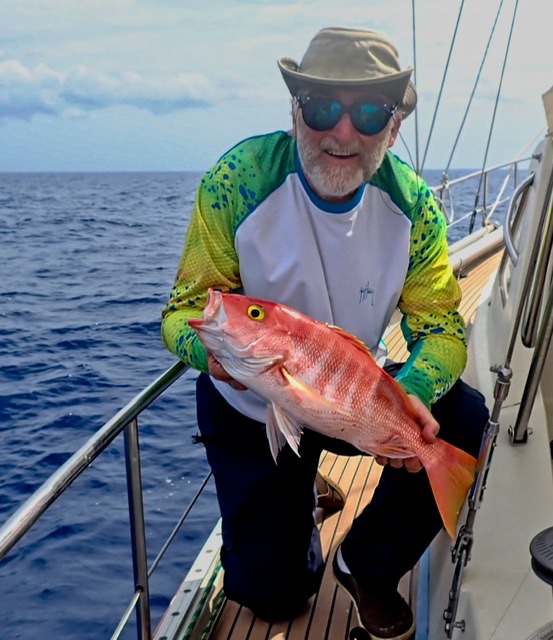
A nice sized silk snapper.
Another drop, and another hookup. At least I am finding the fish! Certainly not the biggest fish of the day, but this time he ends up in the boat! A nice sized silk snapper. All of these very deep living snapper species are REALLY tasty table fish and we are always happy to welcome them onboard.
By this point the “taxman” was circling the boat. A BIG shark, over 8 feet, was cruising around waiting for us to bring up dinner for him. It was time to head back.
It a few ways it was a rough day. Certainly I lost a lot of expensive fishing tackle. But, importantly, fun was had and we DID end up with more fish in the freezer than we had at the start of the day.
On our random walk through the Bahamas we passed through Georgetown, the largest town in the Exumas. It is a very different place this year, and in strange ways.
Last time we were here, there were close to 200 cruising sailboats in the harbor. This year, less than a dozen. On the other hand, a trend we have noticed everywhere in the Bahamas this year, the number of super yachts is far larger than we are used to.
Our definition of “super” yacht is a bit arbitrary, but would be boats bigger than about 100 feet. What we expect is happening, is boats of this sort would normally have scattered all over the Caribbean, but travel restrictions have confined them to these waters where travel has been more open than a lot of other locations.
We have found the local travel to be pretty simple and straightforward. Read the rules, follow the rules. If you are considering coming here, we’d definitely encourage it. Especially if you are vaccinated, it is pretty simple.
We stopped in Georgetown for the grocery store, and to do some repairs. Those chores are now done, and we are off to more remote locations. Tonight, our stop is the northern end of Long Island. A place with some high end resorts and a lot of peace and quiet.
We did promise to post some photos from our stop at the Exumas Land and Sea Park, and since we have a decent cell connection here, here goes!
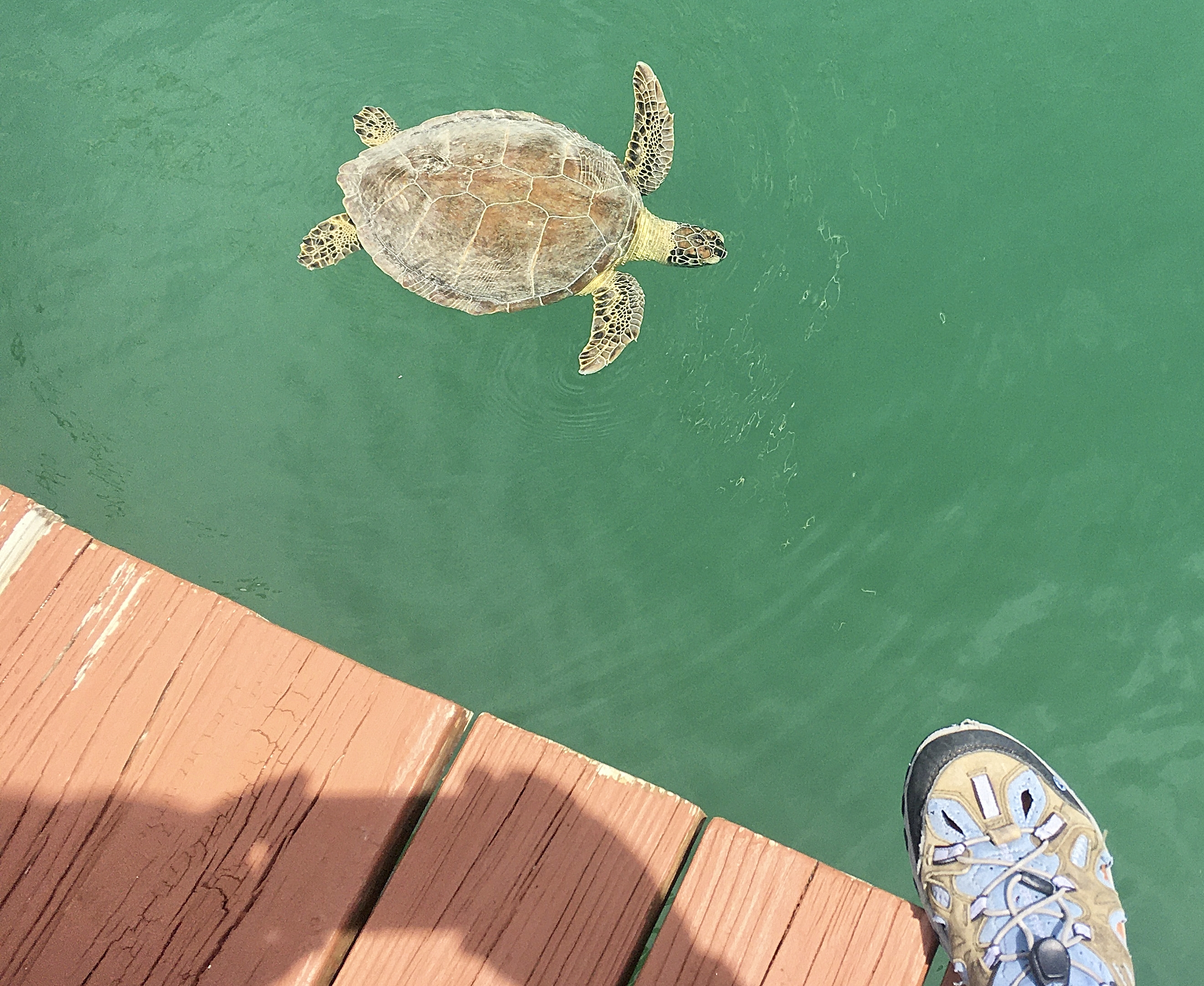
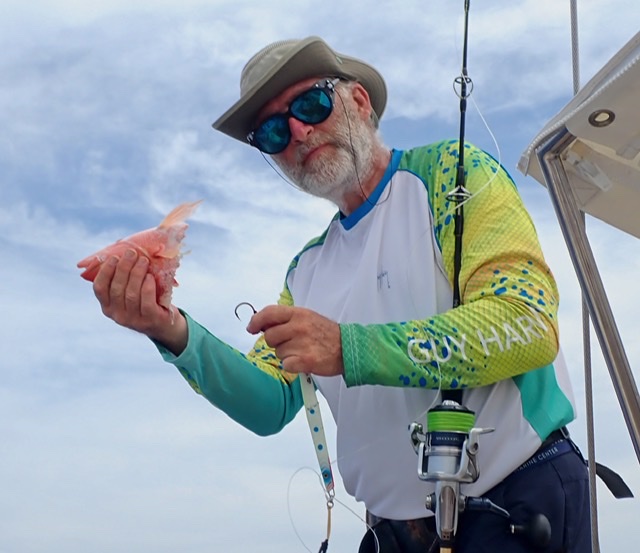
Harmonie on her mooring in Wardrick Wells, the headquarters island of the Exuma Land and Sea Park.A green sea turtle is ready for his close up.A mahi-mahi made the mistake of accepting our dinner invitation…If Bill is here to catch fish, Karen is here to find shells!The view from the top of Harmonie’s mast How many different colors of blue are there????
Pretty much a perfect day out of Cape Eleuthera on our way to the Exuma Land and Sea Park on the island of Wardrick Wells. We landed a mahi-mahi to restock the freezer, we sailed without needing to motor at all, we arrived in a beautiful place, and we were visited—close at hand—by several green sea turtles. We even picked up our mooring ball here, in a cross current and contrary wind, on the first pass. Not exactly a HUGE accomplishment, but we haven’t done it for two years, so it’s good to know we still have the teamwork going!
One of the downsides of these more remote places is that there is little, or no, opportunity to connect directly to the internet. So, even though we have some great pictures, and we will to wait to post them until we have a real internet link and not just satellite email.
We have been struggling a bit with what we hope is a minor issue on our furling system for the jib. I’ll need to get up to the top of the mast tomorrow morning to make what I expect to be a final diagnosis (and fix!) of the problem. Except for that, everything has been working perfectly, which is always a good thing! It is nice when all the time and resources we put into preparing the boat pay off.
We will spend tomorrow here, and then head further south and east toward Georgetown. We haven’t yet decided if we are going to do that in one 14 hour jump, or stop to break it up into two days. It’s a decision we don’t have to make until we are well underway. The expectation is for a quick stop at Georgetown to visit the grocery store, and then continue on to the more remote islands where Karen wants to comb some virgin beaches, and Bill wants to catch some fish.
Bahama islands come in three flavors. “Out Islands,” “Family Islands,” and then the others. The “Others” are pretty easy to pick out. The are the crowded, urban, islands with the big cites. New Providence (which has Nassau) and Grand Bahama (which has Freeport) are the examples. Out Islands are pretty much all the others. Family Islands are a subset of the Out Islands that are inhabited. Some of the smaller more remote islands are populated with just two or three families who have lived there for a hundred years or more.
We are at the very southwestern end of the island of Eleuthera in Cape Eleuthera Marina. The staff here at the marina remembers us from the few times we have been here before. That’s part of what makes it a Family Island. A delightful place, although a bit isolated. Karen loves the remote beaches where she can find unusual and interesting shells. Although right now the marina is relatively empty, they tell us that they have been packed full up until last week.
Our plan is to leave here tomorrow morning, and sail to Wardrick Wells, a beautiful national park. We’ll spend a couple days there, and then move to Georgetown where we’ll take advantage of the larger market to reload on our fresh food, and then head to the the uninhabited islands further east.













 fetchinketch