Fishing our way to San Diego

The trip from Catalina Island to San Diego was not much in the way of wind, we motored probably 2/3rds of the way. But it was productive…
IMG_1697

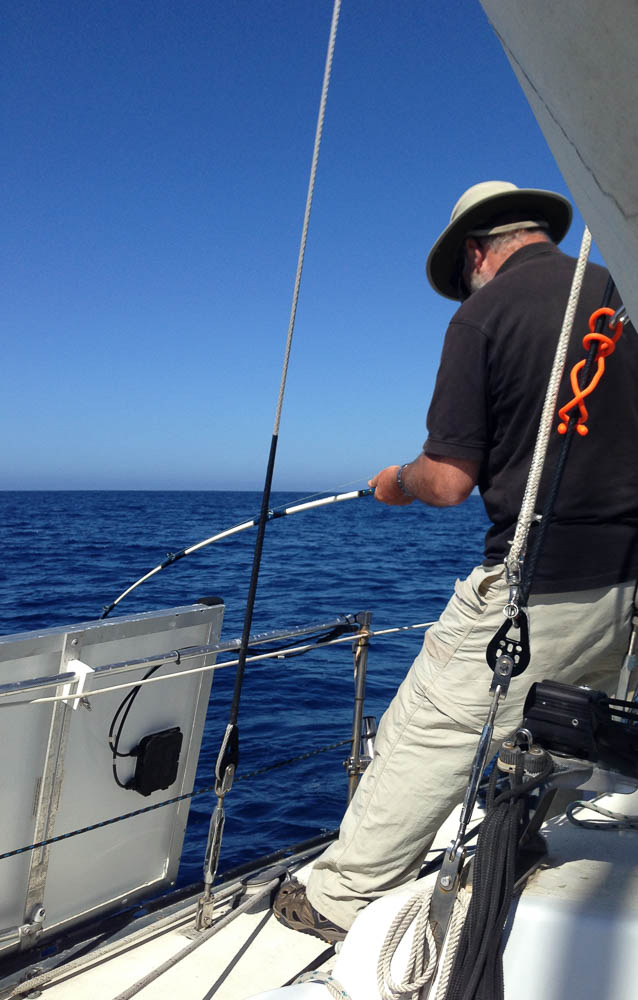
Hooked up again…

Fish on, again!

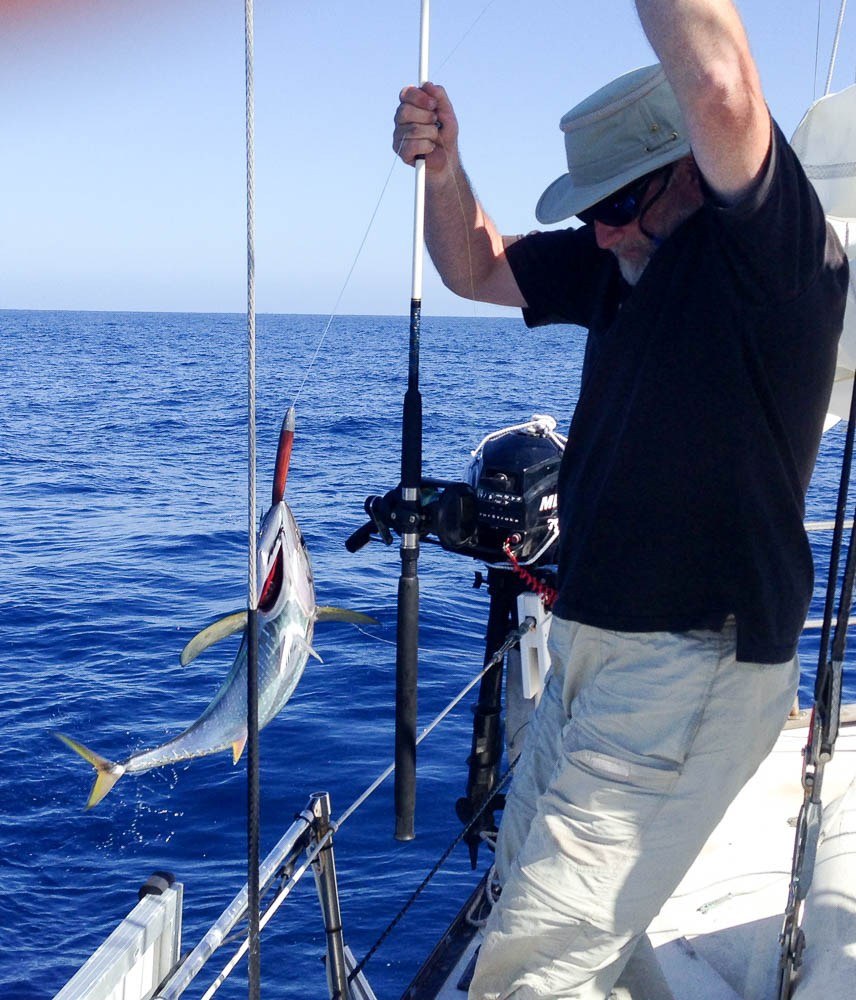
This time it is a small Yellowfin Tuna, also known as an Ahi.  Really, really good eating!  I think this makes it almost officially an El Nino weather year since catching these guys north of the Mexican border only happens in the warmer waters of El Nino.
Come to Dinner!

Come to Dinner!

This is a pretty small Ahi, they get well over 100 lbs.  Interestingly, he wasn’t nearly as strong a fighter as the Skipjacks even though he was a little bigger. One reason might be is the Skipjacks are some of the “warm-blooded” tunas.  Cleaning them quickly after they land on deck you can feel the heat in their bodies. Kind creepy actually, filleting a fish with meat that is body temperature.  Much warmer than the water around them.  Not true with the Ahi. Like “normal” fish their bodies are at water temperature even after a fight on the line.

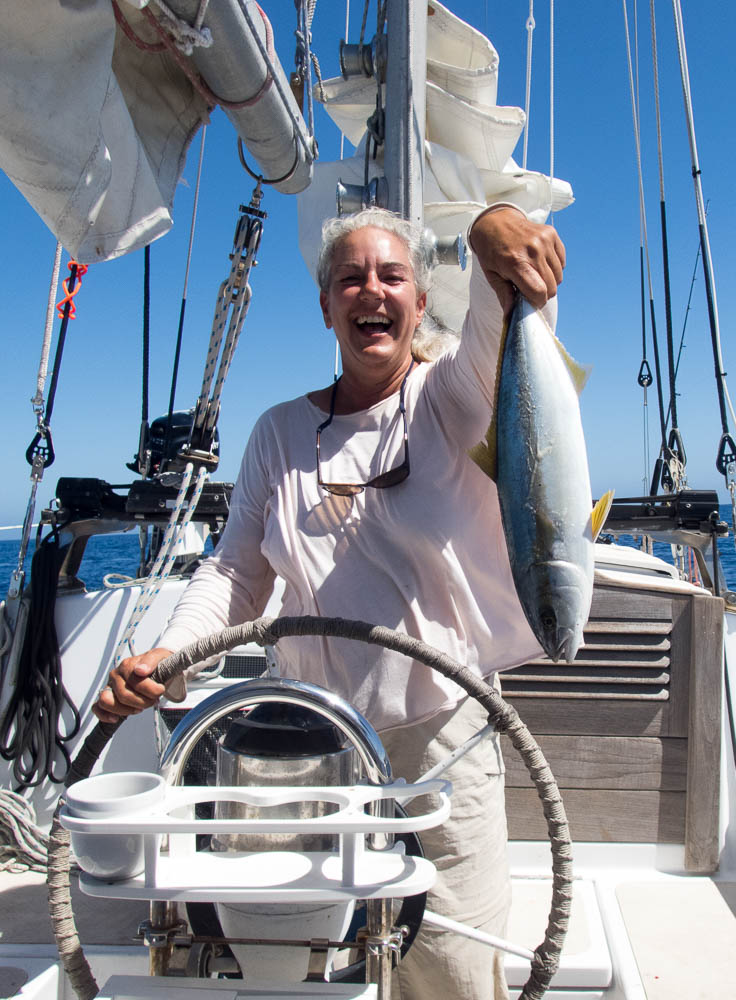
And then a little further along, Karen caught her first fish–ever!  A small yellowtail.  If you are a sushi fan you might know these as “hamachi”.
One Happy Fisherman!

One Happy Fisherman!

We found a large raft of floating kelp and detoured from our course line to swing the lures past it.  We were immediately hooked up into two small yellowtail, members of the snapper family. The one on my rod was the smaller of the two, and we tossed him back to grow a bit.  We could have caught dozens of these guys.  As we pulled the hooked ones to the boat, the whole school followed along.  Some of the school even trying to steal the lures from the mouths of the hooked fish!

Coming into San Diego at night was a bit of a challenge.  It was very busy at the harbor entrance with all of the long range tuna boats heading out with their cargo of hopeful fisherman.  As we made our way in the channel, a small boat pulled up behind and shadowed us for a few minutes before turning on his flashing blue light and pulling alongside.  “Oh-oh!  What did I do?”  It was US Customs.  A few questions across the water about where we had come from and where we were going and they wished us a good evening.

The anchorage itself was PACKED with boats.  My radar did a fantastic job picking out boats and buoys so we could find a place to squeeze ourselves in.  We were anchor down at about 12:30, and probably asleep by 12:33!
Posted in Underway | 4 Comments

Today’s Quiz

Today is warm and sunny, just a trace of a breeze. Delightful really. We buzzed around the harbor in our dinghy getting pictures of boats, lunch in town, spent some time swimming, organizing for our time in port on the mainland. Nothing broke today, and nothing needed fixing!

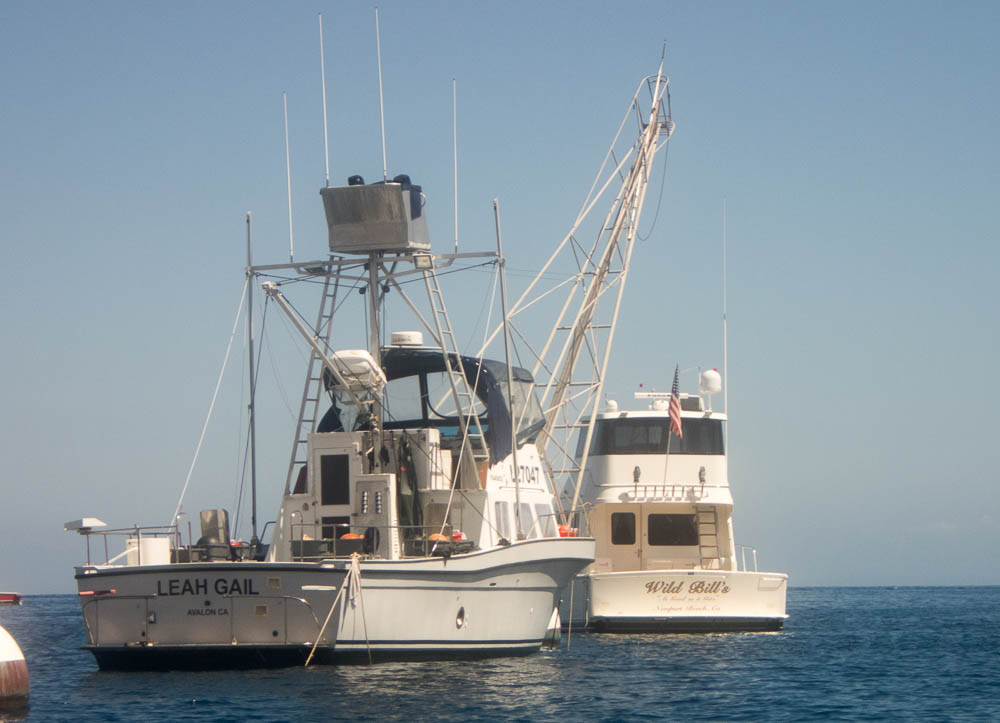
Here is your test for the day. The boat in the photo is a commercial fishing boat of a type I had thought extinct. I have only ever seen one of it’s kind before, and that was in New England.

What does Leah Gail fish for and how?

What does Leah Gail fish for and how?

Here is a photo of the Leah Gail.  Click on the photo for the full sized image.  That long tall structure off her bow is not a mast, rather when she is working it lowers down close to the water, a super long bowsprit.

Here is your two part question:  What does she fish for, and how does she catch them?

Posted in Underway | 4 Comments

Plans and Technical Lessons Learned

Plans

Our we’ll be packing up from Catalina Island in a few days. We’ll be heading over to San Diego where there is more infrastructure for repairs. Based on email exchange with the designer, it looks like I might be able to have the broken casting on the windvane welded. So I’ll need to find a crackerjack aluminum welder. Also a good chandlery is right near the docks there so we’ll have access to other bits we need.

Today I finally traced down and fixed a fuel leak on the engine that has been bedeviling me. Hopefully that is one problem that won’t come back!

Technical Lessons

I have learned something on every sailing trip I have ever taken.  No matter if it was a short day sail across the bay, or a multiple day trip.  This last trip being longer than only other I have taken I learned more than a little.  Here are some things I thought worth noting that might be of interest or use to others.

Water Use.

Only good news here. We did great without really trying super hard.  After 15 days, we have just emptied the first of our two water tanks.  At about 40 gallons, that is about 1.3 gallons per person per day.  Considering we aren’t set up for super water conservation, that’s not bad at all.  In fact I’ll call it awesome.  The biggest single contributor to using so little fresh water is the saltwater pump in the galley.  Washing dishes with as much saltwater as you like and then giving a quick fresh water rinse works well.

Electricity

Two issues here. We used more and generated less that I expected. I was a bit surprised because I had used the solar panels as my sole source of power for weeks at the dock and they more than kept up.  What changed?  Mostly, it was cloudy.  I hadn’t expected that to be a big issue.  In San Francisco Bay it is foggy a LOT.  The panels didn’t show too much of a drop in capacity on foggy days, so I expected the same in clouds.  Wrong.  San Francisco fog might be gray and dreary, but it is only a few hundred feet thick at the most.  It really isn’t very good at filtering out sunlight. A good thick tropical cloud can be many thousands of feet thick, and cuts sunlight dramatically.  Based on comments from other boats in a similar situation, I am considering adding generating capacity in the form of an alternator powered by a propeller that we tow behind the boat.

Things that did not work as promised…

The mast head instrument that works as a ultrasonic wind sensor, a GPS, and an electronic compass did two of those three functions well.  The issue was with the stability of the compass reading.  Despite the claims of the manufacturer, the compass reading was very unstable when the boat was rolling.  It would give the autopilot fits of “twitchy” steering and the “North-Up” radar display became “North kinda sorta thata way”. I have been on the phone with them, and they sounded honestly surprised by the issue.  A couple calls back and forth, and they promised me a call back tomorrow with more information. On the bright side, with no moving parts sticking out, it is pretty “bird proof”.  I was happy with that one evening when we had a masked booby circling the boat looking for a place to land for the night.

The tracking webpage run by Predict Wind has also been a bit of a disappointment.  To quote technical support from PredictWind in an email about the issue, “This is not a strong feature of the product.”  Of course they blame Iridium for the issue. Oh well, maybe it will get better…

Things to get better at…

Sailing in strong winds is easy… relatively.  Sailing in lights winds is hard.  In light air in calm water the boat does fine, and you can milk it along surprisingly fast.  Throw in an ocean swell, and everything goes wacky at less than 7 knots of wind.  Every roll shakes the wind of of the sails messes up the sail shape and slows you down.  I know I’ll get more practice at this!

Posted in Underway | Leave a comment

Some random pictures from our trip out to the middle of the Pacific and back…

This gallery contains 8 photos.

More Galleries | 1 Comment

Tied Up!

We have arrived at Avalon Harbor on Catalina Island! Hot showers! Dry land! A stable deck that isn’t rolling under our feet!

We are going to hang here for a few days, and then transition to a marina on the mainland where we can manage logistics for repair.

The last 48 hours or so were almost all downwind. The struggle of 24 hours a day of hands-on steering really made me feel totally justified in deciding to head back instead of pressing on down wind to Hawai’i. Day after day of hands on the wheel would have been too much for any two person crew. Certainly I found after an hour on the wheel I was ready for a break, and my watch has three hours left to go!

It’s not that the boat is hard to steer, it’s just that it needs it. Imagine driving your car for 12 hours a day for 2 weeks. A day? Sure. Two, okay. Three gets old. A week? Two? Not me!

For now we calling Catalina our “Practice Island”. It’s not exactly like Hawai’i, but it is really a delightful location.

I’ll hopefully have some pictures to post tomorrow!

Posted in Underway | 6 Comments

Fish Stories

Fishermen use the word “structure” a lot. They mean any feature underwater that attracts fish. In a lake it might be a submerged tree, or a deep hole or drop off. In a stream it might be a pile of rocks. Something different from its surroundings.

What could structure look like in the open ocean? One kind is floating stuff. A raft of kelp, or a log attracts some kinds of fish. As we were sailing toward the coast today, I saw on the chart structure. It’s 13,000 feet deep, so what was I looking at? An underwater mountain, actually a series of them, that towered 5000 feet above the surrounding flat plain. Of course that still leaves them 8000 feet below the surface. Not something a surface dwelling fish would ever notice but for the disturbance such a feature makes in the water flow. Nutrient rich water gets pushed up from down deep, and feeds a complex open ocean food chain. As we approach I set two lines and went back to other things.

About an hour later the scream of a fast running drag gets us jumping to action. Getting the boat stopped and getting the rod in hand takes a few minutes. By this time the fish is the better part of 150 yards away. I know because at that point he launched completely out of the water. Long, thin, light colored, about 4 feet long. My 50 pound test line hasn’t slowed him down yet, much less stopped him. On the third jump he threw the hook and was gone. I think it was a wahoo, but can’t be sure.

An hour later, a reel again starts peeling off line. Karen starts to slow the boat, while I go back to the rod. Before we can do either, the OTHER rod is hooked into a fish! A double! Of course one swims left when the other goes right, and then they reverse, twisting the lines. I get the first to the boat, and we have a 6 pound skipjack tuna in the cockpit. The second fish twists off the hook before we can get the lines sorted out.

By the time we get things sorted out, the thrashing fish has left a bloody mess in the cockpit. It looks like the scene of an axe murder. Blood is everywhere. A few minutes later, he is steaks in the freezer, many more minutes later we have things washed down and cleaned up.

So far we are doing pretty well on this ocean fishing stuff! Almost two weeks at sea, and the freezer has more in it than when we left.

It looks like we’ll be tying up Monday. Our planned first stop is Avalon Harbor on Santa Catalina Island. That first hot shower is sounding mighty appealing.

Posted in Underway | Leave a comment

Wind Forecast Translations

We are now 150 miles from our predicted landfall, and within range of the marine weather radio for Southern California. We now are blessed (?) with accurate (?) local weather forecasts. All the planning and arranging we did to avoid hurricanes on the way to Hawai’i, and we are most impacted right here off Southern California. Ok, it’s not a REAL hurricane any more, but the tattered remnants of hurricane Karen are bringing us scattered rain showers, and ironically, light winds as what’s left of the storm system suck the life out of the normal pressure gradients along the coast.

In the interests of public service, I have developed the following translation for the official National Weather Service wind strengths.

35 to 45 knots: Can we stay home today, Please?

25 to 35 knots: Mr. Toad’s Wild Ride

15 to 25 knots: A beautiful day for sailing, and there won’t be any of those pesky fishing boats in our way.

10 to 20 knots: Perfect for lessons!

5 to 15 knots: Could be fun, could be frustrating, and the weather guy gets to be right either way.

10 knots: A special wind forecast. No other forecast gets a single number. You think this means the forecast is for between 9 and 11 knots. Wrong! It means somewhere out there today, at sometime, the wind will peak at ten knots. The rest of the day you’ll struggle to get your boat moving.

Less than 10 knots: See above…

Variable: They don’t know, and don’t feel like guessing today, but it will likely vary between too little and none.

Calm: Gentlemen, start your engines!

Posted in Underway | Leave a comment

Not as big an ocean as you might think.

Right now as I write this there are four ships showing up on my instruments within 25 miles. There was not a minute all day where we had fewer that two within range. Not all of them came close enough for visual contact, but that is way more traffic than I expected.

We are seeing so many here and now because we are crossing the main shipping lane from China, Japan, and Korea to the western end of the Panama Canal. That’s an awful lot of “stuff” moving around!

So far this trip while out on the open ocean we have had to alter course once to keep a safe distance from a cargo ship.

A great day of progress. We are now about 300 miles from the coast. The wind has been very cooperative all day, hopefully that will continue for the next couple of days.

Posted in Underway | 2 Comments

Lesson: Use all your tools, and experiment.

The Fetchin’ Ketch is a ketch type sailboat. One with two masts, the one in the back smaller and called the “mizzen”. I have been told several time by people whose opinions on the matter I trusted that when you are sailing upwind the mizzen sail is no help, and might even slow you down. I experimented a bit to test this theory, but never really carefully, and just accepted it as an axiom. I really only worried about the mizzen when sailing off the wind when it was a great tool.

As the wind dropped at the end of yesterday below about 14 knots it became a real struggle to get the boat steering herself reliably. What had been simple at 20 knots became almost impossible at 12. I fiddled with the trim of the job and mainsail, back and forth, every way I could, with only limited success.

Finally, running out of options, I raised the mizzen, and sheeted it home. Magic! It was like somebody put rails in the water for the boat to ride on. Perfectly straight over wide wind strengths, and at wide range of wind angles. My advisors were right about one thing, we did not go any faster, but what a difference in control. It was an experiment that would have been hard to do in San Francisco Bay. Finding a long enough run of water with lighter, unchanging winds would not be possible, but out here on the open water we had the perfect controlled experiment. I love sailing: there is always something new to learn or figure out.

The wind hasn’t been as cooperative today. We even had to resort to using the engine for a few hours this morning (Please, don’t tell anyone!). Last night was long and tedious with many patches of time where it was just too light to keep the boat moving in a useful direction. It didn’t help that all day today was gray and dreary but we are now mostly caught up on sleep, and we have about 12 knots of wind we are enjoying forward progress without the hard work of beating into the bigger waves. Looks like 4 or 5 days to the coast.

Posted in Underway | 2 Comments

Before and After AIS…

AIS is an acronym for Automated Information System. A less descriptive name I could not have invented, but it is a fantastically useful thing. Here is the description of two interactions between large ships and small yachts sailing at night, and what happens…

The skipper is asleep, and the crew on watch sees ahead lights just breaking over the horizon. As they were instructed, they wake the skipper immediately. Since the lights have appeared ahead of us, we can assume they are sailing in our general direction at something like 18 knots, and we are going toward them at 6 knots, closing speed of 24 knots. We know from previous experience that ship lights like this appear over the horizon at about 6 miles away. We have at most 20 minutes to decide if there is a risk of collision, and then decide on what to do that will not make things worse, and then execute whatever evasive actions we think best, in the dark, all while just awake from a deep sleep. Very stressful.

Now in a world with AIS, the situation looks like this: the crew sees an icon appear on the chart plotter at a distance of about 30 miles. They touch the screen, and information appears. The other ship’s name, destination, course, heading, speed, length, beam, draft, current rate of turn. Everything except how the Captain takes his coffee. Most helpful is the Closest Point Of Approach. Our plotter has taken course and speed from both boats and calculated how close we will get at the closest. The crew can immediately look at that display when the ship is an hour away and decide if the skipper needs to be awakened. ALMOST all the time there will be plenty of room even at the closest, and sleep need not be disturbed. The skipper likes this.

Of course, we still need to look around. It is possible that a ship has a malfunctioning system, or is small enough that AIS is not required. But the vast majority of interactions between ships are now so much easier, less stressful, and safer.

On the boat today, the wind is 20 knots from the NW, we are close reaching at between 5 and 6 knots, on a straight line course for our first anticipated landfall 565 nautical miles away in the Channel Islands. It might not be our anticipated destination, but the sailing is good, the weather is good, the boat and crew are good. Life is good.

Posted in Underway | 4 Comments