20:00 local, 13 Sept 2019
Lat: 43 34.3’ N
Lon: 64 42.8’ W
Weather Clear, wind 2 knots, NE
Water temperature 60F/Air temperature 63F
Course 253M
Distance from St Peters Canal Entrance: 205 NM
Distance from Delaware Bay Entrance: 547 NM
Upon leaving the canal at St Peters we were treated to a delightful sail as brisk northwest winds pushed us along on a fast broad reach. For all of the afternoon and night, and much of today we blasted along at speeds from 7.5 to 9.5 knots. Of course all good things must come to an end, and the wind has died to a zephyr, but we made over 25% of our ocean passage in a fast 24 hours.
Our destination is Annapolis, via the Delaware Bay and C&D Canal, and our plan is to go straight on through until we get to the Chesapeake Bay. We are carefully watching the path of the depression that is forecast to become hurricane Humberto. Right now, it is forecast to stay well south of our track, but if that should change, we’ll have many places along the coast we can put in until it is out of the way.
Power back on, and we squeezed through the lock with three other boats. Once again, we are out in the ocean, and Harmonie gets to stretch her sea legs. We have a beautiful north northwest wind pushing us on a fast reach southeast to warmer climes!
We got down to St Peters without problem, got our provisioning run complete, and have the boat set up and ready for offshore sailing. We are all ready to go… Unfortunately power is out in town again, so the lock is not functional, and the queue of southbound boats waiting to get through is starting to build.
We have enough of a weather window that waiting a day or two isn’t a problem, except it is getting COLD at night!
After a hurricane passes over your boat there is one good result: Your boat is CLEAN. It basically gets a freshwater power wash for hours and hours. Yesterday we spent all day undoing all the things we did to prep the boat for the storm. This morning we pulled up our lines and anchors, and in less than an hour we took the boat from as clean as it has been in months to a filthy muddy mess as all the lines, chains and anchors did their best to move as much lake bottom to the topsides of Harmonie as possible.
A muddy mess!
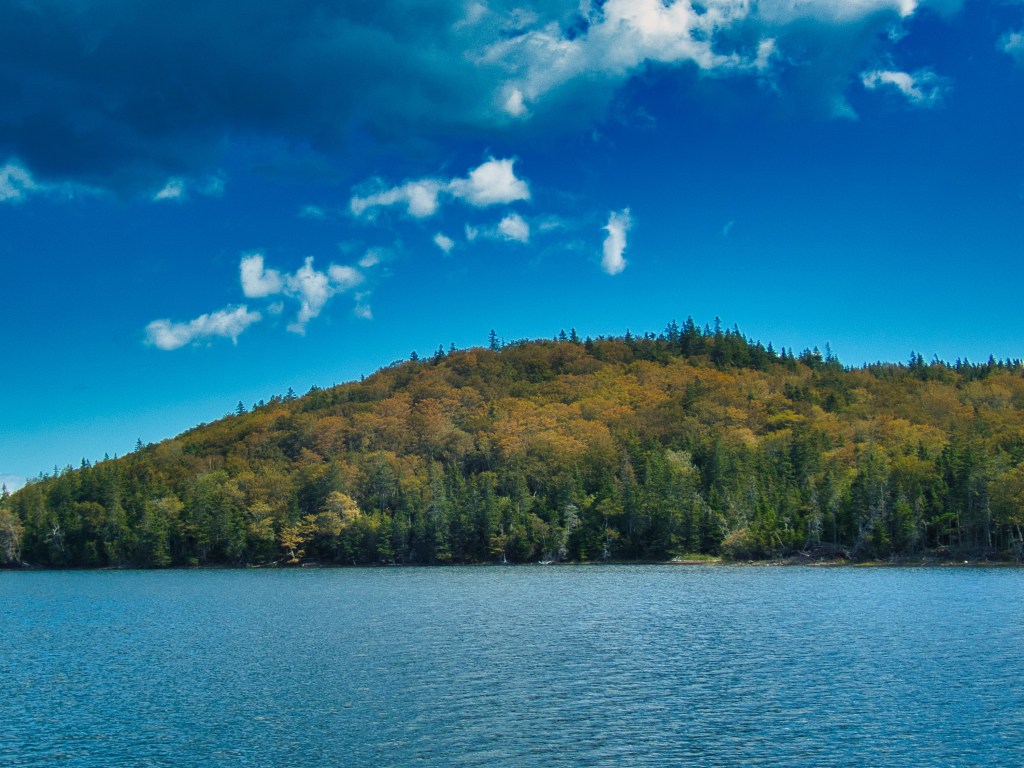
Under sunny, clear, and chilly sky we sailed south on Bras d’Or Lake. On the shores of the lake we see the first hints of fall color showing in the maple trees. That can only mean one thing: It is time to turn further south before winter arrives.
Fall color starting on the hills.
We are anchored at the southern end of the lake, at the town of St Peters. We tried to do a grocery run today, but the storm still had power out in much of the town so the grocery store was closed. Tomorrow, it is supposed to be open for business again so we can stock up for our coming passage south.
Our weather forecasts suggest that we wait a day here before taking passage through the canal back into the Atlantic. Our plan is to reverse the route we took to get up here two months ago: Leaving from Nova Scotia, straight down the coast to the Delaware River, through the Delaware Chesapeake Canal, then down to Annapolis. A total trip time of about seven days.
Other than the muddy water in the harbour and leaves scattered on the ground, there is little evidence of anything having happened. It is a cool, breezy, sunny morning. Harmonie is right where we left her. All is good!
We were talking earlier today about the “good old days” of sailing. Back when we mgiht have heard that there was a hurricane that had hit the Bahamas last week, and this morning it was a bit cloudy and breezy, then… SURPRISE! Maybe they weren’t so “good” after all! A week of preperation was a good thing.
Right now here in the early afternoon we are watching the winds build and the first spits of rain fall. Its very hard to figure out exactly what we should expect, since the terrain here has such a big impact on the wind strength and direction, but so far it looks like the storm will pass to the west of us. That means stronger winds, but from the south which is what we most prepared for, and a bit less rain than the other side of the storm.
Hopefully by this time tomorrow we’ll be setting Harmonie up to be sailing again.
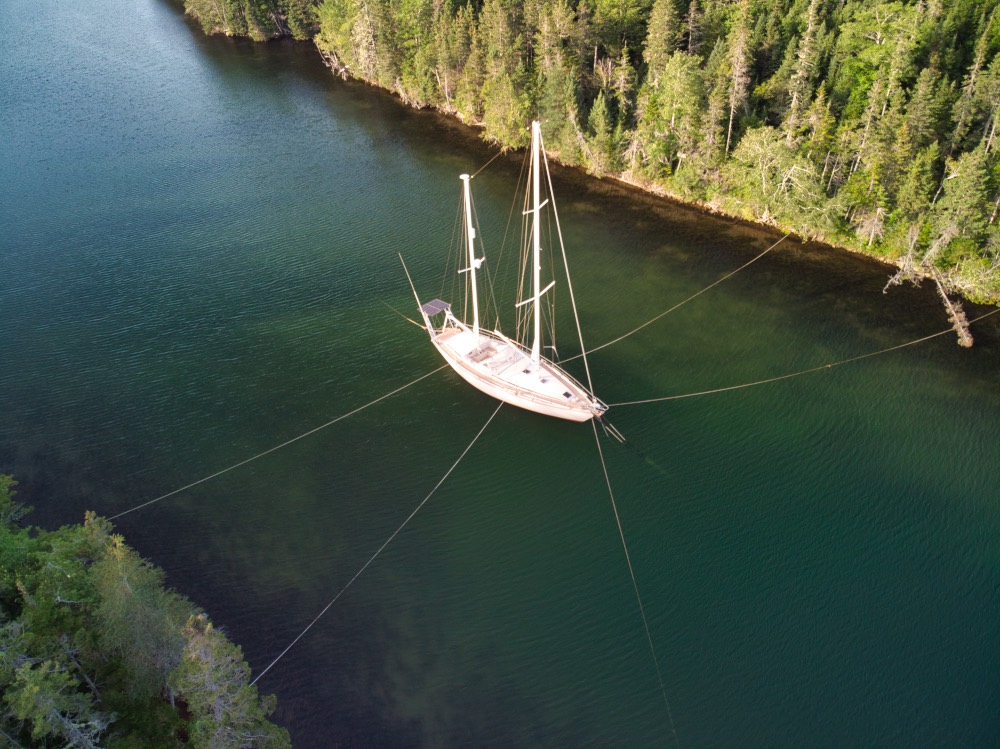
We are almost as ready as we will ever be. We are about 36 hours from the first touches of Dorian.Right now it is dead calm, quiet, and clear. Harmonie is settled in to a narrow shallow cut off the main lake. She has our 110lb main anchor off the bow, our 88lb spare anchor set off the stern, both set hard and deep into muddy clay. She is tied to each shore by a multiple of lines. As much of her gear as possible has been stripped off to reduce windage. She is as safe as we know how to make her. For the duration of the storm we will be staying at a friend’s house high on the hill overlooking the anchorage so we can keep track of our girl. We will be safe, and we expect Harmonie to be as well.
Located here far in from the ocean we have few hazards to deal with. The will be no large waves, no significant storm surge. The steady winds will be below hurricane strength, although we might see significantly stronger gusts. The expected heavy rains really aren’t a concern for us. This far north, the storm will be moving very fast, so will be rather short in duration.
Wireless internet connectivity here is very marginal, and the chances of the local neighborhood keeping power are probably slim. We’ll do our best to post our status right after the weather passes, but it might not be possible.
Now, a word about the people here in Atlantic Canada. Nowhere we have ever been–anywhere–has friendlier people. It is literally true if you ask them directions to the store they will hand you the keys to their car. Ask to borrow a shovel, they’ll dig you a hole. If you ever doubt the basic goodness of human nature, spend some time here.
One of the nice thing about having a network of people is you get help from unexpected places. After our post about our hurricane plans we got an email from one of our Amel correspondents who has a house here on Bras d’Or lake with a perfect “Hurricane Hole” in the tiny harbor behind his property. Although he is on his boat in the Med, he made the effort to offer his advice and suggestions.
So, instead of running off toward Quebec, we’re going to tie down here. Thanks James, there’s a bottle of rum in it for you when our boat’s paths cross! It’s less than 25 miles from our current location, so we should be there and starting the process of securing Harmonie tomorrow afternoon.
Right now, we are directly under the forecast track of the storm for late Saturday. It will certainly be significantly smaller, weaker system than it has been, but still potentially dangerous. Since it is travelling so close to the coastline, very small changes in its track in the next day or so will make a huge difference in its strength and exact location this far out. Here, quite far from the open ocean we have no real storm surge to worry about, and no serious waves. We’ll take all due precautions, but are comfortable with our plan.
The official NOAA Hurricane Center Forecast for Dorian out five days has the storm still at hurricane strength AND located right on top of where we are now. There is only one thing to do:
Run Away!
In this case running away means heading as far to the west as we can go on the strength of several bits of logic. Hurricanes almost never turn west this far north. Even if it did, to get to us it would have to travel a significant distance over land before reaching us, and drop a lot of its punch.
So today is prep, and tomorrow we head out of Bras d’Or lakes, around the northern end of Nova Scotia, and into the Gulf of St Lawrence where we will run as far up the St Lawrence River as seems prudent based on the weather forecast.
The good news is that there are many places to duck into to hide, and if the storm track changes we have a reasonable amount of flexibility. If the strom arrives sooner than forecast, the initial winds will help drive us away, so over all, we’re going to be taking this bet as the best option.
Some of you might have heard that a moderate solar storm was forecast for this past weekend, which brings the Northern Lights further south than they are normally seen. Being in a place pretty far north, and quite dark, we figured this was a great opportunity for us warm weather creatures to observe this phenomenon.
So we pack up our dinghy with the photography gear, warm clothes, and a thermos of hot tea, and headed off to a small island so we could get a better view of the northern horizon. We arrived at twilight, with the cresent moon setting in the west.
We tried to avoid disturbing the harbor seals and cormorants surrounding the island, and set up to wait for the excitement.
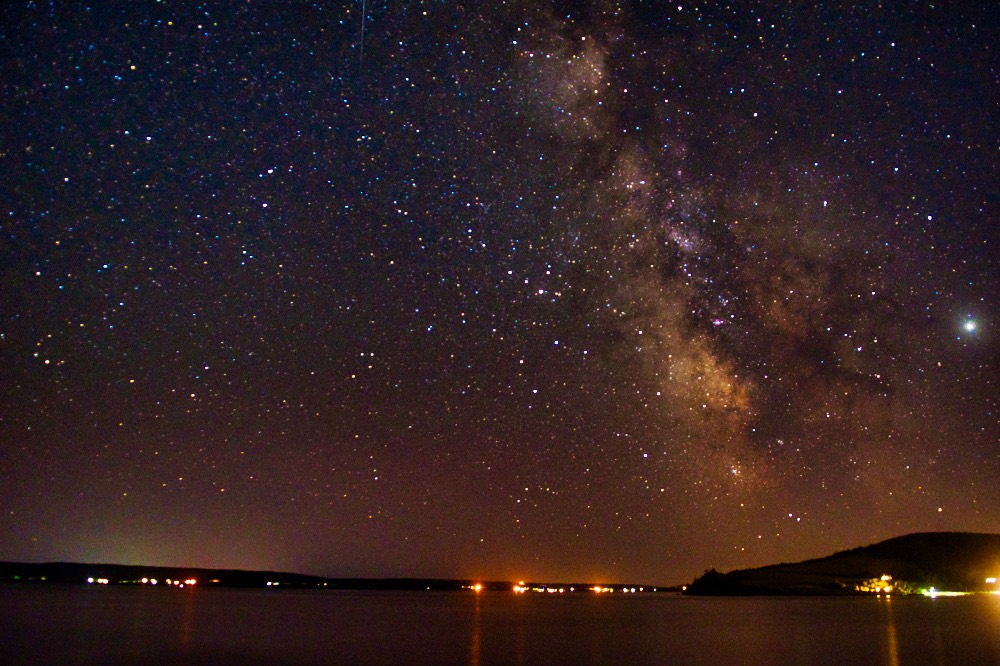
Since the best viewing times for an aurora are around midnight, we had some time to kill. So I warmed up by getting some pictures of the Milky Way high and bright in the southern sky.
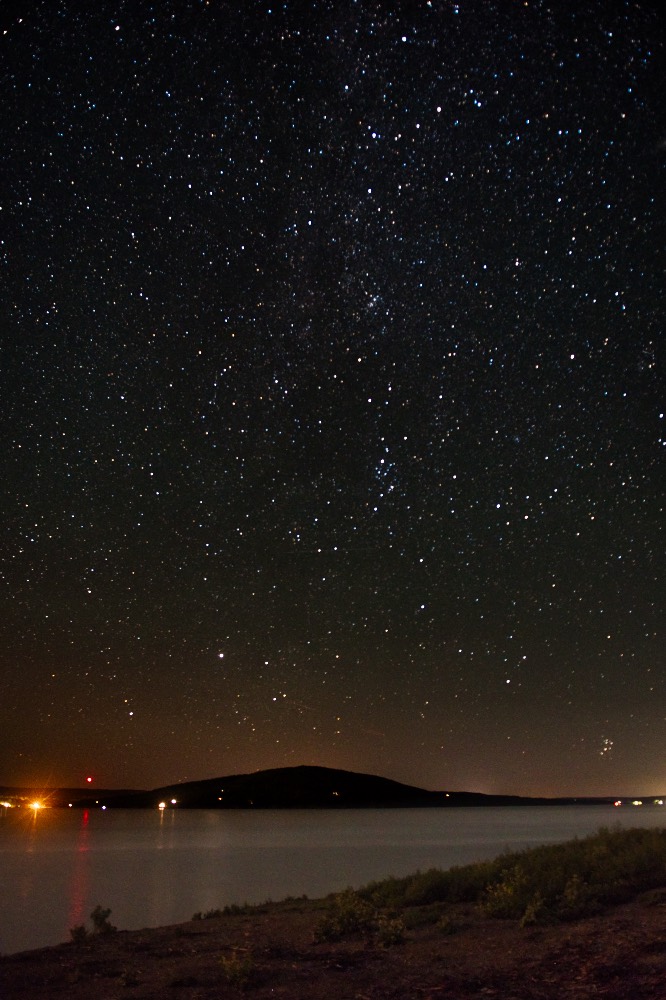
I did a fair amount of research on the technical issues with this kind of photography, but hadn’t every really done it. I was surprised how easy it was, and how beautiful the images came out. I quickly realized that these images are pretty, but they would be the same everywhere, so the key to making them more interesting is adding an interesting foreground.
That’s a little bit better. It gives you a little sense of place with the image. But I am pretty sure I can find something prettier for the foreground.
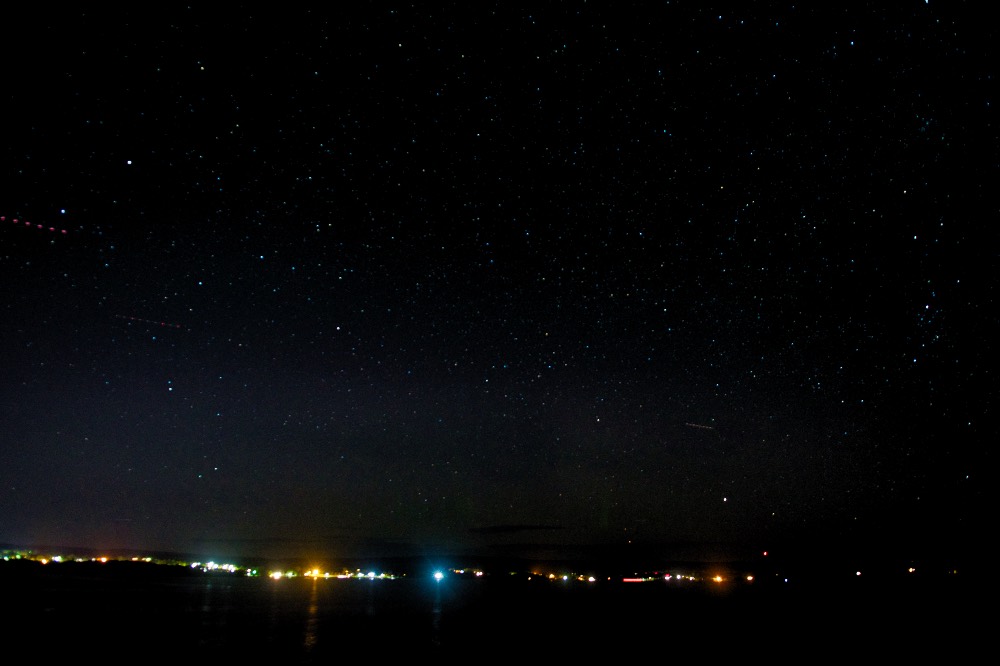
Oh, yes… back to the aurora. It did make an appearance, unfortunately it really wasn’t visible to the naked eye, but the camera did pick up the purple and green lights in the northern sky.
This first image is about what we saw with eyeballs Version 1.0
The Nikon was able to pick out the faint glowing curtains of the aurora.
The bright dotted lines you see are airplanes moving while the shutter is open for the long exposure. I suspect that without the lights of town to the north the display would have been more impressive to the unaided eye.
We are keeping an eye on the movements of Dorian. Both out of concern for people and places we know and love in its path, and to remember that after it finishes leaving a trail of tears behind it in the Bahamas and the Southeastern USA, it heads north as a significantly reduced, but still important storm. We have several options for places to hide if we need to.





 fetchinketch