
I am poking about in the dinghy looking for good fishing water behind some of the small islands here around Great Harbor Cay. Driving carefully in water less than 2 feet deep I scan the bottom ahead looking for signs of feeding fish, when I see something I did not at first understand. All around me is shallow sand covered in turtle grass, barely deep enough to float the dinghy. Ahead of me surrounded by white sand, is a dark patch on the water, and I can’t quite make out what it is. As I approach, I realize I have stumbled upon one of the Bahamas’s famous “Blue Holes”.
Blue Holes are a signature geological feature in the Bahamas Thousands of years ago, during the last ice age, sea level was hundreds of feet lower than it is today. Rain water percolated down through the soft coral rock that makes up these islands, and dissolved some of it away to make large underground caves and caverns. Fast forward several thousands of years, and the ocean level has risen, and some of those caves have collapsed. This results in a deep (sometimes a VERY deep) hole that, in the light colored shallow water of the Bahama Bank, stands out as a sudden, deep blue spot. Some of these are famous among divers and snorkelers, others are uncharted and waiting to be “discovered”. Since the one I found is not on the chart, I can without exaggeration proclaim it to be “uncharted”.
This one is a true classic, almost perfectly round, about 150 feet across, it is clearly visible on a Google Earth satellite picture. So while it might not appear in the charts or guidebooks, it is not exactly hidden.
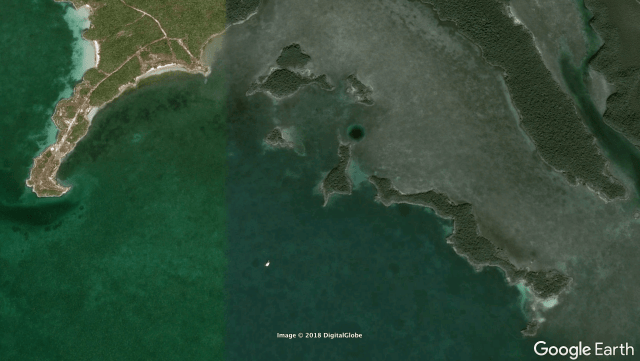
We took our portable sonar over to measure how deep it is, and the answer is: We don’t know; but deeper than 120 feet! To put that in perspective, there is no other water on that satellite image over about 10 feet, and most of it is less than 5.
Snorkeling over the hole, shows, that yes, the bottom is far below what you can see, fading off into endless blueness. And the sides are swarming with fish.
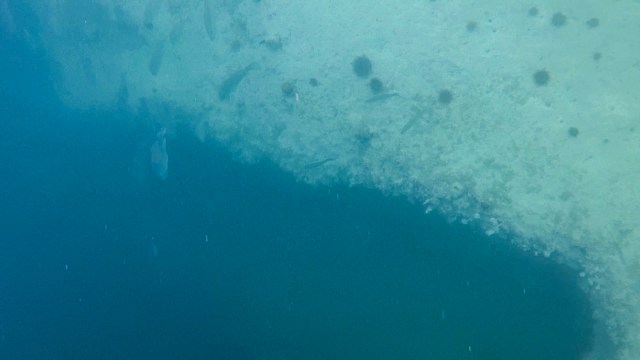 I think i’ll be stopping back there tomorrow with fishing gear and seeing if I can grab a tasty fresh snapper for dinner.


 This stuff is called many things by sailors, usually names not printable. But when in polite company, it is usually called “calcium”. Many sailors assume it is calcium carbonate, the material that seashells are made of. It is not. It is a complex mixture of various things, likely mostly calcium oxalate, a primary component of some kinds of kidney stones. The photo on the right is what we found in the hoses in our aft head. Not a disaster–yet. But the diameter of the hose has been reduced by almost 25%, and every narrowing of the hose makes a truly messy clog more likely.
 One common myth about this stuff is you can prevent its formation and/or dissolve it away with vinegar. Nope. Doesn’t work. This is one of those things that gets repeated so often people start to believe it. It is told to beginning sailors, and becomes part of what they “know” to be true. “Experts” say it all the time. A simple experiment shows that vinegar has almost no effect at all. After the “Before” picture was taken, we emptied the hoses of all water, and filled them with straight, undiluted vinegar, and left them to soak for six hours, then flushed through with seawater. The result was, as you can see, not worth the trouble. The stuff lining the hose was just as hard, and just as intact as it was before.

 I am happy to report, it worked, and not just a little, but perfectly. The picture on the right is the same hose after a 6 hour soak in SewClean followed by a saltwater flush. Pretty impressive.
 A pretty place is Key West. Some parts of town are a bit overrun with tourists and the various ticky-tack businesses that pop up to cater to them, but other places are just plain pretty. There is a pretty steady stream of cruise ships that make port calls here, but they tend to be the smaller ones, and there is only room for one at a time so they don’t quite totally overwhelm town like in some places.
 When the United States acquired Florida from Spain, Key West was pretty much uninhabited. The U.S.Navy developed a base here in the early 19th century that was initially used to “discourage” the original Pirates of the Caribbean. The Navy is still here, although in a greatly reduced capacity. Just a few hours before we arrived, an Amphibious Assault Ship arrived at the Navy dock. We were told she is the largest Navy vessel to make a port call in Key West since World War II.


