Migration Underway

Time 1835 local
Lat: 38º 09.6′ N
Long 76º 16.8′ W
Miles from Annapolis: 49.2
Miles to Port Everglades Inlet: 749.1

We are just passing one of the more interestingly named places in the Chesapeake Bay, “Point No Point”.  We are sailing on a broad reach, at between 5 and 6 knots, not fast for us, but reasonable in the lightish winds.

We got underway this morning with a gentle breeze from the northwest, as forecast.  We sailed almost dead downwind all morning and most of the afternoon with our jib and ballooner sails poled out.  The wind never really blew hard, (4 to 10 knots) but we kept up a boat speed of between 2 and 5 knots.  There was a large flotilla of sailboats headed in the same direction out of Annapolis.  Of the dozen boats, only one other was sailing–everybody else was motoring.

One challenge this afternoon was dealing with the shipping traffic.  Our AIS reported a 770 foot cargo ship coming up behind us, but for some reason no matter how hard I looked I couldn’t pick him out.  There was a little haze and mirage effect, but still… this is a BIG boat!  After searching for a while, and moving further away from the main channel just to be sure, I finally convince myself that there is no such ship.  Rather, one of the sailboats is broadcasting completely incorrect information on his AIS.  Everything is wrong, the boat size, the name, the destination, type of boat, status, everything!  When he finally motors up alongside and I can read his actual name (“Cygnus”) I hail him on the radio and ask him is he is aware of the issue.  “Yeah…  I can’t figure out how to program the thing.  But it’s OK my position is right.”  Sigh.  I am hoping he sails down the bay close to the navy base where I am guessing one of the patrol boats will explain the problem to him in ways I can not.

As the sun sets, our weather is looking good, and the boat is doing well.  The routing program is predicting a 5 to 6 day trip.  As we come around Cape Hatteras, we’ll have our first big routing decision to make:  Do we follow the coast south, staying west of the Gulf Stream?  Or head east and then go south outside the main current flow?  Right now the weather models are split about which will be more efficient.  Hopefully they will give us more consistent guidance as we get closer.


Posted in Underway | Leave a comment

“What is that noise?”

As the weather blew through last night, sometime shortly after midnight Karen asks, “What’s that noise?” As I started to get back up out of bed (which I had just gotten into) I said, “That’s the anchor alarm.”

I have a program on my phone that keeps track of where the boat is relative to where we set the anchor.  If the boat moves more than it should, it makes “that noise.”  I was pretty sure that it was a false alarm.  I hadn’t set the position of the anchor terribly carefully, so I thought the strengthening wind had just stretched the anchor chain a bit further.  That turned out to be wishful thinking.  It has been over a year since we had a real anchor drag, and there was no question we were now drifting quickly toward a shallow mud bank.

It is pitch black, overcast, and windy. There are almost no lights on shore here for reference points.  We get the instruments booted up, and the engine started.  In a few minutes I have the engine is pushing us back upwind away from the shallows, and Karen was getting the anchor back up on so we could reset it further upwind.  Really the only position reference I have to drive to is the chartplotter screen.  Everything around is just black.

Once we get across to the windward side of the bay, I again lower the anchor and let out about 10:1 chain scope.  On the first try, 30 knots of wind quickly push the boat to the end of the chain, and we immediately come to a jerking stop, and head up into the wind.  After a minute of two of nervous watching, it is clear that, at least for now, the anchor has taken a good hold on the bottom.  We get the snubber rigged, and settle in to see what happens.

We keep an anchor watch for several hours, until the wind eases up a bit. The boat sits exactly in the same spot. Eventually, we get back to sleep.

Today was a beautiful, sunny, clear, crisp, early fall day.  The wind has continued from the south, and is still forecast to shift to the northwest late tonight.  First thing in the morning we will be on our way down the Chesapeake Bay.  About 24 hours later, we will be getting down close to the ocean, and we will make our final decision about heading south to Florida based on the weather guess-casts available at that time.

Posted in Underway | 5 Comments

Decisions, decisions…

We are waiting here in a delightfully protected little cove off of Harris Creek in Maryland for the passage of a weather front.  Just north of the town of Avalon, if anybody is keeping track.

In the past few hours the wind has picked up out of the south, and the weather radar is showing heavy rain approaching, all as expected. Once the front passes, the wind will clock to the northwest, and we will be off for points south. All of the weather models predict a reasonably fast run down the coast.  There is just one little issue…

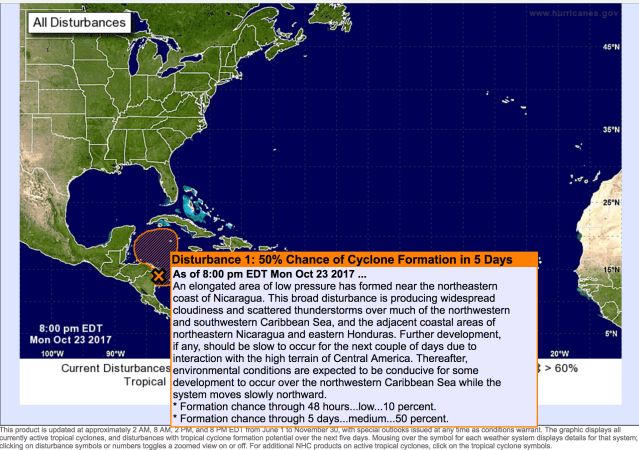
From the National Hurricane Center

Yes, our buddies at the National Hurricane Center just could not leave well enough alone.  After over a week without any activity at all, they posted this annoying update today.  Interestingly, none of the models I see show any development of this system at all, but the guys who know better than I do say it is worth watching. The frustrating part is that it is likely to be a least few days before the status of this system clarifies for the forecasters.

So…  here is our plan.  We will head down the Chesapeake On Wednesday morning with the favorable winds.  If there is still enough risk associated with “Disturbance #1” as we approach the ocean, we will pull into Norfolk, or Hampton Roads, and sit tight until we know more.

Posted in Underway | Leave a comment

Off and sailing…

Time: 2020 local

Lat 38° 44′ 25″N 

Log 76° 19′ 12″W

Well….  today we actually did very little sailing because there was NO wind.  We saw a peak gust of just over 4 knots. So we motored.

We are taking our time because we need to be sure we stay within the limits of navigation our insurance company requires, basically north of Florida until November 1.

We are anchored in a small cove off Harris Creek on Maryland’s Eastern Shore.  Beautiful, protected, secluded and very quiet. This is the first time in our explorations of the Chesapeake Bay we have ventured to the eastern shore because many of the harbors on that side of the bay south of Annapolis are uncomfortably shallow for us.  Looking at the weather forecast, it looks like we’ll be staying here for a few days waiting for the next frontal passage to bring northerly winds we can ride south.

Posted in Underway | Leave a comment

Almost Ready!

While we are here tied to the dock in Annapolis, we have gone from running the air conditioning during the heat of the day, to running the heat in the cool of the evening.  The first hints of colors are starting to show in the trees.  That can only mean one thing:  Time to head south!

One of the projects involved a trip to the masthead, always an exciting time, although we have done this enough now that the set-up is pretty routine.  Our anemometer and wind vane had been giving us trouble, so we were replacing those instruments at the top of the mast.  Oddly, for a boat project, it went perfectly smoothly.  Unscrew, unplug, plug in, tighten, done! Even up at the top of the mast, the care that Harmonie had received from her previous owners shows.  Everything had been properly greased when assembled, which means after years of exposure to the weather, it comes apart just like it was new.

OLYMPUS DIGITAL CAMERA

The view north toward the mouth of Back Creek from the top of Harmonie‘s main mast, 67 feet above the water.  Yes, there are a LOT of sailboats here!

We have enjoyed meeting new friends here, some on sisterships to our Harmonie,  like the Swedish couple Paul and Kerstin on Kerpa and the Australians Dave and Leanne on Perigree.  Having the same boat always gives an excuse for an introduction.

Then one morning Karen tells me before I go up on deck, I have to put on a teeshirt from OCSC, the sailing school where I worked for several years in San Francisco Bay.  Turns out the guy who pulled in to the slip right next to us has his OCSC shirt on. Dave was stopping off on his way south sailing his beautiful, very shiny, almost new Hallberg-Rassy 40, Flight.

img_6666.jpg

OCSC alumni gathering. Dave on the right, me on the left. Dave’s boat, Flight is behind us, and Harmonie is at the right edge of the photo.


Our projects we set out to finish here are almost done.  We have spent the past two days turning Harmonie back into a proper yacht after she spent the past 2 weeks looking like a construction zone. Tools are stowed, water tanks full.  Batteries charged. Looks like we will be underway on Friday morning.

The weather looks as good as it can for a passage to South Florida this time of year which should take about 6 days, if the weather cooperates.  When we get there, we have a few more major projects to complete, then we are off for another year of trouble-free cruising!  (Hey, I can dream, right?)

We are both itching to get underway again.  I am anxious to see how good a job the local North Sails loft did on recutting our sails.  I am hoping the shape will be back to something like what they looked like when new!

Posted in Underway | Leave a comment

10 Things that Belong on Every Boat–Part Three

This is the third and final installment of my “10 Things” list.  You can check out Part One for Books, and Part Two for Maintenance Products.

This category is a bit of a challenge.  I was thinking that it would be easy to select a set of tools that I thought would be valuable to every boat owner.  That is tough to make into a list of a top four.  For example, every boat needs a good set of screwdrivers, but certainly me telling you so wouldn’t add much value!  So I have focused on the odd and unusual.  Things you might have never heard of, or didn’t know existed.  Some expensive, some really cheap, but all are things I have found very valuable and well worth not only the space they occupy on board Harmonie, but also worth the hole they created in the cruising kitty.

Hose Removal Tool

Beyond a doubt, this falls into the category of tools where an initial reaction is “That’s all there is to it??” But seriously, this is worth it. There are hoses all over most of our boats. We push and pull fresh water, salt water, sewage, fuel, oil, and other liquids through hoses. Every one of those hoses attaches to some type of plastic or metal fitting.

At some point in the life of the boat every hose will need to be removed from its fitting for some kind of maintenance or repair project. That can be a real challenge to do without damaging the hose, and/or the fitting it is attached to. This really simple hook helps break the bond that the hose has with its fitting, and gives you the leverage you need to pull the hose off. The next time you need to remove a hose that has been stuck to its fitting for years, you will think this was the best $10 you ever spent.

Balmar Smartguage Battery Monitor 12/24 V This product does one thing very well: One very important thing.  Monitoring the amount of power stored in a cruising sailboat’s batteries is vital to keeping the boat’s electrical system healthy and reliable. There are several different ways of doing it, each has it’s own advantages.

The technology used by this device is unique.  It is very simple to install, and gives consistently accurate results.  This is one of those things that belongs on every cruising boat.  It was developed by a company in the UK and is marketed by Balmar, the company best known to boaters for heavy duty alternators.  The inventing company’s website has a LOT of great detailed information on batteries and battery charging.  Their technical files are well worth a read through.

How does it work?  Well… they are a bit cagey about that.  I THINK they are measuring the battery’s impedance, and using a sophisticated computer model with adjustable parameters to correlate that measurement to state of charge.  I am normally very suspicious of products that say, “Trust us.  It works like magic.”  This one really does work “like magic”.

Triplett Fox & Hound Wire and Cable Tracing Kit with Tone Generator and Probe If there is one thing any modern boat has more of than hoses, it’s wires!  Boat manufacturers, boat technicians, and boat owners are all notoriously bad about labeling wires.  When 10 wires disappear into a conduit in the front of the boat, and reappear half way back, how do you figure out which one is the one you need to work on or replace?  Sometimes, you can pull on the wire, and a helper can tell which is which, but sometimes that just doesn’t work.

This tool can be a lifesaver in tracking down the “mystery wires” that seem to breed on sailboats as they age.  Connect the “tone generator” to the wire, and the Probe picks up the tone that is broadcast from the wire letting you pick the right one out of a tangled bunch, or figure out where it goes when it disappears behind the bulkhead. This makes tackling a lot of wiring projects a lot less of a chore.

Wireless Endoscope, WiFi Borescope Inspection Camera 2.0 Megapixels
Not so long ago, a borescope was an exotic tool with a very exotic price tag. These days very useful cameras for looking into the invisible dark corners of the boat are very affordable. Using a smartphone or tablet as the display screen and computer power keeps the cost of the whole unit really low.

We used ours to figure out what was happening inside the mast while we were running the cable for the new radar unit. Really, really handy. Be sure you get one with a light. Generally speaking the places you are using these are not well lit!

That’s it for the first “10 Best Lists”  from Harmonie.  I am sure we will have more if people find them informative, or just enjoy them.

We are wrapping up the last of the projects that we have been working on here in Annapolis.  Some disappointments…  it doesn’t look like the batteries are going to be delivered in to for installation here.  Not a disaster–the company will ship them free when they arrive to our next port of call. We found a few more repairs that need doing, but nothing disastrous. In a few days, weather permitting as always, we will be casting off lines from Annapolis and heading south.  Next stop, sunny Florida!


Posted in Products We Like, Underway | 2 Comments

10 Things that Belong on Every Boat–Part Two

In my last post, 10 Things–Part One, I covered the books I thought belonged on every cruising sailboat. This time I get to some of the maintenance “goos and gunks” that are needed to keep a boat working well. All of the products I list here are primarily about reducing or eliminating metal corrosion. Picking the first of this list is easy…

Tef-Gel, 2 OZ Tub Anti-seize, Anti-gall Lubricant

Anytime two different metals come in contact with salt water around, there will be corrosion.  The most common scenario on sailboats is when stainless steel screws are used to attached something to an aluminum part.  Either metal by itself is reasonably durable in a salt water environment.  When in direct contact, however, the aluminum rapidly corrodes. This can weaken the structure, destroy paint or other coating, and make the stainless screw impossible to remove.  All these disasters can be prevented by coating the parts with this teflon based product before assembly.  I use this stuff every time I assemble anything on the boat.  It is great stuff.  It works. I have disassembled stainless screws set into an aluminum mast after 14 years–with a hand screw driver. It is expensive on a per-pound basis, but a little 2 oz tub will last a boat owner several years.

There are other good alternatives to this product, Lanacote is the most common. I have used many of them. I think TefGel is worth the small premium in cost.

CORROSION BLOCK GREASE 16OZ Tub

Generally, for fast moving parts, oil is the lubricant of choice. But outside of the engine, most mechanical parts on a boat are slow moving, and are better lubricated with grease. There are dozens of greases, all claiming to be the best at doing what they do. I can not promise that this one is the BEST at everything, but it IS a VERY waterproof grease, that is very stiff and stays where you put it, and as it’s name suggests, if very good at preventing corrosion.

Corrosion-X Corrosion Technologies 16 Oz. Trigger Spray

By now you have surely detected a trend… Corrosion is one of the biggest problems salt water boats have to deal with. Like so many problems, it is far better to prevent it than fix it. This product gets sprayed on on lots of things. Electrical, mechanical, it helps keep water out and prevent the problems it causes. Everything from fishing equipment to electrical connections.

I’ll have one more installment in my “every boat needs” list, focusing on tools that might be a bit unusual, but VERY helpful!

Posted in Boat projects, Products We Like | 2 Comments

10 Things that Belong on Every Boat–Part One

Karen suggested that I put together a list of the ten things I think every boat owner should have close to hand.  It is a bit of a challenge to keep it to only ten, but these are  things that are not in and of themselves necessary to making the boat go.  Lots of things not on the list are important–even vital–but I have to make a cut somewhere.

Sailors need Knowledge.

I’ll start with the books.  There are thousands of sailing books.  Fiction, and non-fiction.  Stories and how-to. Of course every serious sailor will have more books than what I list here, but for a boat owner, and especially the cruising sailor, these are the KEY books.

Humans have been sailing the seas for thousands of years.  In that time we, as a culture, have accumulated a huge body of knowledge. If you try to learn to sail alone, by trial and error you are a fool. The sea does not cut you slack because you are “just a beginner.” Respect the sea and the wisdom of those who have gone before you. Read. Learn.

1.)  Boats break.  If they are well cared for they break a LOT less.

Boatowners Mechanical and Electrical Manual 4th Ed by Nigel Calder.

If you own a boat, or even dream of owning a boat, this is the bible for how it all should work, how to keep it working, and how to fix it if it doesn’t work.  If you read this book from cover to cover–once–you will know as much as many professional boat mechanics.  If you study it carefully and read it over until you understand it all, you will know more than most boat mechanics.

When people ask me how I learned so much about boats, having this book as bedtime reading for many years is a very large part of the answer.

 2.)  This is the closest I’ll have to a “how to sail” book…

Illustrated Sail & Rig Tuning by Ivar Dedekam.

It is a clear, easy to understand guide to what you need to do to with your sails to move your boat as quickly through the water as possible, and keeping the complex system of parts that hold the mast up working together to keep you safe.  This book was originally written in Norwegian, and has been translated into many languages.

Learning what this book has to teach will make you a better sailor, even if you are pretty darn good to start with. It belongs on every sailboat.  Every single one. Yes–yours too!

 3.)  A sailboat is nothing without its rig.

The Complete Rigger’s Apprentice: Tools and Techniques for Modern and Traditional Rigging, 2nd Ed by Brion Toss.

Recently updated with the latest in technical advances in materials and techniques this is a book that presents a complex topic with wit and wisdom.  Mr. Toss is a great writer and teacher, and honestly just seems like a great human being.  If you want to understand, and I mean REALLY understand, what all those ropes and wires do on your boat this book is the best, period.

Did you know that there are knot jokes, and some of them are funny?  You’ll learn a few in this book. It is not a light read, but it is not a light topic either.

Next posting, 10 Things–Part Two, I’ll continue the list with products I consider vital to  keep a boat working and floating, and 10 Things–Part Three will deal with tools that we found especially helpful that you might not have thought of.

Posted in Boat projects, Products We Like, Things to do. | 2 Comments

Projects and Boat Entertainment.

We have been settled here into Annapolis getting maintenance, repair, and upgrade projects checked off the list as fast as we can, and also making time for browsing the Annapolis Sailboat show which is the big event in town this weekend.  This is where most of the “big boats” are shown. It is interesting how few of them would represent an upgrade to the boat we have–at least in our eyes. There are a few accessories that are interesting to see, but overall we have to say that there isn’t much we are lured into. Of all the boats here, there were really only two that I saw as suitable for our interests. (If you have to know, the interesting ones were a Gozzard 44 and a Boreal 52)

_DSC3806

All the newest and shiniest!

One of the more humorous things we saw at the first day of the show was the booth for the local Alfa Romeo car dealer.  Let’s see…  Umbrellas, Check.  Salesman, Check.  Signs, Check.  Booth babe, Check.  Fancy mat to park car on, Check.  Did we forget something?

_DSC3803

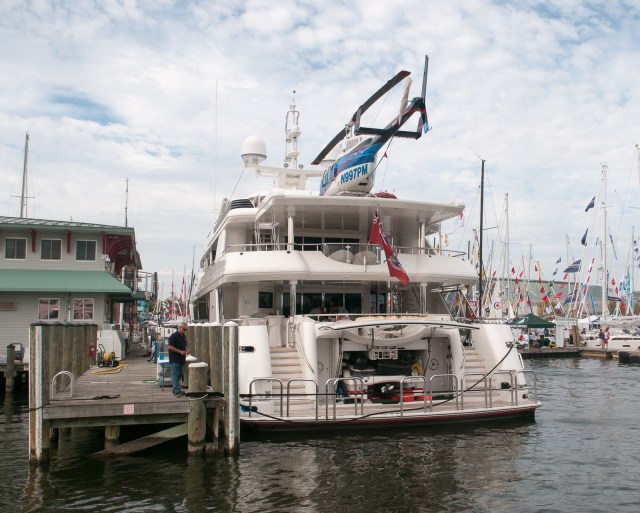
Literally overlooking the boat show was the 160 foot long motoryacht Evviva. It is owned by the founder of the company that makes Bayliner boats.  I guess if you make enough small and cheap boats, you can buy yourself something neither small, nor cheap…

_DSC3813

Today I finished installing our new battery charger/inverter, which significantly upgrades the “behind the scenes” part of our electrical system bringing it into the 21st century.  It was a complex two day project, with quite a bit of new wiring on both the AC and DC sides of the boat, but very satisfying to have everything work exactly as it should when the switches were thrown.

We are still waiting for delivery of our new batteries.  They are practically here, he says.  Hopefully this week!

Cleaning and painting the gearboxes for the mainsail furling system is just about done, so with new seals they can go back together. Lots of other smaller and less interesting things happening too, but all needed to keep Harmonie at her best.

Karen has had fun connecting in Real Life with many of her Facebook friends from the Women Who Sail group.

One of the things that always is interesting is the number of Amel boats that gather in the world’s cruising grounds.  These are obviously boats that do not spend their lives tied to a single marina.  Within 100 yards of us right now there are two other Super Maramus.  One registered in Australia, the other from Sweden.  We have had the chance to meet and socialize with both and, like all sailors, they are delightful people.  Two other Amels homeported in the Chesapeake have been by in the time we have been here.

Our plans for leaving here are still a bit up in the air–other than heading south before winter arrives.  Decisions will be made as needed.

I have slowly been working at implementing an improved way of presenting our travels using Google Earth.  Stay tuned for some awesome coolness, if I ever get it finished!

Posted in Underway | Leave a comment

Hurricanes: Run? Hide?

The destructive power of this season’s hurricanes brings to mind the choices that many sailors have to make when a major storm is forecast to come their way.  Do you run to get away from the destructive power of the storm?  Or do you find the safest place you can, hunker down and hope for the best? There is no simple answer, and there is no answer that is right for every boat, in every situation, in every place.

How fast is your boat?

In our Amel 53 even in no wind at all, if we need to, we can keep up a speed of 7 knots under engine.  With a full tank we can do that for about 500 miles at a rate of almost 170 miles a day.  In three days we can be at least 500 miles away.

Where are you relative to the storm and the shore?

The winds around a hurricane rotate counter clockwise, and here in the northern hemisphere, the storms tend to move to the west, north, or the northeast.  If you are to the south, or the west of the storm the winds are blowing you away from the center of the storm, into calmer waters.  If you are to the northeast of the storm center, you are being sucked straight into the center of the worst of the weather.

Anywhere along the east coast of the USA your options to run are very unattractive. Almost anything you can do puts you at risk of being in the direct path of the storm. Trying to go south puts you between the storm and the shoreline.  A very dangerous place to be if the storm track varies even a little to the west of expected.  Trying to run north has you running against the winds of the approaching weather. Since there is always a chance the storm can turn to the east, running east is also risky.  Best bet?  Find the best place you can to hide from the worst of the weather and hope for the best.

From any of the islands in the Caribbean, running south or southwest is a more viable strategy. The chances of the storm moving to the south are very small, and you are on the side of the storm where the winds are pushing you out of the way.

How important is the boat?

Is the boat your primary home? Or just a seasonal retreat?  Is it insured?  How much financial–and emotional–damage will you suffer if she is lost?  Nobody can second-guess the answers to these questions for any individual situation.  The lowest risk for the boat might be to run away from the storm, but the lowest risk to life of the crew might be to tie her up and stay ashore.

What happened this year?

We know of boats that tried to hide in harbors in Puerto Rico and Saint Martin.  They were all severely damaged or totally destroyed.  The boats we know of that ran away to the south all survived.  That does not mean that any of those owners made the wrong decision for them, or that the outcome would not have been very different in slightly different circumstances.


Posted in Underway | Leave a comment